
This post was originally published on this site.
When my friend — let’s call her Shruti — got engaged a little over a year ago, she insisted she wanted a low-key New York wedding. A simple ceremony at City Hall, a fun dinner out with family and friends, no bells or whistles. “I was like, ‘I hate the wedding-industrial complex. I’m not even going to wear a wedding dress,’” she recalls.
But then, once she got swept up in planning, her vision snowballed. “By the end of it, we had all the trappings. I bought into fucking everything,” she says. They rented a venue, hired a caterer and a DJ, booked a florist, and wound up spending more than twice their original budget of $40,000. She got married in a $4,500 wedding dress, her hair and makeup professionally done.
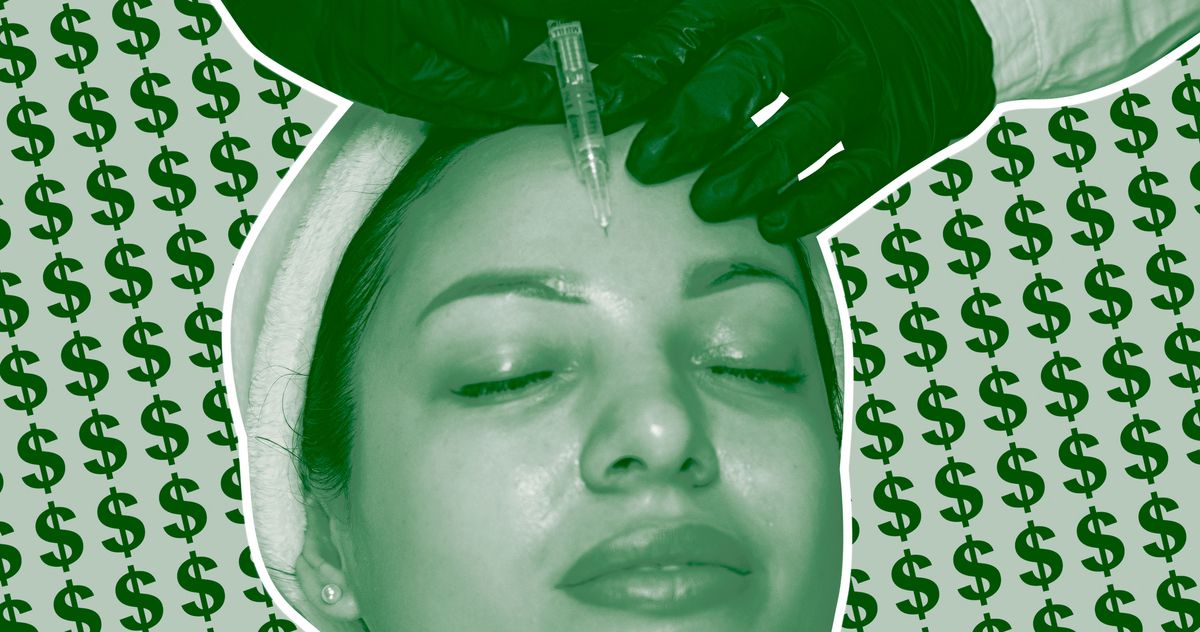
Shruti and her husband split the costs, and their respective parents pitched in too. She kept a shared budgeting spreadsheet and stayed on top of their bills. But soon she noticed that her extra expenses weren’t limited to the wedding day. She was spending more than usual on herself, too — not exactly for the wedding, but on general self-maintenance that was loosely wedding adjacent. She tried Botox (“And not from a cheap place — I wanted someone good”), got her roots touched up more frequently, and started going to Barry’s Boot Camp; she treated herself to organic fruit from the fancy market instead of the corner store that had previously been adequate.
“These are things that you don’t think of as wedding costs, but they sort of are — they’re in service of the whole thing, which includes trying to look as hot as possible on a specific date,” she says. “Everyone knows you need to budget for a caterer, but no one talks about budgeting for Botox or organic blueberries or extra workout classes, probably because it’s embarrassing to talk about.”
Spending a lot of money, time, and effort on looking good at your wedding is not a new or unusual phenomenon — who could forget Emily Weiss’s famous description of her own bridal prep in 2016, which included a 21-day “cleanse,” colonics, and microcurrent treatments all over her body (“butt = higher”) — but the conversation around it has shifted lately, says Sammi Kobrin, a director at Zola, a wedding-planning service and registry platform. “People do not like wedding diet culture,” she says. “It’s sort of taboo to say, ‘Oh, I’m sweating for the wedding,’ or to talk about some of the more extreme measures you’re taking to look a certain way.” But that doesn’t mean that the standards have changed. If anything, they’ve ramped up.
As usual, you can blame social media. “Couples feel more pressure than ever to look and feel their best for their wedding. Almost every couple we’ve surveyed says so,” says Kobrin. “50 percent of couples are using TikTok for inspiration for their wedding, and almost 80 percent are using Pinterest as well. On those platforms, we see the most aspirational view of what people look like, and that’s fueling this pressure that couples are responding to. It’s more covert, but it’s very much there.”
Kobrin has also noticed that brides are more likely to take invasive (and expensive) measures — like microneedling, injectables, and GLP-1s — than they were in the past, probably because these treatments are more widely available. “Among couples getting married in 2026, we’ve found that GLP-1 usage is quite prevalent, significantly more so than in the general population for that age group,” she says. Many said they are taking the drugs exclusively for their wedding, and at least a third said their wedding was a motivating factor. “And in major metropolitan areas, all those numbers go up,” Kobrin adds.
Carla (not her real name), a woman in her late 20s who’s getting married later this year, started on tirzepatide after her grandmother said her arms looked fat in her engagement photos. It isn’t covered by her health insurance, so she pays about $300 a month to get the medication shipped from a compounding pharmacy. Her sudden weight loss made her hair fall out, so now she’s on a hair-thickening program — which includes Minoxidil and supplements — that has cost around $200 so far. Perhaps related to her hair protocol, she’s noticed whiskers developing on her face, which led her to buy a package of laser hair-removal treatments as well as a laser device she can use at home (another $500). So far, she’s been able to cover these costs with her personal savings. “But if I keep going, there’s going to be a point where I eventually run out of money,” she says.
She’s conflicted about this. “In addition to the cost, it’s just such a logistical hassle,” she says. “I’m losing my mind just thinking too much about myself and how I look. It doesn’t feel great, all this vanity. I will be relieved when it’s all over.”
Amy, a bride-to-be in the Denver area, admits her wedding prep has gotten out of hand, too. “I didn’t even want to write it all down, because I didn’t want to come to terms with the reality of how much I’m paying,” she tells me. So far, she’s spent $530 on a fitness app and yearlong gym membership, and she’s signed up for a series of recurring monthly costs: $200 for a Pilates subscription, $200 for a GLP-1, and $100 for facials, all of which she plans to continue until she gets married later this spring. She’s also getting her nails done ($90) and hair highlighted ($300) more often than usual. “I won’t completely stop all these things after the wedding, but I will probably decrease the frequency,” she says.
Why is she doing it? “I’m a pretty anxious person, and all these things are hopefully going to reduce my anxiety around being on display and my expectations of myself,” she says. “If I’m doing everything possible to look and feel my best, then hopefully I will.”
She hasn’t hidden these expenses from her fiancé, but he doesn’t know about the dollar amounts. “It’s difficult to afford all this stuff, and I try not to think about it,” she says. “When I do, I’m like, Oh my God, that’s a lot of money. Is this the right thing to allocate my funds to? I know these are superfluous, privileged expenses that I don’t ‘need,’ and that’s where the guilt comes in. Should I be investing that money instead, or contributing more to our home-renovation fund or whatever? Post-wedding, I probably will.”
No one can say exactly how much the average couple spends on nebulous wedding prep in the name of self-care, especially because they don’t particularly want to keep track either. Another recent bride told me she’d gotten Invisalign (about $4,500) and a series of microneedling treatments on her face and neck before her wedding; she recalled that the microneedling cost about $3,000, but when she looked up the receipt while we were talking, she discovered it was closer to $4,500. “I guess I just blocked it out — selective memory,” she says. She also got Botox on her face and armpits (to prevent sweating on her dress), which she doesn’t plan to do again.
Everyone I spoke to could technically afford to pay for their wedding prep, but they all regretted not planning better. “I wish there was more transparency around some of the auxiliary costs of getting married,” says Shruti. “I knew how much makeup artists and hairstyling would charge for my wedding day — that stuff is in every standard wedding budget. But I didn’t realize all the extras, the gray-area expenses, that add up. And I wish I’d considered those and factored them into the big picture, instead of just feeling bad about it and broke after the fact.”
Of course, you could also just opt out. No one’s forcing you to lose 20 pounds, have poreless skin, or keep your nails immaculate just because you’re engaged. (It’s also possible that very few people will even notice, and even fewer will care.) You do have agency here, even when the opinions of your grandparents, aunts, mother-in-law, and random people on TikTok seem to drown it out.
That said, perhaps the more realistic advice is to anticipate that when you’re getting married, you’ll be more susceptible to outside influence than you think. “The reality is that when we see other people doing all these things and looking fantastic, it makes us want to do those things, too,” says Kobrin. “I’m not saying it’s right or wrong, it’s just the way it is.” Instead of trying to ignore it, plan for it just like you would any other budget item. “Every decision we made about our wedding day was so considered, but when it came to decisions about my personal care, I was just blowing money on whatever my dermatologist suggested,” says Shruti. “If I were to do it over, I would have been more intentional about what I wanted to do and what I didn’t.”
It’s equally important to know when to stop, too. “After my wedding, I had this moment of like, ‘What if I could look like this all the time?’” says Shruti. “It was like a gateway drug.” But then, a combination of laziness and reality set in. She simply did not want to continue going to Barry’s Boot Camp all the time, and she couldn’t stomach another $800 Botox session. “It was fun to live in that fantasy world for a while, but I’m glad it was temporary. That’s not how I want to spend my money and time in the long run.” When I asked if it was worth it, she couldn’t say. “But I did look fucking amazing.”
Email your money conundrums to mytwocents@nymag.com (and read our submission terms here.)
More From This Series
-
‘I Lost $300,000 to My Husband’s Secret Day Trading’
-
Should I Open a Trump Account for My Child?
-
What It’s Like to Be the Mom of a Baby Actor
You Will Probably Spend More on Wedding Prep Than You Think
Your product is saved! You’ll receive emails when your saved products go on sale. Manage preferences.
Comment