
This post was originally published on this site.
The NBA’s latest hot topic is nihilism.
On Dec. 15, most players who signed new contracts this past summer became eligible to be traded — though deals this early in the season aren’t the norm. Around this time of year, one executive calling another usually leads to exploratory conversations. Team X tells Team Y which of its players are available and which of Team Y’s it likes. Team Y does the same. Negotiations never emerge.
Advertisement
The sequence can lead to chatter about what’s going on with the other 28 teams. Before an exchange of players comes an exchange of information.
What are you hearing about the Giannis Antetokounmpo situation? Do you think the Toronto Raptors will get out of the luxury tax? Will the Houston Rockets add a point guard?
Another question seems to have grown more prevalent, too, one that boasts a little more gusto with trade season unofficially underway: Will the Oklahoma City Thunder’s consistent dominance affect the trade market?
The Thunder are mired in their worst slump of the season, an inexcusable one-game losing streak that must feel like a Siberian winter, given what occurred before it: a 16-game winning streak and 24-1 start to a season. Six months removed from becoming the youngest champions in league history, Oklahoma City could challenge for the regular-season wins record. The defense is suffocating opponents at a historic rate relative to the rest of the league. The reigning MVP, Shai Gilgeous-Alexander, is better than ever
So various teams below them have posed the hypothetical: Is it worth it to trade away future pieces just to get better in a time when despair feels inevitable?
How teams answer that question could affect the number of trades, and which types of them go down before the Feb. 5 deadline.
Does a team slightly below the Thunder hold onto draft picks instead of adding an extra rotation piece? Does one in the middle of the pack deem a deal for a star, one who would vault them to contender status in a normal season, not worthwhile because a 24-2 steamroller sitting atop the standings makes this year far from normal, though not unheard of.
The same conversation followed around Kevin Durant’s and Stephen Curry’s Golden State Warriors. In 2016, Durant joined a group that lost in the finals after a magical 73-9 regular season. The Warriors won the title in each of the next two years. Yet, some teams still chose to compete with them.
Advertisement
In 2017, the Houston Rockets, a second-round out the previous spring, traded for Chris Paul. With Paul and James Harden fueling a super-powered offense, they won 65 games and emerged as the grandest Western Conference threat to the Durant-Curry Warriors. Had the Rockets not erred on 27 consecutive 3-pointers in Game 7 of the 2018 conference finals, they could have fended off the same demise the rest of the NBA considered inevitable.
After all, organizations that sit on their hands instead of making moves are susceptible to a self-fulfilling prophecy.
A team could point to the Thunder as evidence of why they should not go all in right now. They could then spew out Told Ya So’s after OKC wins it all. But it’s possible Oklahoma City wouldn’t have had such an easy time if that franchise, and others like it, chose not to wait out the Thunder.
The year after the Rockets went for it with Paul, the Raptors did the same, acquiring Kawhi Leonard on a one-year rental. They ran into luck. Leonard’s buzzer-beater to down the Philadelphia 76ers touched every part of the rim before it fell through the net. Durant got hurt in the finals, as did Klay Thompson. But every champ requires good fortune.
The Raptors put themselves in a position to succeed when much of the league took a less aggressive approach. The best way to fight power is with power.
It’s possible this year’s trade deadline isn’t busy, no matter how teams choose to respond to the Thunder’s success.
The current collective bargaining agreement has made it more difficult than ever to pull off in-season trades. Because of the new rules, more teams are either hard-capped or worried about getting hard-capped than ever. Many franchises aren’t allowed to take in more money than they send out in trades, which complicates matters and often requires a third team to enter deals.
Advertisement
An unusual number of organizations are in the luxury tax, too.
All of these factors muck up the process of adding players.
The standings being so close right now has made potential trade negotiations messier, as well. For example, heading into Wednesday night, the East’s No. 3 and No. 9 seeds were separated by one loss. The group includes the Raptors, Boston Celtics, Orlando Magic, 76ers, Cleveland Cavaliers, Atlanta Hawks and Miami Heat. Would any of those teams trade with another, knowing the move could help a rival pass them in the standings? And if the answer is no, then that untangles a quarter of the league.
The tier above those squads is where all the most fascinating answers to Thunder nihilism exist.
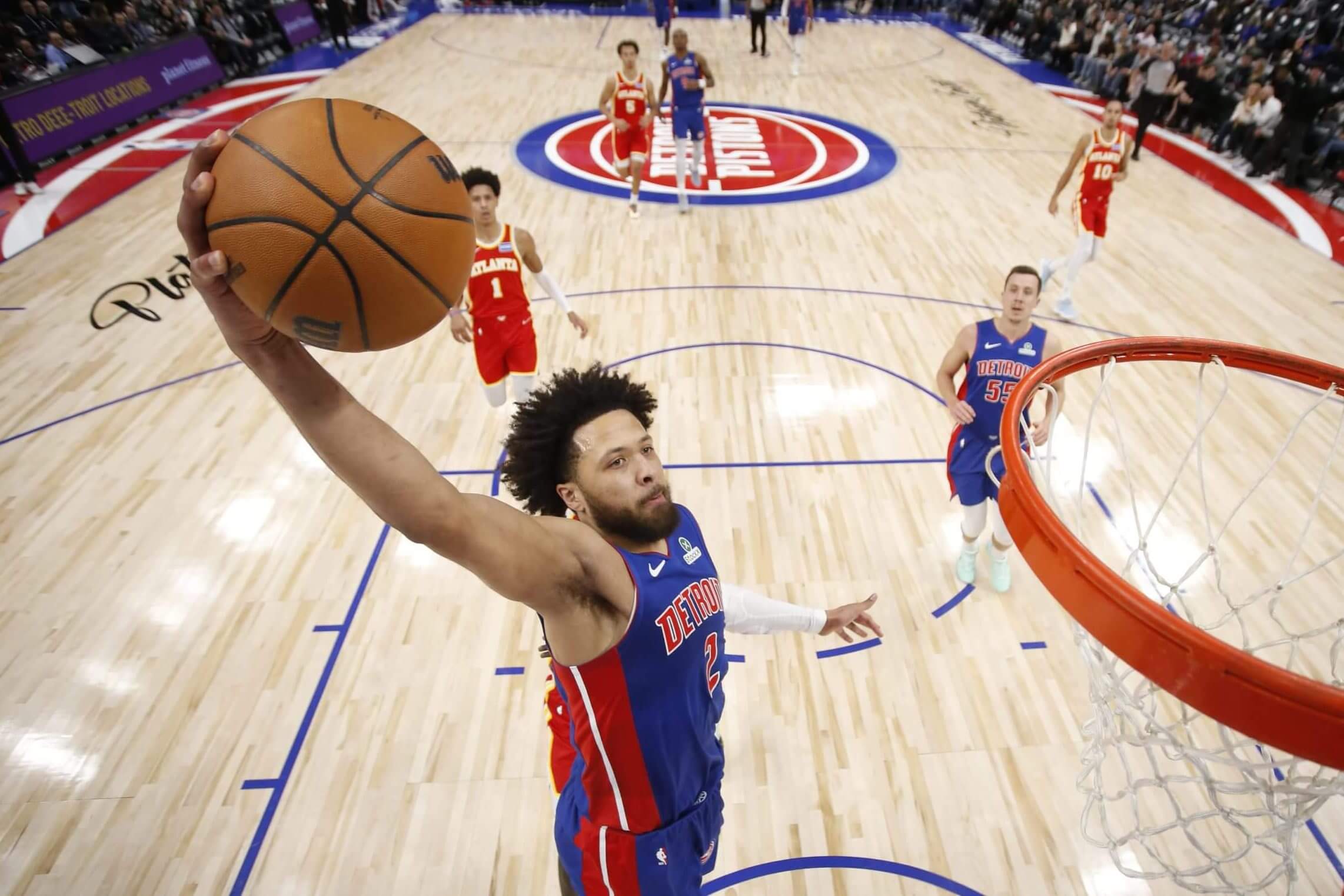
Do the Detroit Pistons, who lead the Eastern Conference, make a trade to complement star Cade Cunningham. (Brian Sevald / NBAE via Getty Images)
Should the 21-5 Detroit Pistons, a young group with a clear identity and an up-and-coming superstar, send out a bunch of picks for someone like Lauri Markkanen? Or should they see what they have in-house first?
Should the New York Knicks shove the few chips they have remaining, a first-round pick swap and a surplus of second-rounders, into the middle of the table?
The answer might be easier for teams in the East, who just need to get to the finals and hope for the best, than it is inside the Thunder’s conference.
Do the 18-7 Los Angeles Lakers have the urge to improve right now, when Luka Dončić, LeBron James and Austin Reaves are all still together, instead of waiting? They have a first-rounder to trade. Do the 16-7 Rockets part with their trove of picks to acquire a point guard? Do the 18-7 San Antonio Spurs fancy themselves as more than just a plucky upstart and bring in a big name to propel them forward immediately?
Of course, teams could convince themselves that now is the ideal moment in Oklahoma City’s timeline to go all in.
The Thunder are 24-2 but are still young. Gilgeous-Alexander keeps getting better. Their second- and third-best players, Jalen Williams and Chet Holmgren, are not yet in their primes. They own the L.A. Clippers’ first-round selection in 2026 — and the Clippers are combusting. The Thunder could have as great a chance as anyone to earn the No. 1 pick in 2026. They could end up with the Utah Jazz’s first-rounder and should get the 76ers’.
Advertisement
The Curry-Durant Warriors were fragile. Durant signed one-year contracts during each of his three seasons there. Murmurs of him potentially heading elsewhere lingered around the team during that time. Beyond that season’s playoffs, the rest of the league could spot slivers of daylight.
Maybe down the line with Oklahoma City, there will be even less light. Maybe one or more of these teams decides the greatest way to fight power is with power.