
This post was originally published on this site.
ATLANTA — So … that’s it?
After seven-and-a-half seasons, four All-Star games, a 2021 Eastern Conference finals run and an All-NBA selection, arguably the most electric offensive player in Atlanta Hawks franchise history was converted into an expiring contract and a reserve wing.
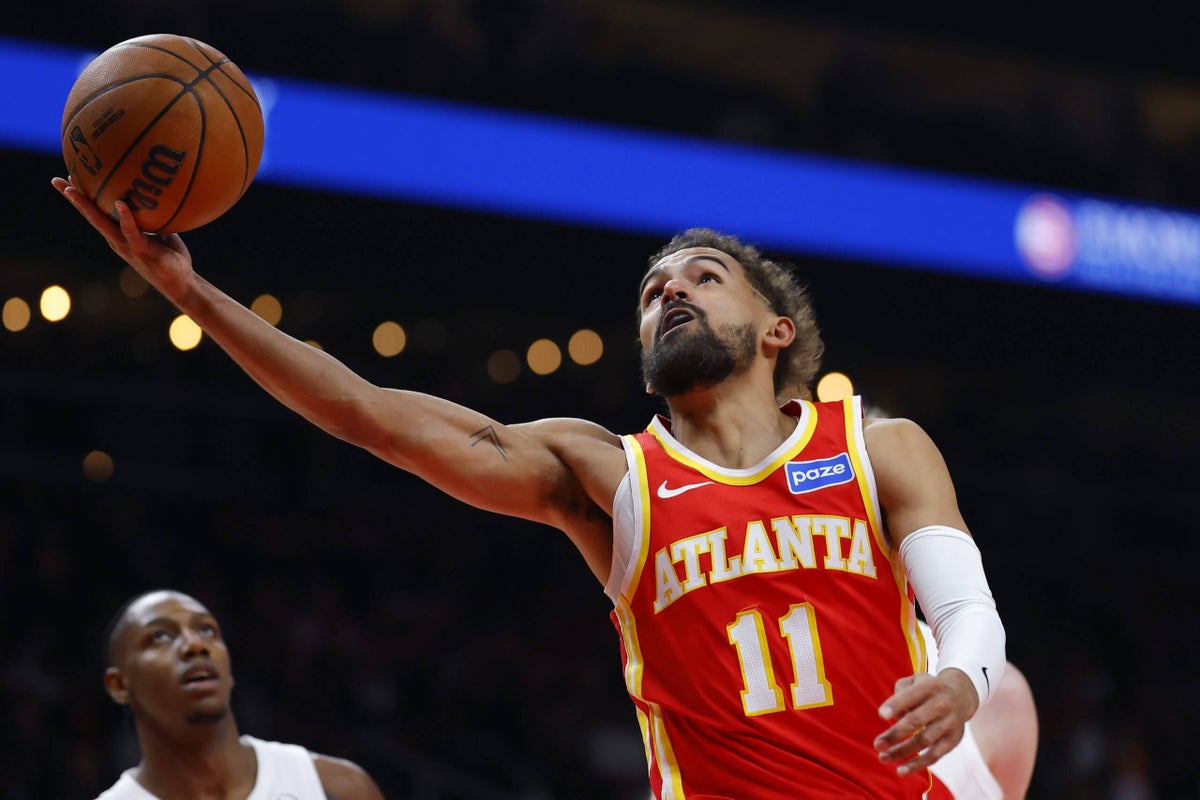
The Trae Young era in Atlanta ended with a whimper rather than a bang on Wednesday night, with news of his trade to the Washington Wizards breaking while he was still on the bench at State Farm Arena watching the rest of the Hawks complete their rout of a pitiful, shorthanded New Orleans Pelicans squad.
Advertisement
Young, who was out for a sixth straight game with a bruised quad (one that likely will heal rapidly once he gets to Washington, but could always flare up at any point if the Wizards threaten to lose their top-8 protected first-round pick to the New York Knicks), left the bench area for a minute when news of the trade broke and then returned to the same seat. Players started hearing what happened from fans behind the bench, and some “Thank you, Trae” chants broke out in the crowd.
It created a surreal moment for players and fans alike.
“People show their phones from the crowd, you know, their Twitters and stuff like that,” Hawks guard Dyson Daniels said, “so I didn’t really know how to feel. It was the last quarter when I got told. And you see all the news headlines and stuff on your phone, and you don’t even know what’s true, what’s not.”
After the game, Young spoke to the team in the locker room and then said his goodbyes, which players said was an emotional scene for the face of the franchise — virtually every fan in a Hawks jersey at State Farm Arena sports Young’s No. 11.
The trade sent Young and his $49 million player option for next season to the Wizards for guard CJ McCollum and forward Corey Kispert; no draft picks were exchanged. The 34-year-old McCollum is on an expiring deal worth $30.7 million and, while needed for backcourt depth in the short term, likely isn’t in Atlanta’s plans beyond this season. Kispert is a good shooter who has otherwise underperformed his current four-year, $54 million rookie extension; it still has three years left to run after this season, although the final one in 2028-29 is a team option.
Some other minutiae: Atlanta will generate a $1.4 million trade exception, and Young’s trade bonus (which applies to this year only) will boost his 2025-26 salary by nearly $400,000 to his maximum of $46.4 million. His $49 million player option for 2026-27 remains unchanged, and he can sign an extension for up to two years beyond that once he’s dealt.
Advertisement
So in other words … it was a salary dump.
Which is a poor end-game with a max-contract player. But this one had been a long time coming, and the era had clearly run its course in both directions. The Hawks had made the play-in tournament four straight times since the magical run to the 2021 East finals and are tracking to take the streak to five.
Alas, no market for Young involved major assets coming back to Atlanta, even dating back to the Hawks’ efforts to break up the zero-synergy pairing of Young and Dejounte Murray. Young is one of the league’s most dynamic offensive players, but interest in him from other teams has always been tepid.
To understand why, let’s start with a moment that precedes Young playing for the Hawks, because in the lead-up to the 2018 NBA Draft, several teams took note of it.
There’s a video of the NCAA Tournament selection show from that year, when Young’s Oklahoma team was on the bubble and on camera as the field was announced. When the bracket showed the Sooners had made the field, all the Oklahoma players rose and celebrated with each other … except Young. I mean, he was happy too, but it stood out that the rest of the team was celebrating around him rather than with him.
Leading into that draft, the background from scouts was that Young wasn’t a bad guy, but that he was, in scout parlance, a “tennis player” — an individual playing a team sport. You’ll rarely encounter a great passer who had as many accusations of selfish play leveled at him, as the rap on Young was that he’d seek out the assist but not the hockey pass or hit-ahead that created advantages for everyone else, that he wouldn’t give a full effort on defense (or even, like get in a stance), and that he’d only cut away from the ball if it involved receiving an inbounds pass.
Advertisement
Even as Young put together a brilliant rookie season and took the Hawks to the conference finals in his third year as a pro, confidently trolling Madison Square Garden’s crowd as a 22-year-old, 164-pound guard while also skewering the Knicks’ defense, he never quite beat those charges. The scuttlebutt was that even the players who were eating off his passes didn’t like him or enjoy playing with him.
But what’s funny is that, as he got older, he got better at some of the things that had been more glaring failings in his first four seasons. He tried more regularly on defense, made hit-ahead passes more frequently to get other players advantages, recruited players in free agency (notably and ironically including his replacement, Nickeil Alexander-Walker) and would spend post-game media sessions pumping teammates for awards.
“He was always inviting guys to dinner,” Alexander-Walker said. “I wish I would have got that opportunity to play with him; he’s the main reason why I’m here. That’s the part he was active in: me and him talking and getting me to [sign with] Atlanta and making it work for me.
Instead, other factors conspired to limit Young’s value, particularly his issues on defense. Even if he had played with messianic fervor on that end, his limitations at 6-foot-2 with fairly average athletic chops were readily apparent. Forget about on-ball defense; when he was the low man on the weak side, he had absolutely no chance of breaking up a play, and when “fighting through screens” against bigs he was Michael Spinks vs. Mike Tyson.
All of that was perhaps easier to live with before he visibly lost a step over the last two seasons, rendering his isolations a little less explosive and his forays to the rim a little bit less frequent.
Young at his best was an offense unto himself; just set a ball screen and let him cook, especially if he had a rim runner to work with. However, his lessened burst the last two years has made it easier for opponents to switch his screen-and-rolls and take away the lobs; he’s also had a much harder time getting into the full-speed floaters that made him dangerous without getting all the way to the rim, and he’s become much more dependent on long 3s for offense. His defenders were also less vulnerable to the devastating right-to-left move Young would use to reject screens, a move open to him because opponents were terrified of letting him get downhill on his right hand.
Still, this version of Young remains a massively better offensive engine than anyone on Washington’s 27th-ranked offense, and it’s reasonable to think the 27-year-old Young still has some runway. My understanding of the Wizards’ rebuilding road map is that they plan to be more respectably competent next year, and having a real starting point guard would go a long way toward accomplishing that. They also have a legit rim protector and rim runner to pair with Young in second-year pro Alex Sarr; fellow French-speaker Clint Capela thrived next to Young in the same role in Atlanta, and one can argue Capela’s age-related decline made life significantly harder for Young the last few years.
Advertisement
Contractually, the Wizards can take the plunge here because Young’s $49 million doesn’t hurt them. They were facing a “Brewster’s Millions” situation just to get the salary floor this coming offseason and still project to have near-max cap room, especially after low-key throwing a $14 million obligation to Kispert out the window.
But let’s get back to Atlanta. The other key explanation for the trade is that the Hawks’ situation fundamentally shifted in the past 12 months. Young didn’t change, but the team around him did. Once the franchise decided not to extend his contract after last season, the trade winds were blowing, but Atlanta’s play in Young’s absence this year made it much easier to move on.
For the first time in the Young era, the Hawks have mustered a competent offense with him off the court, thanks to Jalen Johnson’s emergence as a do-it-all, All-Star forward. Alexander-Walker has had a breakout year since coming from the Minnesota Timberwolves, taking advantage of Young’s injuries (he’s only played 10 games this season) to more than double his scoring average to 20.5 points per game.
The Hawks also fleeced New Orleans in a draft-day trade that likely will result in a high lottery pick (they will have the better of New Orleans’ or Milwaukee’s pick). They have an emerging stopper in the 22-year-old Daniels and other productive 20-somethings like center Onyeka Okongwu, 2024 top pick Zaccharie Risacher, mad bomber Vit Krejčí and developmental success story Mo Gueye (who was awesome in Wednesday’s win, including dispossessing Zion Williamson three times).
All of that made it much more palatable to remove Young’s $49 million salary from the equation a year from now, when the Hawks are looking at roughly $30 million in cap room depending on where the draft pick falls; alternatively, the Hawks can re-sign Kristaps Porziņģis and operate as an over-cap team with oodles of flexibility.
I should point out one key piece of flexibility Atlanta lost in this trade, however: It severely constrains the Hawks’ options for any in-season pursuit of Anthony Davis. The Dallas Mavericks big man makes $54 million, and the players Atlanta acquired from Washington cannot be re-aggregated in any future trade this season. That means that stacking the salaries of McCollum and Kispert won’t work as a salary match. Instead, any potential Davis deal would pretty much have to send Porziņģis, Risacher and the expiring deal of Luke Kennard to the Mavs to meet league requirements.
In the meantime, the rest of the Hawks will continue much as they have all season, embarking on a four-game Western trip without Young while standing in 10th place in the East. The Hawks owe a pick swap to the San Antonio Spurs and have no tanking incentive, and McCollum and Kispert should help juice the bench scoring (McCollum’s defense … alas). Maybe they can make a run and get into the East playoff field.
But the Young trade was never about this season, or about avoiding a fifth-straight trip to the Play-In. It’s about Johnson’s emerging stardom, the young core around him, and the pick from the Pelicans trade, all combining to make the unthinkable — a Trae Young salary dump! — suddenly seem like a worthwhile transaction to jump-start an increasingly bright-looking future.