
This post was originally published on this site.
The initial reaction felt fairly universal across the hockey world.
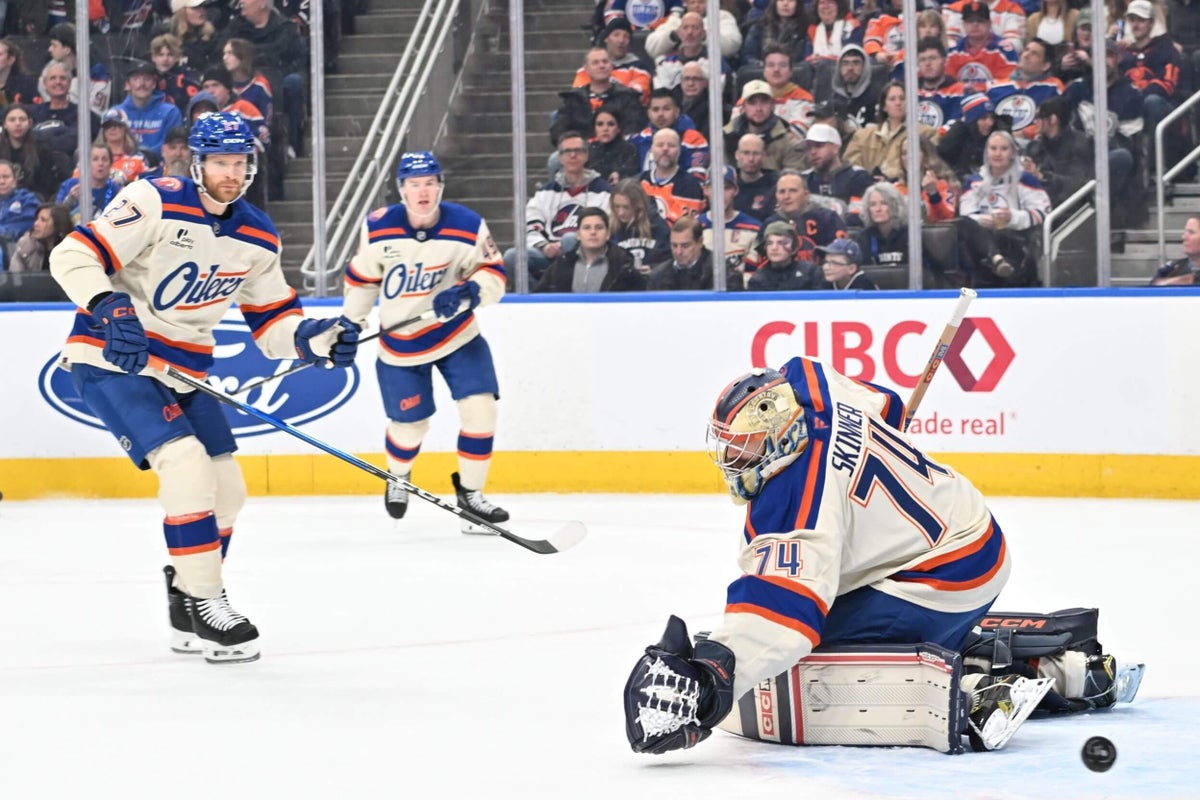
The Edmonton Oilers finally did it. They finally went and got a goalie, moving away from Stuart Skinner, their beleaguered starter the past four seasons — including two ultimately failed runs to the Stanley Cup Final the past two seasons during which he was pulled.
Advertisement
So, problem solved, then?
After their latest 5-2-2 stretch, the Oilers are back in a playoff spot, sitting in the Western Conference’s first wild-card spot with a 14-11-6 record that projects to an underwhelming 90-point season. They’re currently on pace for their worst season since 2018-19, and there’s no question that a big part of their early-season funk is the fact that they’ve allowed 3.39 goals against a game, fourth-worst in the conference.
While Skinner and backup Calvin Pickard have received a large share of the blame for the Oilers’ failures in recent years — and especially early on this season — if you take even a surface-level look at what’s been happening in Edmonton, it’s clear this team’s problems run deeper.
Yes, Skinner has an .891 save percentage, the lowest of his career, but he was also facing the most difficult workload of his career this season. His track record is such — that of a streaky, below-average starter — that it was obvious he wasn’t going to be able to handle that and not wilt.
While the Oilers only concede the seventh-most shots in the NHL, those they give up tend to be of higher quality than those of other teams. They currently sit 17th in expected goals against and 20th in high-danger chances against, hardly the numbers of a contender.
Of the 55 NHL goaltenders who have appeared in at least 10 games this season, meanwhile, Skinner ranks 30th in goals saved above expected, putting him right about average among regular starters and alongside the likes of Jake Allen and Karel Vejmelka.
The bigger problem in the Oilers crease has been Pickard, who sits down in 46th in that same stat after allowing a whopping 37 goals in 10 appearances. If the plan is to continue to play him 25 percent of the time, goaltending will clearly remain an issue in those starts.
Advertisement
Combined, the Oilers’ two goalies have allowed 3.34 goals per 60 minutes played against 3.18 expected goals against, meaning they have been allowing slightly more than one would expect based on the chances they’ve faced. But the bulk of that negative mark has been due to the backup, not the No. 1 they dealt away.
What’s harder to read now is what the Oilers are getting in Tristan Jarry, the primary piece in the trade general manager Stan Bowman made with the Pittsburgh Penguins on Friday morning. Yes, the 30-year-old has been better than Skinner this season, but that’s based on a sample size of a whopping 13 starts. And statistically, Jarry hasn’t managed to outperform Skinner in any of the last three seasons, including last season’s disastrous turn when Jarry went through waivers unclaimed and spent 12 games in the minors.
If there’s an upgrade there, it doesn’t appear to be pronounced.
Factor in Jarry’s $5.375 million cap hit — $2.775 million more than Skinner — and an additional two years of term, and this feels like a losing bet. Especially given the Oilers also concede a depth defenseman in Brett Kulak and a second-round pick in the deal.
Given their slow start, it makes sense the Oilers wanted to shuffle the deck, especially given how their goaltenders have struggled in multiple recent postseasons. And they were somewhat stuck, given how few goalies are available in season.
But that scarcity further underlines the fact that they needed to try and upgrade their tandem at some point over the past year, not 31 games into the season.
Other teams currently in playoff position have brought in goaltending depth in the past 12 months that has outperformed Pickard and done it for a far lower acquisition cost, such as Scott Wedgewood with the Colorado Avalanche (trade), Brandon Bussi with the Carolina Hurricanes (waivers) and Dan Vladar with the Philadelphia Flyers (free agency).
Advertisement
Those feel like they would have been far higher leverage moves than making such a big commitment to Jarry, who no one wanted 11 months ago.
Even if Jarry ends up being a small upgrade over Skinner, the Oilers still have bigger problems to address. Their forward depth has been further hollowed out this season, with bets on Trent Frederic, Matt Savoie, David Tomasek and Isaac Howard, among others, not paying off.
On the blue line, 35-year-old Mattias Ekholm has struggled mightily coming off an adductor tear last season, posting one of the worst defensive ratings in the league. And it’s also been a tough start for Jake Walman, who signed a seven-year, $49 million deal in October.
Overall, the Oilers look like an aging, top-heavy team that has played a ton of hockey the past two seasons. And that’s not really on the goalies.
The good news is Edmonton’s play has improved over this recent nine-game stretch now that Zach Hyman and Ryan Nugent-Hopkins are healthy, giving Connor McDavid and Leon Draisaitl better linemates than they’ve had much of the season. The Oilers have still been conceding some of the higher-quality chances in the NHL over the past few weeks, but they’ve simply become better at outscoring those issues, as they’ve piled up four goals a game and converted on 35 percent of their power plays.
If their stars can keep that heavy lift up, it may not matter if Jarry is only a middle-of-the-road starter, especially in the regular season. After all, the Oilers have the eighth-best regular-season record in the NHL over the past three seasons, and they did all that without a true No. 1.
It’s hard to see how Jarry will be a significant upgrade overall, however, given his struggles in Pittsburgh, his lack of playoff experience, his age and his contract. If he’s not, Edmonton just sacrificed nearly $3 million of its very limited cap flexibility without truly improving what ails the team.
And the stakes have never been higher, given McDavid’s commitment to the team was only a modest two-year extension in the offseason.