
This post was originally published on this site.
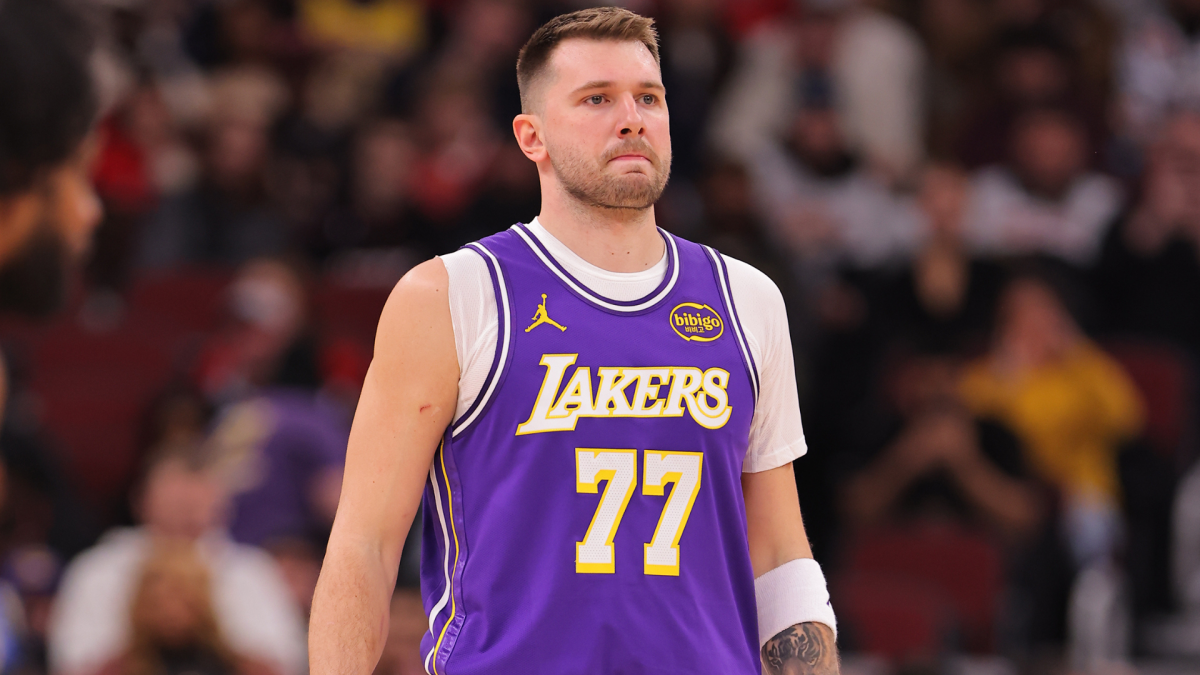
How good are the Los Angeles Lakers? They’ve played 46 games, and I’m not sure there’s a clear answer. They’re 10 games above .500. That’s good. They’ve also allowed 29 more points than they’ve scored on the season. That’s bad. Their three best players, Luka Dončić, Austin Reaves and LeBron James, have played just 140 minutes together. That suggests that, when the Lakers are back to full strength, there is room to grow. In those 140 minutes, the Lakers have been outscored by 24 points. That suggests that even at full strength, these Lakers have fatal flaws that will box them out of genuine championship contention.
We’re now one year into the Dončić era, and the Lakers have yet to find a suitable starting center. As Mark Williams thrives in Phoenix, Deandre Ayton and Jaxson Hayes anchor a defense that allows opponents to shoot 72.1% in the restricted area. Only the Kings are worse. The perimeter banshees who kept the defense alive on the perimeter last year? They’re all gone. Marcus Smart is the only consistent positive defender on the team. They currently have the highest 2-point field-goal percentage in NBA history while leading the league in free-throw rate by a mile. They still rank only eighth in offense because they never take or make 3s, rarely rebound and turn the ball over too much.
Would having Dončić, Reaves and James on the court together more address some of the problems? Sure. You’d hope they’d at least be able to generate more 3s. Maybe with a lighter workload on offense, James could be better defensively. But these are questions with pretty uncertain answers. The Lakers may not know who they really are for months.
This is a problem on a number of levels. The trade deadline is in less than a week. The Lakers, under Rob Pelinka, have tended to use the first few months of the season to evaluate whether or not the team is good enough to justify further investment through trades. In some years, like 2022 and 2024, the Lakers have stood pat. In 2023 James and Anthony Davis did enough to prove to management that they could win if Russell Westbrook was only dumped. They wound up reaching the Western Conference finals. That duo was good enough to compel Pelinka to trade for Dorian Finney-Smith last winter. Then, obviously, the Dončić trade followed.
This isn’t to say the Lakers haven’t gleamed any significant information based on the season they’ve had thus far. They can feel reasonably confident in Reaves as a long-term secondary offensive option for Dončić, for instance. He was going to make an All-Star team before he got hurt. They should also know with relative certainty that Ayton isn’t their long-term center. Shocker, the guy Portland paid to go away wasn’t a keeper, at least not as a starter. But hey, he was a No. 1 pick who once earned the max contract he didn’t live up to. It was worth the talent swing. He shares an agent with Dončić, so it might’ve been politically necessary as well.
But this year’s team? It’s a mystery box. Their record tells one story. Their underlying numbers, and, well, our eyes, tell another. They’re as thin and helpless against elite athleticism as they were last spring, when the Timberwolves smacked them around for five games en route to an embarrassingly early exit. The top of the West seems a bit more mortal now than it did a month or two ago. Houston isn’t the same without Steven Adams. Denver and Oklahoma City have been banged up, and the Thunder are no longer on a record-breaking pace. If you squint hard enough, maybe you can talk yourself into a few minor tweaks beefing up the supporting cast just enough for all of the shot-creation this team has assembled to carry it through a real playoff run.
But it’s going to be a tiny needle to thread here. It’s no secret that the Lakers can create substantial cap space this offseason. Their tradable first-round draft capital jumps from one pick to three. More than that, this is an organization that has been devoid of continuity for a decade. They can’t keep overhauling their roster every 12-18 months. They have Dončić and Reaves in their 20s now. These are building blocks, players you hope are in purple and gold for the next decade. At a certain point, you need to set roots, to build a team that can stay with them and grow with them for the rest of their primes. You can’t do that if you’re punting assets and cap space on short-term impulse buys.
There isn’t a player available at the 2026 trade deadline that checks all of these boxes. Herb Jones would be a perfect fit for the current roster, is young enough to grow with the current core and cheap enough not to impede the team’s long-term financial plans. But there’s no indication the Pelicans want to trade their defensive cornerstone, and if they did, it probably wouldn’t be for the meager collection of assets the Lakers can put together. The Lakers have been after Walker Kessler for years. He can’t right now, as he’ll miss the season due to injury, but he’s the rim-protector they’ve been lusting after since the moment they landed Dončić. Utah is famously difficult to negotiate with. The Jazz aren’t giving him up for a first-rounder and a couple of swaps.
That’s the danger here. The Lakers have such gaping holes that they need multiple essential pieces, yet they might not have the assets to get even one. So most of the players they’re getting linked to at the deadline are compromises, and not good ones.
Take De’Andre Hunter. The Cavaliers are seemingly trying to dump him to shave money off of their gargantuan luxury tax bill. He’s the player they’d specifically want to dump because, well, he’s playing badly. His hot shooting from last season has cooled off considerably. He’s always been an underwhelming defender despite his impressive physical tools.
Cleveland has a real chance at winning the weak Eastern Conference. The fact that they seem eager to move him should probably be a red flag. Of course, the Lakers are starting a center the Blazers are paying not to play for them, so that’s never stopped them before. Hunter checks many of the same boxes as Ayton. They’re high draft picks who have had success against the Lakers, specifically. He’s a lottery ticket, the outline of an archetype the Lakers want that they’re hoping they can turn into the actual player they need. They’ve mostly missed with such equations lately.
Bringing in Hunter, at a bare minimum, would cost the Lakers $22 million in cap space this offseason. At that rate, the $50 million or so in space the Lakers can generate gets trimmed enough that it may no longer be practical to operate with cap space. In other words, they’d presumably stay over the cap, try to sign everyone to one-year deals and try to rebuild again in 2027. Is De’Andre Hunter of all people really worth that? I’d say no. He’s a lateral move from Rui Hachimura at worst, a playable reserve that would be swapped in for non-playable reserves (Gabe Vincent, Maxi Kleber) at best. You’re not changing this season with Hunter. You’re hurting you’re long-term prospects.
Another idea that’s been floated: trading their unprotected 2031 first-round pick for multiple, lesser, protected picks. This way, the Lakers could split up their lone pick this year into multiple moves and potentially feel less pressure to get one, single impact addition. Phoenix did this at least year’s deadline, turning a single unprotected pick into three bad ones from the Jazz. Of course, the caveat there would be that Phoenix, old, capped out and pick-less, was viewed as having such a bleak future that gaining control of an unprotected Suns pick deep into the future was treated as a prize. That’s less likely for a Lakers team that has Dončić and history of falling backwards into more Hall of Famers.
Besides, splitting the baby makes it harder to take the sort of impact swings they’re going to need later. One pick right now might not be able to get Jones. Maybe two unprotected picks deep into the future could over the summer. Or maybe they could use two picks on a center and another on a wing, targeting players better than Hunter or the current crop of available centers. The offseason class of wing free agents is actually pretty promising. Keon Ellis. Quentin Grimes. Ayo Dosunmu. Peyton Watson. All players who would serve the Lakers better than what is seemingly out there at the deadline. Sure, Ellis might be gettable now, but would you give up a first-round pick just to get him five months early? The center market isn’t quite as appealing, but there are options. The Knicks won’t trade Mitchell Robinson, but he could be stolen in free agency. Maybe the Lakers could use restricted free agency to find a way to leverage the Jazz into finally giving them Kessler.
These are the things the Lakers need to consider, and it’s why the question marks surrounding this year’s team are so impactful. If they’d had their whole team healthy for most of this season, they’d know whether or not a Hunter acquisition or dividing up their lone pick would give them a meaningful chance at winning a championship. Right now, they can at least feign ignorance. And that’s potentially scary in its own right.
Remember, the Lakers have new ownership. While Jeanie Buss is still technically the governor of the team, Mark Walter is now the majority owner. When he bought the Dodgers in 2012, he cleaned house, brought in his own front office and built a baseball dynasty. Rob Pelinka may have gotten an extension last offseason, but Walter has already fired the entire scouting staff. That included some Buss family drama, of course, as younger Buss brothers Joey and Jesse were essential components of that department, but it also signaled a desire to revamp the team’s basketball operations. The family business era appears over. The Dodgers are a well-oiled machine.
That surely puts some degree of pressure on Pelinka to earn his keep. How would it look if he was handed Dončić on a silver platter last February only to go back to back postseasons without a series victory, or even a single acquisition that appears primed to be a long-term part of the Dončić-Reaves core? Certainly not great, and that is potentially compromising for the Lakers. The last thing any team wants is a general manager making moves for the sake of preserving job security rather than in the team’s best long-term interest.
That’s where this uncertainty extends. The Lakers don’t know how good they are, but they also don’t really know what sort of operation they’re going to have in the coming years as Walter takes more and more control over the team he spent $10 billion to buy. This is an entire organization in flux. James is near the entire of his legendary career, and even if it continues, it may not be with the Lakers. Half of the roster is on expiring contracts. We’re in the middle of a management change.
And under those conditions, it probably wouldn’t be responsible of the Lakers to do anything rash to attempt to improve a team that hasn’t even been able to outscore its regular-season opponents. We don’t know how good this year’s Lakers are, but we have a pretty good idea of how good the next few Laker teams can be. In 2024, Dončić took a team with one other All-Star scorer and a group of scrappy defenders and rebounders all the way to the NBA Finals. The Lakers have the other All-Star scorer in Reaves. If they maximize their upcoming cap space and the draft picks they’ll have to trade over the summer, they’ll have a real chance to emulate the blueprint laid out by the 2024 Mavericks. That’s the timeline that matters here. It almost doesn’t matter how good this year’s team is. What matters is the future they can build if they’re just patient enough to reach the summer.