
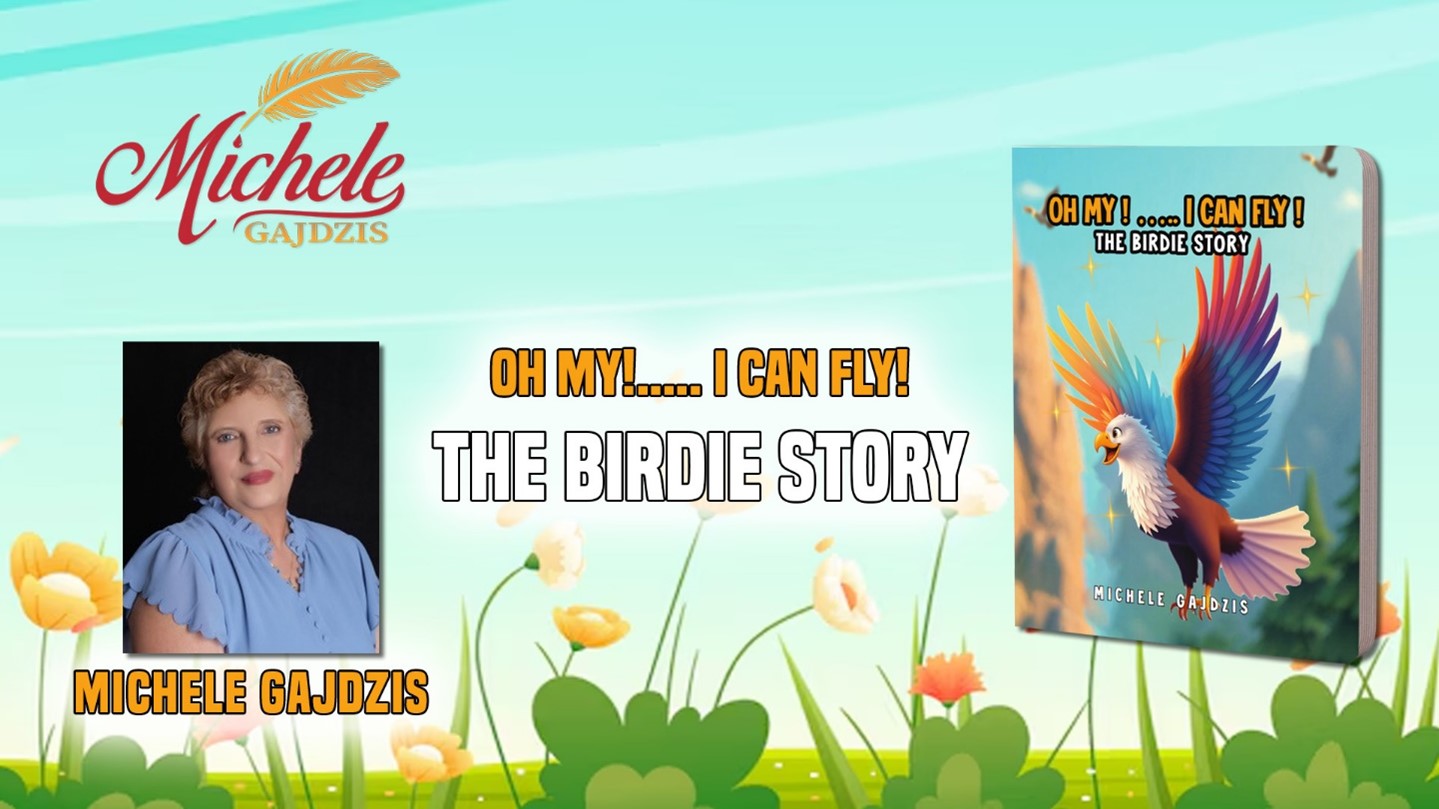
In every child’s life, there comes a moment when they look at something they deeply desire—learning a skill, understanding a lesson, or becoming who they dream to be—and wonder, “When will it happen for me?” In today’s world of instant results and constant comparison, patience can feel like one of the hardest virtues to practice. Yet Michele Gajdzis reminds us of its quiet power in Oh My!… I Can Fly!. Through the gentle refrain, “Time will tell,” the story shows that growth cannot be rushed and that hope must endure while waiting.
At the beginning, Barry is a tiny, featherless bird living in a locked cage atop a mountain. He watches the other birds dance through the sky and longs to join them, but he is not ready—physically, emotionally, or spiritually. Gajdzis shows us that waiting is not failure; it is the beginning of growth. Barry’s stillness, his longing, is the first step toward understanding that becoming is as important as achievement.
When Wally Bird arrives, he does not offer an immediate escape. Instead, he plants a seed of possibility: “You are an eagle and were created to soar.” Barry cannot yet see it; he doesn’t feel like an eagle. But Wally’s words, repeated patiently throughout the story, become a whisper of hope. Every day brings a new Promise Feather—blue, red, yellow—each marked with golden letters Barry cannot yet read. Each time he asks, Wally smiles and repeats, “Time will tell.” This deliberate repetition teaches children—and readers—that understanding unfolds only when the heart is ready.
Kenny Bird reinforces this lesson through practice. “Up and down, up and down,” he instructs, teaching Barry to flap his wings. The slow, tiring process mirrors the frustration children feel when effort seems fruitless. Barry asks, “What’s wrong? I have all the feathers I need. Why can’t I move?” Kenny and Wally’s guidance reminds him that growth is cumulative, often invisible, and that patience is the bridge between effort and achievement.
The story deepens this lesson when Wally and Kenny disappear, leaving Barry alone. In this quiet, uncertain period, the author reflects the emotional reality of children learning to navigate challenges independently. Yet even in solitude, growth continues. When Wally returns with Harmony Bird, whose songs bring renewed strength, Gajdzis shows that patience can bring unexpected blessings—support, joy, and encouragement arriving at just the right time.
Finally, the moment of breakthrough arrives. The mountain shakes, the cage sways, and the door holding Barry back finally opens. This freedom comes not when Barry demands it, but when he is ready—emotionally strong, spiritually grounded, and supported by hope, strength, and joy. The story emphasizes that patience is not passive; it is preparation. Every feather, every lesson, every moment of waiting contributes to this moment of clarity.
At last, Barry reads the golden letters on his Promise Feathers: HOPE. STRENGTH. JOY. Only now does he understand what was there from the beginning. “All this time they came to show me that I am truly loved,” he exclaims. Gajdzis reminds us that patience leads to understanding, confidence, and growth—emotional, spiritual, and personal.