
This post was originally published on this site.
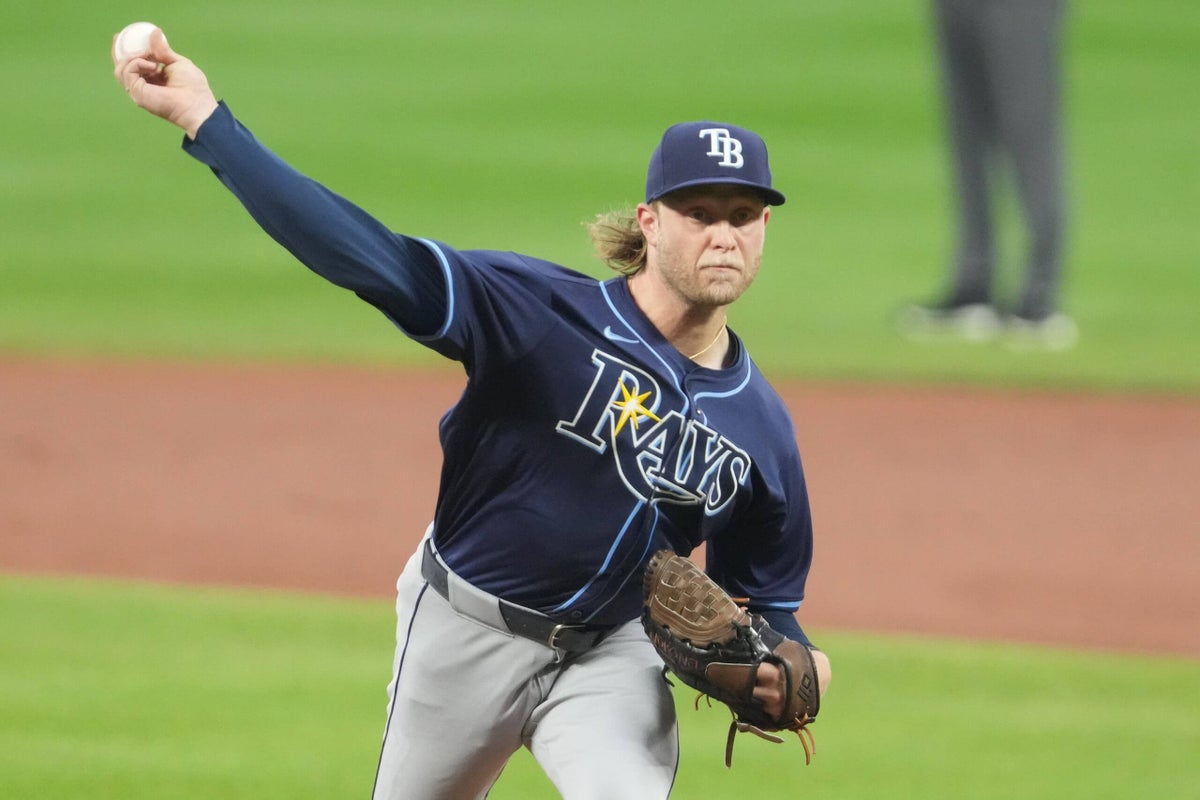
Mike Elias, the Baltimore Orioles’ president of baseball operations, knew all about Shane Baz.
In 2017, Elias was living in Houston, working as the Astros’ amateur scouting director. Baz was pitching at Concordia Lutheran High School in Tomball, Texas, about 30 miles from Houston.
Elias watched Baz pitch in high school, saw him work out with an 18-and-under U.S. national team that trained in Houston, got to know the teenager and his family well. In the 2017 draft, Baz went to the Pittsburgh Pirates with the 12th pick, before Elias had a chance to take him at 15. The Astros instead selected righty J.B. Bukauskas, who later became part of a deadline blockbuster for Zack Greinke.
Advertisement
It took 8 1/2 years, but Friday, a clear path for Elias to land Baz finally emerged. To pry Baz from the Tampa Bay Rays, Elias traded four highly regarded prospects and a draft pick in the mid-30s. With that move, the Orioles’ super-charged offseason continued. And it isn’t over yet.
The Orioles see Baz joining lefty Trevor Rogers and righty Kyle Bradish in the front three of their rotation. However, they plan to continue looking for another starter, additional bullpen help and complementary position players, according to people familiar with their thinking.
Baz, 26, is talented enough to be a No. 1 and under club control for the next three seasons. The Rays were not looking to trade him and priced him accordingly. Not on his performance in 2025, his first full season after undergoing Tommy John surgery in Sept. 2022, but on his potential to do so much more.
Executives talk all the time about how they look “under the hood” in their evaluations, dive deeper into the numbers. With Baz, a few taps on the keyboard provided all the information they needed to get excited.
Baz’s 4.87 ERA in 166 1/3 innings last season broke down to 5.90 at hitter-friendly Steinbrenner Field, 3.86 on the road. His average fastball velocity of 97.0 mph ranked seventh among qualified starters. His stuff+, a measure of the physical characteristics of his pitches, was roughly the equivalent of that of Hunter Brown and National League Cy Young Award winner Paul Skenes.
Before Baz, the Orioles discussed a trade for Miami Marlins righty Edward Cabrera, the signing of free-agent righty Michael King and a variety of other starting pitching options. Cabrera, who remains with Miami, and King, who signed a three-year, $75 million contract with the San Diego Padres, both come with health concerns. Most starting pitchers do. But Baz, with his TJ behind him, seems to be in a good place physically. At least in a relative sense.
Advertisement
Elias and his Rays counterpart, Erik Neander, compete in the same division, the AL East, against three big-money behemoths, the Toronto Blue Jays, New York Yankees and Boston Red Sox. Yet the Baz deal marked the fourth time in the last three-plus years they traded with one another. The previous three deals (a three-team swap that sent Trey Mancini to Houston, Jose Siri to Tampa Bay and prospects to Baltimore in 2022; Zach Eflin to Baltimore in 2024; and Bryan Baker to Tampa Bay in 2025) were at trade deadlines.
Baz carries greater value than any of those players did. The Orioles knew moving within the division would require them to pay a premium. The Rays, according to people familiar with their thinking, are like most teams this offseason, preferring to acquire major-league talent rather than prospects. They figured if they were going to trade a controllable pitcher, they would do it for a controllable hitter. And if they were going to make such a deal for prospects, the price would be exorbitant.
Elias was willing to play along. At least in this deal, he wanted to move future value, players far away from the majors. He had plenty of it, too. The Orioles in the 2025 draft ended up with four of the top 37 selections — their first rounder, two they gained by losing right-hander Corbin Burnes and outfielder Anthony Santander to free agency and another they acquired from the Rays for Baker.
Two of the players they traded for Baz — catcher Caden Bodine and outfielder Slater de Brun — were among those picks (de Brun was chosen at No. 37, with the selection the Orioles acquired for Baker). The Rays in the deal also acquired emerging right-hander Michael Forret, outfielder Austin Overn and a Competitive Balance Round A pick.
That pick, and the accompanying bonus money, will be especially valuable. The Rays can cut a below-slot deal with their first selection at No. 2, then go above-slot with a player who drops into the 30s. And keep building a new core around third baseman Junior Caminero, first baseman Jonathan Aranda and outfielder Chandler Simpson.
Advertisement
The other trade the Rays made Friday — the three-team extravaganza with the Pirates and Astros that landed them outfielder Jacob Melton and righty Anderson Brito — actually grew out of the Astros’ pursuit of Baz earlier this offseason.
Melton and Brito also were part of those discussions. The Rays ultimately landed them by sending second baseman Brandon Lowe, outfielder Jake Mangum and lefty reliever Mason Montgomery to the Pirates, with the Astros getting the controllable starter they were seeking, righty Mike Burrow, from Pittsburgh.
With the two trades, the Rays transformed their farm system, adding six prospects to their top 30, according to MLB Pipeline — Melton (4), Brito (6), Forret (7), de Brun (8), Bodine (13) and Overn (22). They are now positioned to acquire Arizona Diamondbacks second baseman Ketel Marte, St. Louis Cardinals second baseman Brendan Donovan or any other player who might intrigue them.
As always, the Rays will not rule anything out. But after trading Baz, they might not be willing to part with the pitching the Diamondbacks want for Marte unless they acquire additional arms from a third team. They also must decide if such a pursuit would be worthwhile.
Even after trading three major leaguers to the Pirates, the Rays believe the signings of free-agent center fielder Cedric Mullins and left-hander Steven Matz put them in position to win 84-85 games. The problem is, that might only be good enough for last in the AL East.
The Blue Jays have signed free-agent right-handers Dylan Cease and Cody Ponce and righty reliever Tyler Rogers. The Red Sox have traded for righties Sonny Gray and Johan Oviedo and remain in the market for at least one big bat. The Yankees, too, are lurking. Their winter is not going to end with the one-year $2.5 million signings of lefty Ryan Yarbrough and infielder Amed Rosario.
Then there are the Orioles. Their frenzied offseason already included the additions of first baseman Pete Alonso, outfielders Taylor Ward and Leody Taveras, closer Ryan Helsley and righty reliever Andrew Kittredge. On Friday, they added Baz to that list, with help from a division rival.
The Rays easily could end up winning this trade, and winning it big. The outcome, though, probably will not be determined until the 2030s. And in the next three seasons, Baz might develop into all that both these clubs think he can be, electrifying Baltimore, haunting Tampa Bay.