
This post was originally published on this site.
It’s Tuesday of the NBA trade deadline, and one exec’s prediction to me was minutes away from coming true.
“Every year I come into the office on Monday of trade deadline week all excited to get some business done,” he said, “and then I just stare at the phone all day. Nothing starts happening until Tuesday.”
Advertisement
Well, almost nothing. Very late Monday, word broke that the LA Clippers and Cleveland Cavaliers were in talks on a potential move that would swap James Harden for Darius Garland. That’s clearly a blockbuster, and I’ll talk about it more in a minute.
First, however, let’s talk about the lack of activity so far and why it may not be a hyperactive deadline week despite Monday’s earthquake. We have only had three trades the entire season, 66.7 percent of which involved the Atlanta Hawks, and while that number is certain to increase by several multiples before Thursday, there are some underlying reasons for the general pattern.
To wit: All the arrows are pointing to this offseason being where the real blockbusters happen, with the exception of moves involving players — such as Harden — who can become free agents after the season. With one or two exceptions, this trade deadline may just be an accounting exercise of slinging slop contracts back and forth with negligible on-court impact.
Of course, one decision in Milwaukee could change all that; even if nothing else notable happens, a Giannis Antetokounmpo trade would obviously be a trade deadline earthquake. But as my colleagues and I noted late last week, the Bucks may find a much richer trade market in the offseason.
They’re not alone. With 14 teams over the luxury-tax line and 10 of them at or above the first-apron payroll threshold, the flexibility to do deals now just isn’t there for a wide swath of the league. Additionally, those teams are the ones that are most successful and thus, in other circumstances, the most likely to push in chips to complete a deal. But they can’t.
A potential Harden-Garland deal actually underscores the immense difficulty of completing trades in this environment. Because the Cavs are over the second apron, they can only trade Garland for a player who makes less money. But because the Clippers are just $1.3 million from the first apron and use their taxpayer midlevel exception on Bradley Beal (woof), they can only trade Harden for a player who makes $1.3 million or less more than Harden does.
Advertisement
Almost miraculously, a Harden-for-Garland swap checks these boxes, with Harden making $263,397 less than Garland. (Harden has a trade bonus that can soak up that $263,397 if he doesn’t waive it, but he can’t be on the books for even a dollar more than Garland made. Incidentally, Garland also has a 15 percent trade kicker, but it won’t apply because it would put his salary past the max for a player with six years of service.)
While we’re here, more fun: Harden can also veto any trade, because he signed a one-year deal last summer and would have no Bird rights with his new team if he opts out of his deal. As a practical issue, that wouldn’t matter; as a non-Bird free agent, he could still sign for up to $47 million in 2026-27 salary and up to four years.
This leaguewide difficulty goes beyond apron issues, though. We also have a draft pick situation that impacts many of the same teams, with the twin forces of the Stepien Rule, which limits teams from trading consecutive first-round picks outright, and the turning of the league calendar meaning they can offer much more draft capital in late June than they can today. The Los Angeles Lakers and Cleveland both can only trade one future first right now but up to three (picks in 2026, 2031 and 2033) on draft night. The Minnesota Timberwolves and New York Knicks can’t trade any firsts right now but can do two (2026 and 2033) on draft night.
It’s also much easier to make maneuvers once the June draft order is set, and teams know exactly what pick is being returned to them in any swap involving a 2026 selection. Waiting also takes protection scenarios that invoke the Stepien Rule out of the way.
The draft is another reason the Cavs would look at a move for Harden now; they just don’t have the draft capital right now to do anything grander. Neither do the Clippers, for that matter, who don’t have a tradeable first until 2030; it appears they might need to sacrifice that to meet Cleveland’s terms for a deal.
Advertisement
Between all those factors, it’s tough to thread the needle on a trade for a $40 million to $50 million salary like that of Ja Morant, Anthony Davis or Domantas Sabonis, unless it’s a situation like this one where two large, nearly-identical salaries are traded for each other. That’s especially true when the market for the three players I mentioned wasn’t all that hot even in the best of circumstances.
All of this is even harder when the entire league is waiting to see what happens with Giannis first … and might be waiting for four more months. If so, his biggest suitors will likely choose to keep their powder dry for the offseason rather than chase a lesser target now. Again, a Garland-for-Harden swap wouldn’t affect Cleveland’s ability to jump into the Giannis fray in June and might actually improve it depending on the resolution of Harden’s player option. (He can opt in for $42.3 million or become a free agent; his deal cannot be extended.)
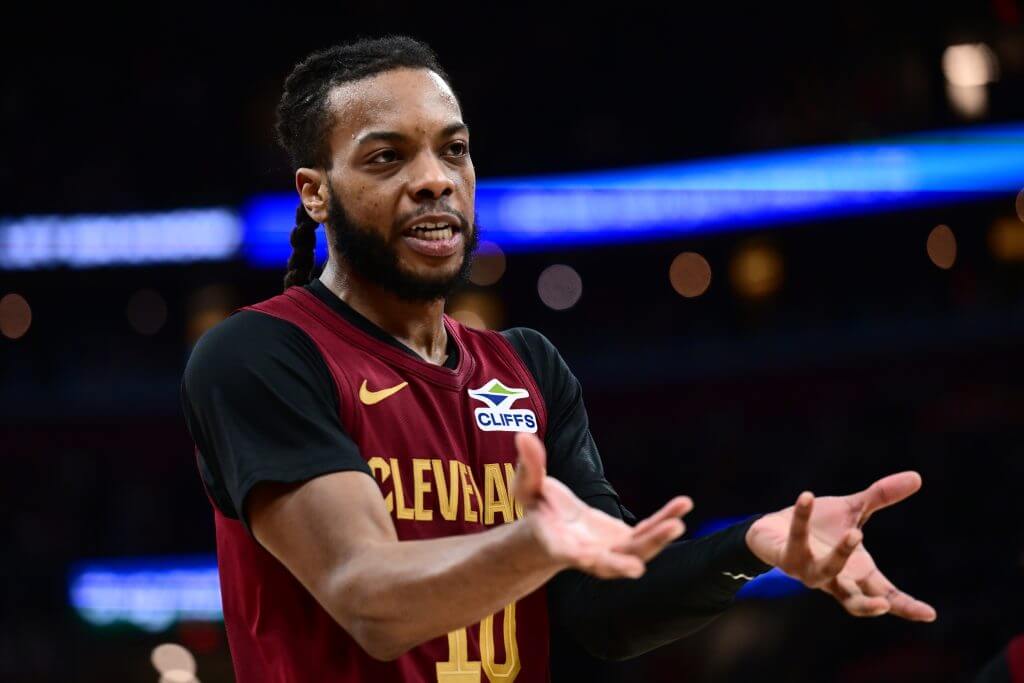
Darius Garland argues a call with an official during a Cavs-Jazz game last month in Cleveland. (Ken Blaze / Imagn Images)
Finally, there is an issue of alignment. At least a few teams appear to be operating on a tank-now, actually-earnestly-try-next-year trajectory, most notably Utah, Brooklyn, Washington and Indiana (the Pacers have tried honorably, actually; they’ve just been awful). The Wizards dealt with this via an acquire-and-shutdown maneuver with Trae Young, but the others may be more willing to pursue roster upgrades after the season.
That doesn’t mean we won’t see any trades, with Monday’s late-night excitement as our proof. As our Mike Vorkunov already pointed out, the four teams that are pennies above the tax line (Philadelphia, Denver, Phoenix and Toronto) are virtually guaranteed to make small deals to get under; these will just be spectacularly uninteresting trades in terms of actual basketball.
Additionally, players on expiring contracts whose future signability is in question will always be in play at the deadline. We’ve already seen it with Young, Sacramento’s Keon Ellis and now Harden. It’s why we’ll likely hear names like Bennedict Mathurin, Coby White, Ayo Dosunmu, Quentin Grimes, Cam Thomas, Anfernee Simons, Jeremy Sochan, Kristaps Porziņģis, Jose Alvarado, Collin Sexton, Jusuf Nurkić, Tyus Jones, Matisse Thybulle and Ochai Agbaji come up often in the next 48 hours.
And hey, maybe some other gigantic move will pop up out of nowhere, something we never saw coming. We can’t claim to be shocked by anything that happens after the late-night Luka Dončić bomb that hit just over a year ago; the Garland-Harden saga erupting on Monday night is just another example.
But reading the tea leaves right now, it doesn’t seem the way to bet. I don’t expect the trade deadline to be quiet, exactly, because that’s not how the trade deadline works anymore. There are too many small, sensible deals out there to clean up teams’ books and line things up for an active summer. But in terms of the seismic blockbusters that have dominated the last few trade deadlines, don’t hold your breath.
Advertisement
I’m wondering if my exec friend is going to spend more time than usual staring at his phone, waiting for it to ring.
Cap geekery: Catch-and-release trades
One of the interesting things about the upcoming trade deadline is how many teams have given themselves the ability to absorb salary. That starts with Brooklyn, of course, which has $15 million in cap room, but several other teams have millions in room below the tax line and trade exceptions large enough to take on a decent-sized salary … or two … or three.
On the flip side, five teams are in the luxury tax by small amounts and could get all the way out by dumping fungible players this week, while nine others can cut their tax bill considerably with minor trades. For example, trading a minimum guy and signing another minimum guy for the rest of the season in his place cuts a team’s tax number by roughly $1.5 million, which could add up to nearly $10 million in tax savings for a few teams once you include the tax multipliers.
For those teams in the business of taking on salary in return for cash and picks, the possibility exists of doing multiple iterations. Chicago, for instance, has already been paid off with two second-round picks to take on the unwanted $5.4 million salary of Dario Sarić; the Bulls could now execute a similar transaction with the $8 million in room they have remaining below the tax line, as long as they release Sarić and open the roster spot.
Chicago has time to do this since the trade was executed on Saturday, but there’s a special art to doing this maneuver at the deadline. A team like Brooklyn might line up three different salary-dump trades for Thursday, but if so, it has to execute a very specific order of operations.
That’s because a trade must be completed in the eyes of the league before a team can move on with subsequent transactions involving players in the deal. Typically, this process takes multiple days, as players must report and complete physicals. The rapid-fire trade deadline version of this, however, is that, in a salary-dump trade, teams will waive the physical and reporting requirements and certify the trade is completed immediately after the trade call with the league. As long as this is done before 3 p.m. Eastern on Thursday, the team is then free to make another move.
So, for example, the Nets could execute a trade at 9 a.m. Thursday to take on a salary, waive all the physical and reporting requirements and have the deal completed by 9:30; they could then release that player and complete another trade later in the day and theoretically could continue doing this ad infinitum until they either ran out of cap space or the clock hit 3 p.m. They wouldn’t need until the last trade in the cycle to complete before 3 p.m. as long as they had the terms filed to the league ahead of the deadline, but they would need every transaction in the cycle before then to be complete.
Advertisement
I’m keeping an eye on this type of maneuver for Thursday. If we get a dud trade deadline in terms of stars, it may be the most exciting part for the cap nerds.
Rookie of the Week: Ace Bailey, 6-7 SF, Utah Jazz
Travel issues left me in Salt Lake City on Friday night, and I made lemonade out of the situation by heading to the game between the Nets and the Utah Jazz. While it was not exactly the game of the year aesthetically, it did allow me to get eyes on Utah rookie Ace Bailey and talk with him a bit after the game.
First of all, let’s start with the fun stuff. Bailey had one absolutely monstrous highlight in his 12-point effort in Utah’s 109-99 loss. On the first play of the fourth quarter, he slipped a screen on the left side, caught a pass on the left wing and quickly changed direction into a rocket step move with his right hand. With one dribble, he blew past Brooklyn’s Day’Ron Sharpe and got from the 3-point line to the rim with a soaring statue-of-liberty dunk:
“I mean, I just went up, I don’t know how to explain it,” Bailey said. “I caught it off the roll. I was very precise. I just went at it.
“That’s something I’ve been working on a lot, just using my jab, using my first-step quickness.”
The rest of Bailey’s night was more of a mixed bag, which is to be expected with a 19-year-old rookie. The fifth pick in the 2025 draft has shown flashes as a scorer and pull-up shooter and has surprised many with his ability to make quick-decision passes, something that wasn’t exactly a feature of his game in his one trigger-happy season at Rutgers.
Bailey’s biggest deficiency at the moment is in strength; there are few players who more badly need to add the proverbial 15 pounds of muscle. He missed out on some summer development work on that front and is now catching up, so he’s behind his fellow rookies in this area. Bigs easily muscle him out of the way in switch situations, and offensive players go right through his body en route to the rim.
Advertisement
Offensively, it’s a similar situation. Bailey’s shooting numbers are perfectly fine (34.6 percent from 3, solid on long 2s and 52.4 percent inside the arc); the problem is that they come with virtually no free-throw attempts.
One notable exception came in the third quarter when he took two hard dribbles and then put his shoulder into fellow muscle-challenged rookie Egor Demin, shrugging him off to get into a pull-up that he knocked down.
“One of my strengths is pull-ups and just (shooting) right over (the defender) to finish,” Bailey said. “Using my body, I’ve been working hard in the weight room, so (I’m) using that to my advantage.”
Beyond adding strength and continuing to develop his long-range shooting, Bailey also needs to upgrade his handle; he’s a full-time wing now after playing power forward in college. Defensively, he shows playmaking aptitude for blocks and poke-check steals, but like many rookies, he needs to upgrade his overall defensive awareness.
That said, Bailey has put together a respectable season at a very young age. Most rookies are negative overall players, and Bailey is one of them, especially with the strength deficiencies. However, the upside for a long-term starting wing is clear, and time will tell where he fits in a strong rookie class.
One fun final note to complete the circle on the clip above: Bailey told reporters after the game that he had a lot of other dunks in his bag, and he’d compete in the slam dunk contest at All-Star Weekend if asked.