

This post was originally published on this site.
For many ecommerce brands, growth feels straightforward at first. Traffic increases, product catalogs expand, and marketing channels multiply. Then conversion rates stall, cart abandonment rises, and revenue stops scaling in proportion to demand.
More often than not, the issue isn’t traffic or product quality—it’s the checkout layer.
Industry data consistently shows that checkout is where growth momentum breaks down. Global cart abandonment rates hover around 70%, with complicated or slow checkout processes cited as one of the reasons shoppers fail to complete a purchase.
As order volume increases, even small checkout inefficiencies can quietly erase the gains made elsewhere in the funnel.
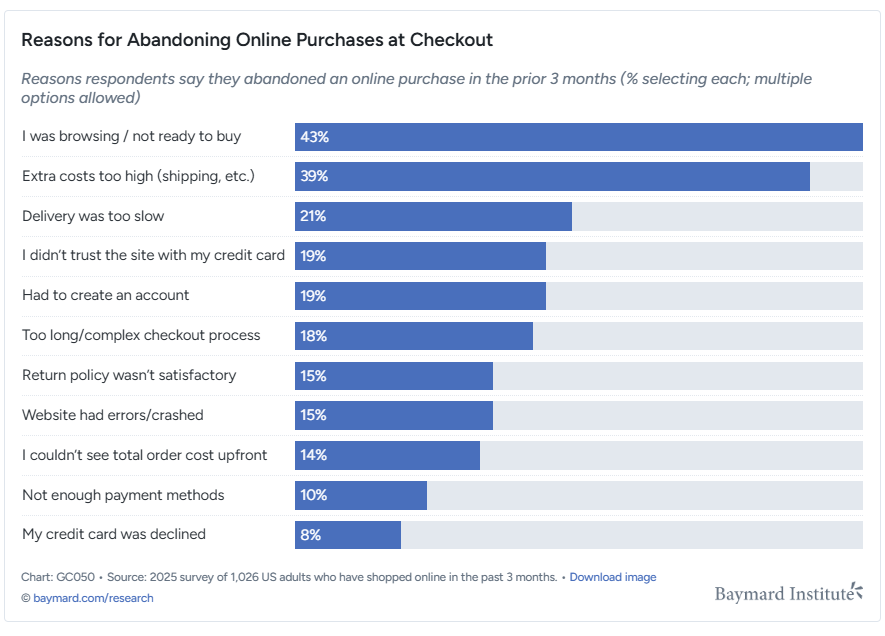
Understanding why checkout breaks under growth pressure is key to sustainable ecommerce scaling.
Checkout Was Built for Simplicity, Not Scale
Most checkout systems are designed to help merchants launch quickly. They prioritize ease of setup, default flows, and minimal configuration. For early-stage brands, this simplicity is a strength.
At scale, however, those same design choices become constraints. A checkout optimized for a single region, currency, and payment method doesn’t adapt easily when a business expands internationally or introduces complex pricing, promotions, or fulfillment logic. What worked for hundreds of orders a month can struggle under thousands per day.
This flaw isn’t unique to one platform. It’s a common structural trade-off across ecommerce tools.
Performance Bottlenecks Appear Under Real Traffic
Checkout performance issues often don’t appear until traffic spikes. High-concurrency events like product launches, flash sales, or seasonal promotions put stress on systems that were never tested at that volume.
Common problems include:
- Increased latency caused by third-party scripts
- Payment gateway timeouts during peak load
- Failed transactions that don’t surface clearly in analytics
Because checkout is the final step in the purchase journey, even small delays or errors can have an outsized impact on revenue and customer trust.
Regional Payments and Compliance Add Hidden Friction
As brands expand into new markets, checkout complexity grows. Regional payment preferences, local tax requirements, and address validation rules introduce layers of logic that weren’t necessary early on.
A checkout flow that works in one country may cause friction or outright failure in another. Declined payments, incorrect tax calculations, or missing compliance steps can prevent customers from completing purchases even when demand is high.
This highlights the difference between basic checkouts and flexible ones, particularly for global businesses.
Customization Limits Block Conversion Improvements
Many growth-stage teams want to experiment with checkout to improve conversion, such as testing alternative flows, adding conditional logic, or integrating custom services. But default checkout environments often restrict access to the underlying logic.
As a result, teams rely on workarounds:
- Additional apps layered onto checkout
- Manual processes outside the platform
- Hard-coded exceptions that are difficult to maintain
Over time, these patches create technical debt and reduce the team’s ability to iterate quickly. Checkout becomes a roadblock instead of a space for testing new ideas.
When Checkout Architecture Becomes a Strategic Decision
Over time, checkout stops being purely a design challenge and becomes an infrastructure concern. This is often where comparisons like Shopify Plus vs. Shopify come into play.
Since 2024, Shopify has fully transitioned away from checkout.liquid in favor of Checkout Extensibility, a more structured and secure framework for modifying checkout behavior. This change standardized how checkout customization works and made the distinction between standard Shopify plans and Shopify Plus far more explicit.
Shopify Plus, for example, offers deeper checkout extensibility, automation options, and access to APIs that aren’t available on standard plans, which intentionally restrict checkout-level customization. For teams managing high order volumes or complex operational requirements, these differences can materially affect performance and flexibility.
At this stage, brands often assess whether they need additional tech support, whether that’s working with Shopify experts, a specialized Shopify web developer, or a Shopify Plus development agency experienced with large-scale builds.
Agencies like Lantern Sol, which focus on ecommerce growth and checkout architecture, can help brands determine whether scale-related checkout limitations, integrations, and performance challenges can be addressed within Shopify without forcing an immediate replatform.
The key is timing. Architectural changes matter most when checkout constraints begin limiting growth, not before.
Quick Takeaways
- Checkout is often the weakest link in ecommerce growth, with small inefficiencies compounding quickly as order volume increases.
- Systems designed for fast launch prioritize simplicity, but those same design choices can limit performance, flexibility, and global readiness at scale.
- Traffic spikes expose checkout bottlenecks, including latency, payment failures, and third-party dependencies that directly affect conversion.
- Global expansion introduces payment, tax, and compliance complexity that standard checkout setups aren’t always built to handle.
- Advanced checkout customization and extensibility are exclusive to Shopify Plus, making checkout architecture a strategic decision for scaling brands.
- Sustainable ecommerce scaling requires treating checkout as core infrastructure, not just the final step in the purchase flow.
Conclusion: Scaling Checkout Requires Intentional Design
Ecommerce growth doesn’t fail because demand disappears. It fails when systems built for simplicity aren’t adapted for scale. Checkout is often the most fragile layer because it sits at the intersection of performance, payments, compliance, and customization.
Brands that scale successfully treat checkout as a system, not a feature. They evaluate when default tools are sufficient and when more extensible architectures and the right technical expertise are required to support continued growth.
Checkout isn’t just where transactions happen. It’s the infrastructure that decides whether your growth efforts pay off or fall apart at the finish line.