
This post was originally published on this site.
The Vancouver Canucks aren’t looking to take a victory lap in the wake of Monday’s trade that sent Kiefer Sherwood to the San Jose Sharks for second-round picks in 2026 and 2027 and an AHL depth defender.
No, even as Canucks fans understandably seized onto a rare moment of hope and directional clarity from the franchise, the organization remains wildly disappointed that it’s come to this. They’re concerned with how the team’s on-ice performance is trending, even as this recent run of fecklessness — 10 losses in a row entering Monday night’s game — serves the best interests of the franchise in the big picture.
Advertisement
It’s all a matter of perspective, perhaps. Before Vancouver let it be known that its veteran players were available for trade this fall, Canucks brass would’ve been stunned to have netted more than a single second-round pick for Sherwood.
Once the offers rolled in and significant interest in Sherwood was expressed from around the league, however, the club had adjusted its expectations. Over the past few weeks, the club had hoped to sell Sherwood for a first-round pick and pushed hard to do so.
Sherwood is a unique asset more than he’s a premium player, though.
In the midst of a career year in which he was pacing for 30 goals (having never previously scored 20), Sherwood is a standup citizen in the locker room and a hard worker. He hits everything that moves, he’s an 80th percentile skater and he’s a genuinely gifted one-shot goal scorer. Given that his cap hit came in at a deeply affordable $1.5 million, Sherwood was more than just the type of winger that literally every team in the league would’ve wanted to add to their roster; he was also the type of winger that literally every team in the league could’ve afforded to add to their roster.
Ultimately, however, the market never produced a Sherwood offer that included a first-round pick. And just over a week ago, Sherwood sustained an injury to his hand that’s expected to keep him out until after the Olympic break.
All of that played a role in the timing of this deal, as did the appetite of the Sharks to land this particular player to their group. Late last week, Vancouver’s stance on selling Sherwood’s market price softened somewhat and almost simultaneously, the Sharks stepped up their interest and put an additional second-round pick on the table.
There was only one final hurdle: San Jose was pressed up against the 50-contract limit. The Sharks even made a minor Friday trade to clear a contract and give them some breathing room. The Sharks asked Vancouver to take on a contract in completing the trade, and the two clubs settled — with Vancouver’s AHL general manager Ryan Johnson having a shaping influence on the particulars on the Canucks’ end of the deal — on 25-year-old right-handed defender Cole Clayton.
Advertisement
Clayton is a relatively expensive AHL player with nearly $300,000 guaranteed in salary this season. His inclusion in the deal, however, wasn’t a cap jump that helped Vancouver juice the return, team sources told The Athletic. It was simply a matter of contract slots, with Vancouver agreeing to take back an AHL depth option with the ability to help Vancouver weather injuries over the balance of this season if required.
On a day when the Canucks executed their first obvious seller trade that returned at least a second-round pick in over 11 years — dating back to when the club sold Kevin Bieksa to the Anaheim Ducks for a second-round pick in the summer of 2015 — the direction of Vancouver’s rebuilding began to take clearer shape.
Here’s what I’m hearing about what’s next for the Canucks between now and the NHL trade deadline.
The draft picks aren’t being dangled as bait
From Vancouver’s perspective, selling Sherwood was a necessary deal for a good winger that the Canucks decided they were going to trade — and not extend — earlier this month.
The club may have hoped for a first-round pick in return, but there’s significant utility to Vancouver in adding multiple second-round picks split between multiple seasons.
I also don’t expect the Canucks to trade any of the four picks they now hold in the first and second rounds of the 2026 NHL Draft before the trade deadline. Given how frequently we’ve seen the Canucks acquire draft picks by selling veteran players, then turn around and utilize those picks to buy win-now help, this is notable.
As the draft moves nearer, the club may look to move up or down in the draft order, but those are options to explore in the future.
For now, the Canucks are intent on holding their newfound 2026 draft capital, and counting on those four picks — all currently projected to be among the top 50 — to give their prospect system the significant shot in the arm it so sorely requires.
Advertisement
What’s left to trade and the looming 23-man roster crunch
Impacting Vancouver’s immediate planning in the aftermath of the Sherwood trade is a looming roster crunch that will be created this week with Teddy Blueger and Filip Chytil expected to come off Injured Reserve.
The Canucks have some straightforward options to consider to be 23-man roster compliant this week with Chytil and Blueger activated — they have until the end of the month before Arshdeep Bains will require waivers again — but even with Sherwood’s subtraction, the club will be managing a glut of additional bodies up front.
Obviously, there’s no real desire internally to scratch the likes of Aatu Räty or Liam Öhgren at this juncture, but the club also has to be mindful of making sure that its pending unrestricted free agent players who are priorities to sell — players like Blueger, David Kämpf and Evander Kane — are getting into games regularly, and showcasing themselves for various trade partners.
It should go without saying that Blueger, Kämpf and Kane are all players that don’t factor into Vancouver’s plans beyond the trade deadline. These are the players who are most available and on the trade block in the wake of the Sherwood deal.
With this roster crunch in mind, the Canucks are motivated and looking to sell an additional forward with at least some level of urgency.
Certainly, the club wants to avoid the eventuality that could present itself if there are no further injuries and Marco Rossi returns, which could cause the club to assign a waiver-exempt forward like Öhgren down to Abbotsford.
That’s an eventuality the club will try to avoid. The organizational view is that Öhgren has earned more NHL-level opportunities with his performance since the Quinn Hughes trade, not fewer. To that end, it’s even possible that the Canucks could consider keeping Öhgren and exposing an additional player to the waiver wire instead, if a trade doesn’t present itself before then.
Advertisement
The club will be able to take some time to sort through this and will be especially cautious in managing Rossi’s return. There’s a feeling that Rossi was so eager to prove himself following his acquisition from Minnesota that he might’ve rushed back prematurely from the lower-body injury he was dealing with.
Slow-playing Rossi’s reintegration into the lineup may buy the Canucks more time. What matters more for our purposes, however, is the club’s overall posture. In the immediate aftermath of the Sherwood trade, the Canucks remain very much open for business and are keeping one eye on expediting the sale of at least one additional veteran forward, given their surplus of options up front on the 23-man roster.
How Vancouver’s lack of NHL centres will shape approach to selling veteran forwards with term
At odds with the idea of slow playing Rossi’s return is the organization’s eagerness to get Blueger, Chytil and Rossi back in the lineup.
The Canucks entered the season with concerns about their centre depth. Then, there run out was putrid, with Blueger and Chytil sustaining early-season injuries from which they’re only just about to return. There’s a strong internal belief that those injuries, and Vancouver’s lack of options down the middle of their forward, have fully submarined this team.
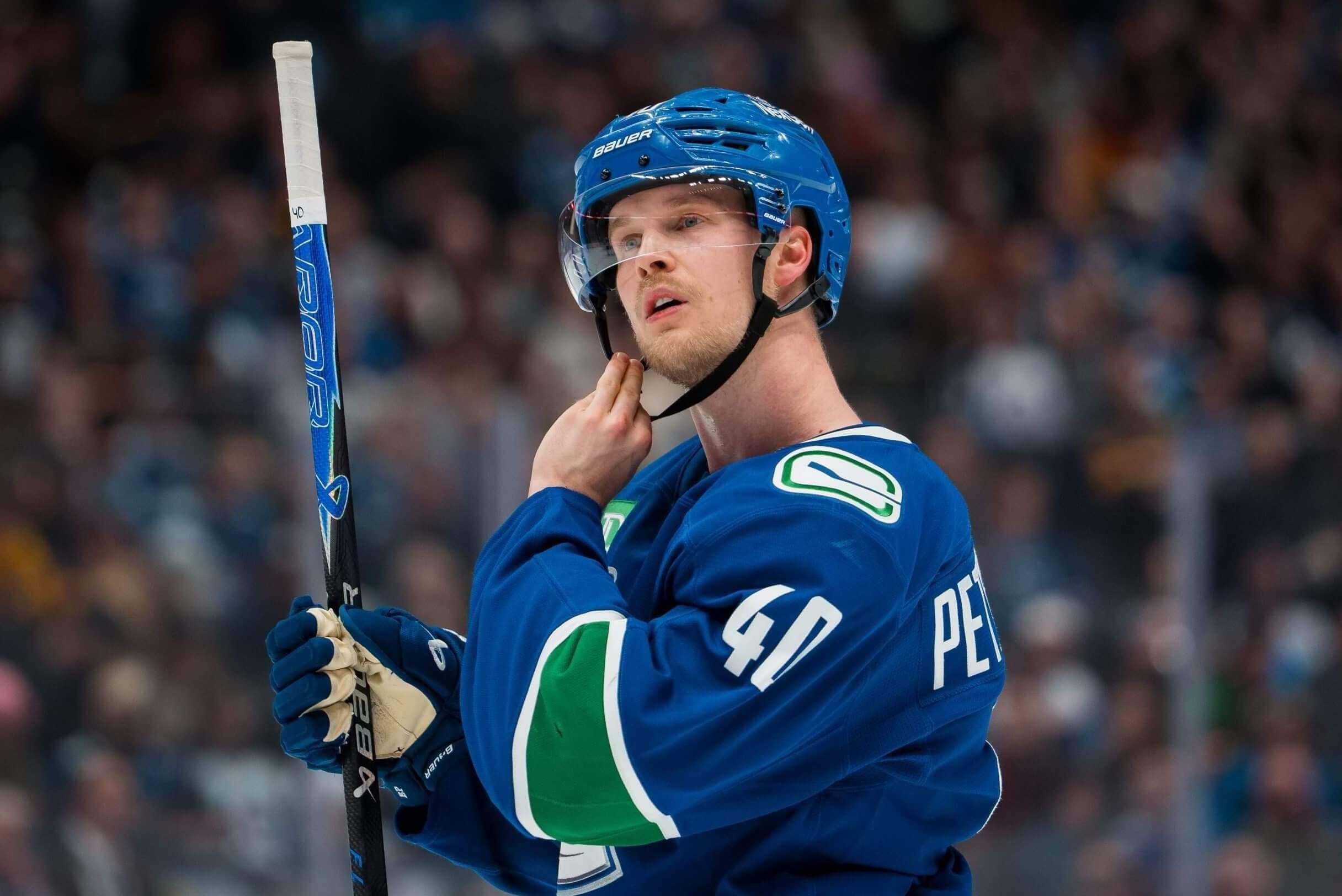
While centre Elias Pettersson has nominally bounced back in terms of his point production and defensive play, he hasn’t performed to a star level. Outside of Pettersson, the club has mostly relied on replacement-level options down the middle of its forward group, including Lukas Reichel, Kämpf, Räty and Max Sasson. The results haven’t been pretty.
Beyond the club’s on-ice struggles, the organization feels that its lack of NHL-calibre centre depth this season has made it difficult to evaluate the state of this roster.
This applies in particular to the three veteran wingers with significant term and money on their contracts — Conor Garland, Jake DeBrusk and Brock Boeser — who are the most frequent topics of trade speculation locally. It applies to the likes of Nils Höglander, too.
Advertisement
Vancouver remains open for business and listening on all of its players in the wake of the Sherwood trade, but the sense I still get is that none of the late-20s veterans with significant term and money remaining on their contracts are aggressively being shopped, or on the block necessarily. Vancouver views all of that class of player: Pettersson, DeBrusk, Garland, Boeser and Marcus Pettersson, as young enough that they can hold value through this season (and even through next season) as the Canucks reconstruct the roster around them.
A team in Vancouver’s position has to remain open-minded, and intends to do so between now and the trade deadline, but the club is desperate to evaluate its team — and its veteran wingers — down the stretch with more credible centre options in the lineup. The organization also isn’t fundamentally worried about these players as depreciating assets that must be monetized urgently.
Keep the centre question in mind as the deadline approaches, because it’s an understandable organizational preoccupation. Based on what I’m hearing from team sources, it’s likely to shape the club’s posture as it pertains to the trade deadline generally and especially as it pertains to the possibility of an Elias Pettersson trade.
While Pettersson has struggled to recapture his imperious, starry form from previous seasons over his last 150 or so NHL games, he remains a top-six centre whose defensive impact has been solid at five-on-five. If the Canucks do ultimately decide to move on from Pettersson, and I believe the team will strongly consider that possibility if the right offer comes along, their overall lack of options down the middle will dictate the shape of the trade.
Put simply, the Canucks would require a centre back, in addition to other assets, in a Petterson trade before the deadline.
The Filip Hronek thing
Filip Hronek has been easily Vancouver’s best skater this season, and the club regards him very highly for both his quality of play on the ice and the quality of his leadership off it (even if he never shows that side of himself to fans or media).
In discussing Vancouver’s various veterans and whether they may end up on the trade block in the weeks and months ahead, it’s probably best to separate Hronek from the other late-20s players with term, money and some manner of no-trade or no-move protection remaining on their deals.
The Canucks are willing to listen on everybody, of course, but that’s circumstantial. From what I can gather, their level of interest in trading Hronek — who has a full no-movement clause — is virtually nil.