
This post was originally published on this site.
0:00 spk_0
So, starting with your estate planning process, you need to know where you’re actually starting. You have to understand what’s the starting point from a financial perspective, and also understand what your financial picture looks like going forward.
0:24 spk_1
Imagine leaving your family, not just assets, but with a clear plan that prevents confusion, reduces stress, and shows how much you care. Today we’re demystifying estate planning and why it’s crucial for everyone, regardless of wealth, to have an estate plan. My guest is Colleen Carcon. She’s director of wealth planning strategies at TIAA and co-author of Principles of Estate Planning. Welcome, Colleen.Hi Bob, thanks for having me. Oh, it’s a pleasure, and it will be a pleasure to have you demystify estate planning. Let, let’s start here. What is an estate plan? Why do people often misunderstand it? Who really needs one and why is it crucial for everyone to have one, not, uh, just the wealthy?
1:08 spk_0
Well, I’m glad that you asked that question because it can be very mystifying. Um, an estate plan, Bob, many people think that an estate plan is just a will, but it’s so much more than that. Uh, an estate plan is a process not only of making sure that you’re accumulating assets and conserving assets, but also making sure that assets are gonna be distributed in the manner that most efficiently and effectively accomplishes your goals.We all spend a lifetime accumulating our assets, and many folks want to make sure their assets are distributed in the simplest manner possible to the people that they want. Um, most people want to reduce taxes, costs, attorneys’ fees, and make sure things get out as quickly and efficiently as possible.Yeah. They also want to protect assets from any predator risks or financial risks. And so a good estate plan is going to integrate all of those components, and it’s going to be integrated with your overall financial plan.
2:16 spk_1
Right? And I know we’ll get to this, but when you talk about assets, it could be money, it could be jewelry, it could be a house, it could be a variety of things. Is that right?
2:26 spk_0
Absolutely,your estate, really, it is any asset that you own at the time of your death, whether it’s all of those things that you listed or a car or life insurance, retirement assets. So think of anything that you own.
2:42 spk_1
Yeah, and then walk us through the, the process, the step by step process that one needs to go through when creating an estate plan.
2:50 spk_0
That’s a great question. Oftentimes folks think they just show up at the lawyer’s office and order up a will, but it really needs to be a little bit more comprehensive than that. Um, you know, the, and, and I just want to highlight, your attorney is the only person who can actually draft legal documents, but the estate planning process incorporates more than just your attorney. We need to have the attorney who drafts documents working hand in hand.With your other team of financial experts, whether that’s your financial advisor or your accountant. So, starting with your estate planning process, you need to know where you’re actually starting. You have to understand what’s the starting point from a financial perspective, and also understand what your financial picture looks like going forward.You need to identify your goals. What are you trying to accomplish? What are your financial needs? What are your goals? What are your priorities, and how are you going to accomplish that?And then also to prioritize the impact of any financial decisions on achieving those goals.You need to next understand the course of action or the potential alternatives to what is currently in place.We always hear from folks, I don’t need a financial plan. Not having a plan is a plan in and of itself.And so we wanna
4:31 spk_1
make sure, not a good plan.
4:32 spk_0
Yeah,no, not a good plan, and I’m sure we’re gonna talk about that in just a few minutes.Um, once you’ve identified where you’re starting and where you want to end, that’s where your team can work together to identify the best route to get there.
4:52 spk_1
Yeah. It’s, it’s fair to say, Colleen, that this is a time-intensive process. I know when I’ve gone through my own estate plan, uh, the, uh, gathering the documents and identifying who owns what and who’s the beneficiary and who, uh, and who I want assets to pass to, etc. etc. it’s not like I can do this on the weekend. It seems like it’s taken me weeks, if not months to to sort of assemble everything and think about things.
5:19 spk_0
Well, it certainly can, and Bob, I think that’s where, um, you know, a couple of things come to mind. First, you need to know what you have before you go see your attorney. So you just mentioned assembling all of your documents. Before you meet with your estate planning attorney, you need to have.That comprehensive list of assets. And I actually want to see account statements, beneficiary designations, just to confirm, because you’d be surprised how often we see someone who thinks things are owned one way, but it’s actually legally titled a different way.You need to collect all of your old estate planning documents that you’ve created, but also, if you’re a beneficiary under anyone else’s documents, you need to gather those too.And that’s where I suggest you partner with all of your other advisors, your financial planner is gonna have an idea of all of your financial assets. Your accountant is going to list on your tax return all of the different sources of income that you have. So that might be a clue to have I collected all of the statements? And then of course, there’s always ways to create efficiencies.Yeah,
6:41 spk_1
efficiency is what I want when I go to update it. So when I think about the, all the estate planning documents, there, there are, there are many. There’s a will, there’s a living trust, there’s a durable power of attorney for financial matters, for healthcare matters, uh, there are healthcare directives, they’re, like you mentioned, beneficiary designations. There’s, there are a lot of documents to gather as part of this process. that fair to say, can you walk us through them?
7:07 spk_0
Yeah, absolutely, um, you mentioned first your will, and everyone needs to have a will.The will is going to be the document that spells out, uh, basically where things are going to pass following your death, and we’ll talk in a second about trusts, but your will, if you don’t have a will, then any assets that you do have titled in your name alone are going to pass according to state law. And I have yet to meet with a client who looks at those state laws and says, oh yeah, that works perfectly. So everyone needs to have a will.Um, the second document you mentioned was a trust, a living trust or revocable trust. That’s a will alternative. Your will alternative is often going to be used if you want to avoid probate, which I’d love to talk about. Um, it’s going to help to dispose of transfer assets following your death.So those are two that you need to uh transfer assets following your death, but you mentioned a couple of other documents. Uh, you mentioned a durable power of attorney and a healthcare power of attorney. These are two documents that are very important if you become incapacitated. Your durable power of attorney allows someone to step in and help you make financial decisions. Your healthcare power of attorney is going to help.Uh, guide someone in terms of healthcare decisions. And then last but not least, we don’t want to overlook beneficiary designations. And, and what I oftentimes see is that clients don’t think of their beneficiary designation as part of their estate plan, butIt’s actually a very important part of the estate plan, because no matter what your will says, no matter what your trust says, if you have a beneficiary designation, that’s going to direct the distribution of that specific account following your death.And so that’s something that we need to make sure we’re taking a look at as part of that overall estate planning process.
9:17 spk_1
Yeah. And, and when it comes to beneficiary designations, my understanding is a life insurance contract or policy, uh, it passes by beneficiary designation, as does a 401k and IRA. Are, are there other documents, other types of policies that or accounts where they pass by beneficiary?
9:34 spk_0
Great question. There are, uh, a cable on death designation is effectively a beneficiary designation for bank accounts, and a transfer on death designation works as a beneficiary designation for other investmentaccounts.
9:51 spk_1
Yeah.And, and, uh, and, and I’m sure in your practice, and I’ve heard these horror stories as well, is that oftentimes people forget to update their beneficiary designation and their ex-husband, ex-wife end up getting a life insurance, uh, policy instead of someone that was intended to get it, right?
10:07 spk_0
We see that all the time, Bob, and, um, you know, depending upon state law, the impact of divorce can impact the beneficiary designation.But again, um, this is another reason why we need to continuously be looking at these things and make sure that our plans, and not only including the documents, the beneficiary designations reflect ourwishes.
10:32 spk_1
Yeah. Another part of the state planning, Colleen, is the naming of an executor. Uh, walk us through the process of doing that and who makes for a good executor.
10:44 spk_0
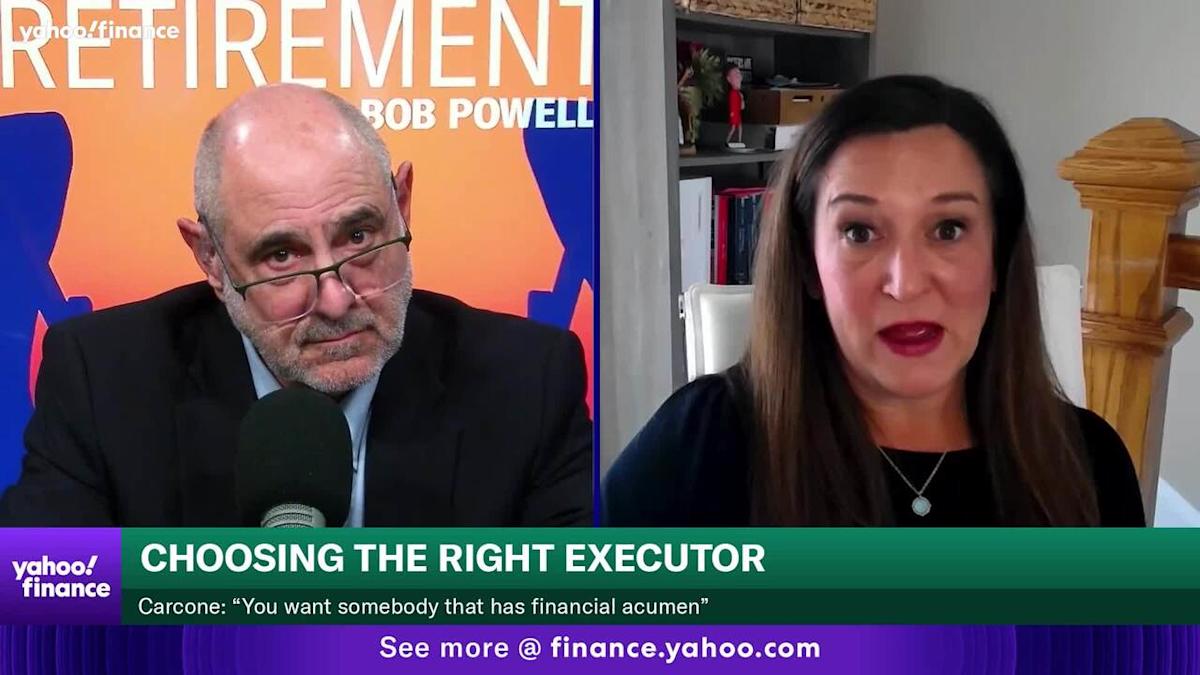
Uh, well, an executor is a fiduciary, and so your fiduciary is somebody that you’re going to need to step up in, and they, they always think of it as somebody wearing your fiduciary cap when you step into the role of executor. And so the executor is going to be charged with performing specific acts or specific duties, and the scope of the authority is going to be spelled out in the document.Oftentimes people think that it’s an honor to name somebody as an executor, but it actually has a lot of work. The executor is going to be responsible for collecting all of the assets after someone dies, valuing those assets, paying the decedent’s debts, paying taxes, and then ultimately distributing assets out to the various beneficiaries that are named in the will.Um, and this process can last from 9 months to a few years, so the executor has to be willing to serve throughout that period. You want someone that has the time to handle it. You want somebody that has financial acumen.They, they don’t, an executor doesn’t need to know exactly what to do and when to do it, but needs to know when they need help and when they’re gonna pull in other resources. It can be a very daunting task, it could be a challenging task, and so you really need to think about who you should name as thatperson.
12:24 spk_1
Yeah, I think uh.If anyone ever names me as executor, I’m going to take one step back because I’ve seen all the work that’s involved and, uh, I’m not sure I’m up to the task, but you’re right, it is a lot of work. So
12:36 spk_0
what you just mentioned is something that happens quite commonly. Folks might name their trusted family member or a friend.However, if you don’t have the time or the know-how or the skill set, it can truly turn out to be a mistake. So you want to think very carefully about that.
12:55 spk_1
Yeah, that’s good advice. Colleen, we’re gonna take a short break and when we come back, we’re going to talk about probate and also incapacity planning, one of my favorite topics. So don’t go away. Welcome back to Decoding Retirement. My guest is Colleen Carcon. She is director of wealth planning strategies at TIAA and also co-author of Principles of Estate Planning.Uh, well, right before we took a break, I promised that we would be talking about probate and incapacity planning. But first, Colleen, I want to talk about navigating special circumstances when it comes to estate planning, uh, blended families, unmarried couples, business owners, etc. Tell us what we need to know about that.
13:33 spk_0
Um, you know, when we initially, uh, the estate planning law, it’s draft has was drafted many years ago, and even though we undergo and go through revisions, the law at its core does not anticipate for some of these what we call special circumstances. And in many cases, the law has just not caught up. And so, your law isn’t going to say something to the effect of, if you have a party.But you’re not married. Or if you are in a second marriage and you each have children, the law is strictly going to look at what has been referred to as a traditional nuclear family. And so if you find yourself with any sort of what would be considered a unique or special circumstance, such as a blended family, second marriage, unmarried, if you’re not married to your partner.If you have children or dependents that have special needs, those are going to be considered special circumstances. You can provide for the special circumstance however you wish, but you have to incorporate it into your estate plan because default laws are not going to provide for those.
14:53 spk_1
Yeah. All right, let’s turn our attention to, uh, probate. Uh, years ago.Many books were written about how to avoid probate as if it was the worst thing in the world. Uh, let’s do a deep dive into it. What are the pros and cons of probate? What are some strategies for, uh, minimizing probate challenges that might come about and maybe how can living trust help the process here?
15:15 spk_0
Well, I wouldn’t say it’s the worst thing in the world. It might be the second worst thing in the world. I’m justteasing.
15:20 spk_1
I gotta think that death might be the worst thing,
15:23 spk_0
Colleen, but.
15:24 spk_1
But I’ll put probate right up there.
15:27 spk_0
Right, um, probate, you know, just to, uh, set the, you know, to set a baseline, probate is the court-supervised process of settling a decedent, the state, and it’s important to note that any assets that are passing by will are going to be subject to probate.And assets passing by intestacy are going to be subject to probate. And I mentioned that because I hear people say all the time, I don’t have to worry about that because I have a will. So I want to clarify that one of that myth. So, let’s look first at the disadvantages or why probate gets such a bad rap. Probate can in certain circumstances in certain states be very complex.It can be expensive, it can be lengthy, and probate is a public process, meaning probate records are going to be a matter of public record. Think of many of the celebrities that we hear about after they’ve passed. We know this because their estates are a matter of public record. So if no problems are anticipated.Then that court oversight and that cost and that delay might be viewed as a disadvantage. If you’re concerned with privacy, then probate is going to be considered a disadvantage. You might not want your estate to be a matter of public record. And finally, one of the most often overlooked components of probate is called ancillary probate.If you have property in more than one state, your will could actually be subject to probate in multiple states. So that’s the bad news. That’s kind of the cons. There are some advantages, Bob. There is court supervision, which if you are anticipating that there might be a will contest or other problem, then court oversight could be an advantage.Probate also protects creditors and beneficiaries, because the probate process provides a forum for creditors to step forward and say, hey, the person who just died owed me money. And then when the beneficiary is receiving assets, they know that they’re going to get it without a creditor showing up and knocking on their door down the road.
17:54 spk_1
Yeah.All right, well, that’s helpful to know. Um, let me turn my attention to incapacity planning. Uh, I talk a lot about this in the classes I teach and the articles I write, and, uh, it’s becoming increasingly more common that because of cognitive decline, dementia, Alzheimer’s, etc. people really need to plan for the possibility of not being able to make, uh, decisions on their own, whether it’s financial or healthcare related. Uh, tell us what we need to know about that.
18:23 spk_0
You’re absolutely right, Bob, and this is also a very often overlooked component of estate planning. I’m sure that we could talk for an hour on just this topic.Um, but if you’re not able to make decisions for yourself, if you have suffered cognitive decline or you’re just temporarily incapacitated, someone has to step in and make those decisions for you. And absent having the right documents in place, there’s going to be court oversight. So your financial power of attorney is going to be a document.That allows somebody to step in and handle financial decisions if you’re not able to. Compare that to your health care power of attorney or healthcare proxy, which names someone to step in and make healthcare decisions for you.And finally, your living will is going to be the document that expresses your wishes with respect to healthcare documents. Having these documents in place is going to make what is potentially one of the worst times in your family’s life where they’re seeing their loved one incapacitated, suffering, and having all sorts of health struggles.Having these documents in place won’t make dealing with the financial matters or the courts, um, would make dealing with these financial matters even more difficult than they need to be.
19:53 spk_1
Yeah, and, and it doesn’t have to be the same person for your health, your proxy for financial matters as it is for healthcare. In fact, it probably ought not be the same person, right?
20:04 spk_0
Yeah, absolutely. You want to look at the skill set of the people that are involved in your life when I think through my parents’ own estate planning. I’m an estate planning attorney. I’m in the financial realm, so it’s natural for me to make financial decisions. My sister is a nurse.And so it’s natural for her to be in a position, and she’s more well equipped to make healthcare decisions. And so you want to look at the skill set of the folks that you’re thinking about naming and see who has a skill set, who’s better equipped, who can handle the handle the responsibilities associated witheach.
20:45 spk_1
Yeah.So, uh, I would like to think that estate planning is a set it and forget it exercise, but it’s not, right? It needs to be updated on some regular basis. Maybe when a life event, uh, happens, uh, the birth of grandchildren, a divorce, the death of a spouse, etc. What do we need to know about the ongoing updating?
21:05 spk_0
You’ve named just a couple of the, uh, couple of the circumstances, Bob, and you’re exactly right. Um, ideally your estate plan would be reviewed every year.At a minimum every couple of years, and some attorneys do offer that as part of their service, but folks are oftentimes meet with their attorney, get their estate plan in place, and then move on and don’t look back. That’sWhere your financial planner, again, going back to one of the first things we talked about, that team that’s in place to help you, that’s where your financial planner can help. So I know at TIAA our advisors typically meet with their clients at least once a year, and we talk about what’s changed in your life. If you’re hearing any of those changes, the birth of a child, the death of a parent or someone else.The birth of a grandchild, divorce, illness, acquiring new property, these are all going to be triggers that you want to take a second look at your estate plan and make sure that what you have in place is going to continue to meet your objectives. Another big one, Bob, is changes in law.Now we know that the One Big Beautiful Bill Act has permanently set the federal estate tax exemption amount at $15 million. We also know that any time we hear something is permanent in the tax code, it’s written in pencil because there’s always going to be changes down the road.Any change in federal or state law is a cause to revisit your documents. Massachusetts changed their exemption amount in 2023, and as a result, we’ve been meeting with clients and really revisiting whether the plan that’s in place continues to meet their objectives or if it can be improved.
23:03 spk_1
Yeah.Colleen, uh, we’ve run out of time, unfortunately, uh, we’d love to have you come back on and do a deeper dive into some topics we didn’t get to. So, but in the meanwhile, thank you for sharing your knowledge and wisdom with us. It’s, uh, greatly appreciated.
23:17 spk_0
I’d love to come back, Bob. Thanks somuch.
23:19 spk_1
So that wraps up this episode of Decoding Retirement. We hope we provided you with some actionable advice to help you plan for or live in retirement. And don’t forget, you can listen to Decoding Retirement on Amazon Music or just ask Alexa, play Decoding Retirement on Amazon Music.
23:37 spk_2
This content was not intended to be financial advice and should not be used as a substitute for professional financial services.