
This post was originally published on this site.
Inside Groupon’s 2-year-old headquarters on the 25th floor of the Leo Burnett Building in downtown Chicago, a giant cat in a spaceship with flashing lights greets visitors in an otherwise staid office tower.
Here, the quirky e-commerce startup once dubbed the fastest-growing company ever, amid Super Bowl ads and ubiquitous media coverage, is quietly executing a turnaround after years of downsizing and red ink. Groupon is trying to become the next big thing once again. It happened once before.

“We’re at a point now in our journey where we have some victories, we have some things to look at, some proof points,” Groupon’s chief financial officer, Rana Kashyap, said during a recent tour of the newly expanded headquarters. “And everyone loves a comeback story.”
In 2023, Groupon, whose daily deals platform made it the startup star of the post-millennium Chicago tech scene, was teetering on the brink of insolvency.
A groundbreaking unicorn that once spurned a $6 billion takeover offer from Google on its way to a $25 billion valuation, Groupon had fallen to a fraction of its previous worth amid dramatic downsizing and sharp revenue declines.
When Dusan Senkypl, a Czech investor and the company’s largest shareholder, took control of the struggling e-commerce site and announced a turnaround strategy, Groupon issued a “going concern” warning to investors in May 2023 that the company could be out of business within a year.
“It was not a great situation for the business,” said Kashyap, 43, a New York-based former hedge fund investor who joined Groupon in January 2023 under Senkypl’s leadership. “Things were pretty grim.”
Groupon’s turnaround strategy included cost-cutting measures, such as breaking the lease on its massive River North headquarters at 600 W. Chicago Ave., once teeming with thousands of millennial employees. In January 2024, Groupon moved downtown to sublease a 25,000-square-foot floor of the Leo Burnett Building at 35 W. Wacker Drive, with a local workforce that had dwindled to 150 employees.
Like an expiring deal for a mani-pedi, Groupon itself seemed to be running out of time. But two years later, Groupon is still there and the turnaround is gaining traction, Kashyap said.
Once called the fastest-growing company in history by major media outlets, Groupon became a cautionary tech rise-and-fall story. Some analysts thought an epitaph was in the works. But last year, the company resolved its going-concern issues through belt-tightening measures, and is now ready to write a new chapter.
The downsizing is done and the focus has turned to growing revenues and expanding its reach, with the Chicago market providing a model for making the Groupon name relevant again in the competitive world of e-commerce it once pioneered.
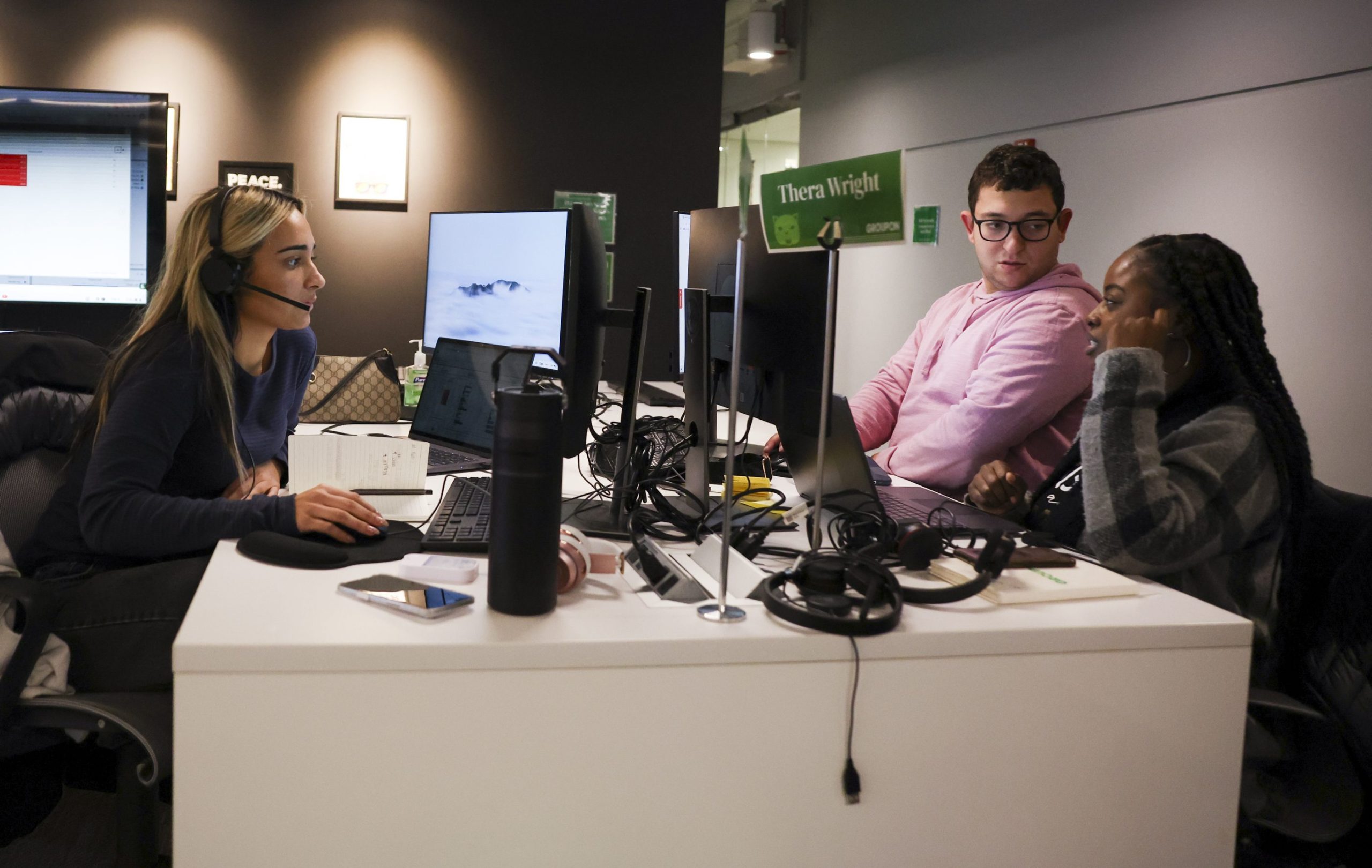
The Chicago headquarters has more than doubled to 377 employees, including sales, finance and other roles. Most work two to four days a week in the busy office, which added a second floor this year to accommodate the increased activity.
Kashyap, who joined Groupon as senior vice president and head of transformation, was elevated to chief financial officer in September, filling the role vacated by Jiri Ponrt, a partner with Senkypl in Prague-based Pale Fire Capital, Groupon’s largest investor, who moved up to chief operating officer.
Ponrt relocated to Chicago, grabbing an office to oversee operations at Groupon’s new headquarters, where he has been commuting to work each day in a Chevy Suburban. Meanwhile, Kashyap remains New York-based, with plans to be in the Chicago office 100 days next year in his new role as CFO. Both see 2026 as pivotal for Groupon 2.0.
“There was lots of work here internally to put processes in place and also cut the cost, and now we are focusing purely on revenue,” Ponrt said.
Groupon the Cat, a whimsical giant cat in a spaceship that hung from the fourth-floor atrium at the old headquarters, also made the move downtown — at new CEO Senkypl’s urging — stationed at the modest entrance to the 25th floor.
While it is getting busier and bigger, the downtown office tower is still a long way from where Groupon was as a stratospheric tech startup in the early days of e-commerce, with an origin story made for the new millennium.
In 2007, Andrew Mason, then a recent Northwestern University music grad, started a website called The Point with $1 million in seed money from tech entrepreneur Eric Lefkofsky. The initial concept was to catalyze support for common causes, but the mission soon pivoted to a daily deals retailing site.

Groupon launched in 2008, creating its own e-commerce niche with heavily discounted daily deals on everything from manicures to meals, blasted out to subscribers via email. It exploded in popularity and employment grew from a handful to more than 11,000 worldwide as the company’s valuation blossomed into the billions.
Google tried to purchase Groupon for nearly $6 billion in 2010, but Mason and his investors said no deal.
By 2011, Groupon was flying high, generating billions in annual revenue and cultivating a quirky culture that drew thousands of millennials to its new headquarters in the former Montgomery Ward catalog warehouse, a collegial frat house of a workplace that became the mecca of the burgeoning Chicago tech scene.
Groupon went public in November 2011, raising $700 million and reaching a market valuation north of $17 billion on its first day of trading.
For investors — and the company — it’s been mostly downhill from there. Operating losses, management missteps — including a disastrous 2011 Super Bowl ad — and a rapid post-IPO decline in valuation led to the 2013 ouster of Mason as CEO.
Early on, the business model expanded to include stocking and shipping products, which put it in direct competition with online retail giant Amazon. While Groupon Goods grew to become the lion’s share of the company’s revenue, it proved less profitable than the local third-party deals on which the company was established.
Gross billings peaked at $7.5 billion and revenue topped $3 billion in 2014. By 2019, the last prepandemic year, billings had fallen to $4.6 billion and revenue was $2.2 billion.
During the pandemic, billings plummeted and downsizing accelerated amid operating losses and dwindling cash reserves. By the time Czech investor Senkyl took control of Groupon in 2023, billings had fallen to $1.65 billion, while revenue dropped to about $515 million. A global workforce that once topped 11,000 was down to 2,213 employees, including 229 in Chicago.
At its 2023 nadir, a company once worth $25 billion had a market cap of about $100 million.
Billings bottomed at $1.56 billion, while revenue dropped to $492 million in 2024. But this year, both numbers are on the rise, with projected billings of $1.6 billion and $500 million in revenue. Kashyap said the company has reached positive free cash flow for the first time in years, and the turnaround is finally taking hold, with the Chicago market leading the way.
During the third quarter, billings growth across North America was up 18% and Chicago, Groupon’s largest and fastest-growing market, nearly doubled the national rate. A supply-driven business, Groupon is finding success by offering more local third-party deals that resonate online with customers, Kashyap said.
Meanwhile, the company has shifted away from its goods business, ceding that turf to a plethora of online competitors that have sprung up since Groupon launched 17 years ago.
Things To Do is Groupon’s largest category, offering experiences like boat tours, museums and other activities with a strong value proposition. Groupon also does brisk business in the Beauty and Health category, a core offering since inception.
King Spa & Sauna in northwest suburban Niles, for example, has been using Groupon for 15 years. The current offering is a 38% discount on admission to the “largest Korean-inspired spa in the U.S,” featuring sauna rooms, thermal pools and revitalizing treatments.
Groupon is looking to build up its offerings in other categories as well, including food and drink, hotels and live events, Kashyap said.
Charged with recruiting those deals for multiple markets, new hires are undergoing sales training in the Chicago office to reach local merchants and get them on the platform.
Sales director Sarah Neligan, who has been with Groupon for 12 years, moved from Ireland to the Chicago office a year and a half ago to head up new business development for the eastern half of the U.S.
“What Groupon does for local merchants is even more required now than it ever has been,” Neligan said during an impromptu stop-and-chat. “All local merchants are competing against these bigger players in the market, and we really do offer them a solution for smaller businesses with no upfront costs on how to grow their business.”
Neligan helped develop the new local market sales focus in Chicago, creating a playbook that Groupon plans to roll out in other cities.
As the company shifts from cutting costs to growing sales, Groupon has also recently ventured a modest return to TV advertising, something the startup once tried in a very big way.
Groupon aired its first Super Bowl ad in February 2011 — four months before the company filed for its IPO. The irreverent spot — a faux public service announcement for the endangered Tibetan people that shifted to a deal on fish curry — landed with a thud, precipitating a downward spiral that led to a rapid decline in valuation, the 2013 exit of Mason and a series of shifts in the business model.

In 2018, Groupon returned to the Super Bowl with a new TV ad featuring actress Tiffany Haddish, and a renewed focus on its daily-deals roots, but the company essentially went dark as business declined during the pandemic.
The new 30-second commercials are airing in Chicago, New York and Madrid, promoting generic discounted experiences such as spa days and date nights, while urging viewers to “Turn Life On With Groupon.” The essentially identical spots are customized for each market by dropping in a few landmark shots, such as The Bean in Chicago.
Groupon ran its first ill-fated Super Bowl ad three years after launching and Kashyap said the company is thinking like a startup again. But getting back to the Super Bowl may take some time for Groupon 2.0, he said.
“It’s not going to be next year,” Kashyap said. “From where we are today to the ultimate of TV advertising, the Super Bowl, there’s a long way from where we are to that. But we like to believe that that’s in the realm of possibility here.”