

This post was originally published on this site.
The Trae Young era in Atlanta is officially over. The former No. 5 overall pick is on the move, headed to Washington to join the Wizards after almost eight years with the Hawks. In exchange, the Hawks will bring in the expiring contract of CJ McCollum alongside sharpshooter Corey Kispert.
This was the first trade of the 2025-26 season, and it was a big one. A four-time All-Star is on the move, so with almost a month left before the deadline, let’s get into the weeds on this blockbuster. Who won? Who lost? And how will the deal impact the rest of the league with four more weeks of trading still to come?
Winner: Hawks
A few years ago, the notion of trading Young without getting a single draft pick would have seemed crazy. Things change. Young never really grew as a defender or off-ball player. The new CBA made his max contract an albatross. Atlanta went 2-8 with Young this season and 16-13 without him. Nobody was going to give up a haul for Young. But that doesn’t mean the Hawks won’t eventually get one.
By trading Young before he can pick up his $49 million player option for next season, the Hawks set themselves up to have potentially around $30 million in cap space next summer. If they use that space to sign a player or players, that will be the functional return on this trade. Conversely, the Hawks could turn around and use that newfound flexibility to trade for a veteran now. They’ve been linked to Anthony Davis, and moving Young will allow them to chase him without worrying about the luxury tax. They could also pursue a 2025 free agent they like now with the idea that acquiring him before free agency would allow them to operate above the salary cap and re-sign their own free agents.
We don’t know definitively what the Hawks plan to do yet, but we know they wanted to do it without Young. Just getting off of the last year of his contract is a win. Getting Kispert as a cost-controlled role player is a cherry on top here.


Think of recent veterans who have left the Wizards. Daniel Gafford and Deni Avdija thrived when they joined teams that were actually trying to win. Kispert should similarly enjoy playing for a team that’s actually competitive.
Loser: Point guards and the teams trying to trade them
Much of this season’s trade discourse has revolved around three point guards on max contracts: Young, Ja Morant and LaMelo Ball. The narrative surrounding all three has been about how limited the market for points has become, especially for players who aren’t reliable jump-shooters or defenders. But all three are former All-Stars. There’s a sheen of value that comes with that. Surely, if the Hornets or Grizzlies put their point guards on the market, they’d expect significant returns, right?
Well, the Young deal suggests what many of us have been thinking: players like this just aren’t worth that much in the modern NBA, at least when they’re earning max salaries. Young was a straight cap dump. He was traded without a single draft pick attached. Morant’s max contract is a year longer, and he carries far greater risk of injury and off-court conduct issues. If Young can only net a matching salary, why would Morant get much more?
Trae Young trade is latest example of an NBA archetype going extinct
Brad Botkin
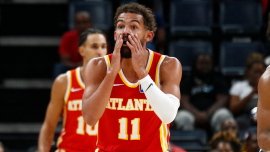
Ball is the youngest of the three. He’s also the biggest, suggesting slightly more defensive upside, and though his shooting percentages are often underwhelming, his skill is undeniable. There’s a bit more hope for him. But there’s been no notable movement on the Ball front for some time, and with the Hornets playing better, they may be happy to just roll with what they have for now. After all, if this is the market, why rush?
The long-term antidote to this problem will be contractual. If most point guards are impossible to trade with max salaries, then point guards who don’t consistently compete for All-NBA berths are going to stop making max money. A decade or so ago, a version of this played out for centers. The league was skewing smaller, and big men that were previously viewed as extremely valuable like Roy Hibbert quickly fell out of fashion. Now the league is bigger and more skilled than ever. If you can’t contribute defensively, if you can’t move off of the ball and space the floor, if everything your team does has to revolve around you, it’s just going to get harder and harder to earn the sort of contracts such players once got easily.
The easy Atlanta winner here would be Jalen Johnson. There’s now no debate. He’s the franchise player. He doesn’t have to compete with the expectations that Young generated over almost a decade. But the truth of the matter is that Johnson had already supplanted Young. If he had remained with the Hawks for the long haul, his role would have reflected the reality that Johnson was the best player on the team. While the Hawks didn’t play well with Young this season, the notion that the two could have fit together wasn’t ridiculous. Young is a shot-creator. He could have made Johnson’s life easier in some ways even if his weaknesses made it harder in others.


But Alexander-Walker? His role materially changes with Young gone. Remember, he didn’t even start on opening night. He was brought in ostensibly to be a 3-and-D reserve. His emergence as a genuine on-ball threat was something of an accident. His usage rate jumped from 16% last season to 25% this season. That never would have sustained if Young had been reintegrated onto the team. He would have been relegated to role player duties forever, and that would have capped his long-term earning power. He’s still under team control for two more years, but if he keeps playing as well as he has this season, he’s going to be able to turn this higher usage into a payday in the summer of 2028.
Loser: Trae Young
Alexander-Walker joined the Hawks last summer in part because Young actively recruited him. That’s how much things have changed over the last six months or so. Last offseason, it looked like the Hawks had properly recalibrated around Young’s skill set. They improved their perimeter defense with Alexander-Walker. They got Young the best rim-protector and shooting big man of his career in Kristaps Porziņģis. This was supposed to be his chance to prove he could lead a consistent winner. And then he got hurt, and everything fell apart.

Reports indicated that Washington was Young’s preferred destination. The Wizards were also the only team known to be interested in Young, so it’s hard not to wonder if that was just PR spin. The Wizards are, after all, a 10-26 team. Rarely do players as accomplished as Young want to join such teams.
It actually does make some sense in his specific case. Again, it doesn’t seem like anyone else was interested, so just getting to a team that wants him and can accommodate his present salary is something of a win. But the Wizards owe a top-eight protected first-round pick to the Knicks. They are going to do everything in their power to ensure they keep that pick. If that means putting Young on ice in the near future, so be it. If he plays too well, he gets shut down. If he plays poorly, it doesn’t exactly help his long-term value as a 2027 free agent. Young has a year and a half to convince the league he deserves another big contract. That’s not going to be easy on a team as young and presently unsuccessful as Washington. The Wizards were probably his best-case scenario at this year’s deadline. There certainly didn’t seem to be a contract extension out there for him on another team. But for his stock to have fallen this much over the past few years is an enormous disappointment.
We just covered the top-eight protected pick Washington owes the Knicks. Yes, the Wizards are likely to do everything in their power to keep the pick. But remember, perception is reality when it comes to trading draft capital, and the Wizards have quietly gone 7-6 in their last 13 games. They don’t actually need the Wizards to hand them the No. 9 pick. They just need the rest of the league to believe it’s feasible that they could, and then their trade deadline gets a bit more interesting.
The Knicks, after all, have no other first-round picks they can trade. That Wizards pick is still pretty enticing even if it falls in the protected range. It turns into two second-rounders, one of which would be Washington’s this season, which we know will be fairly high. But if they can convince another team that those two second-round picks they’re trading for actually have a chance to become the No. 9 overall pick, well, that opens some doors that were previously closed. The Knicks are still operating with minimal tradable salary regardless. They’re likely looking to flip Guerschon Yabusele and Pacôme Dadiet for a player making in the $7-8 million range, so pickings are slim, but Washington’s resurgence combined with the Young trade might just help them convince one of the teams with a player in that range to pull the trigger.
Loser: CJ McCollum
No, we’re not talking about McCollum, president of the player’s association, though he holds quite a bit of responsibility for the nature of the 2023 CBA which played a part in forcing this trade in the first place. We’re talking about McCollum, the 13-year veteran who has reached the conference finals once.
Now, this is something of a matter of opinion. As we covered, there is a chance the Hawks operate above the salary cap this offseason and re-sign McCollum at a reasonable rate to stay with them as a role player. However, that’s no guarantee. They could flip him elsewhere as part of a win-now deal, though his salary can’t be aggregated before the deadline. But more pressingly, he’s probably lost the chance to get bought out. The Hawks are going to want to keep him for the rest of the season.

I bring this up because, quietly, the field for potential buyout players is about as desirable this season as it has ever been. The new CBA prevents players like McCollum, who make more than the non-taxpayer mid-level exception, from signing with teams who are above the first apron after receiving buyouts. In some years, that would severely restrict his market. But this year? Most of the contenders are below that line, and several of them could certainly use McCollum.
Oklahoma City’s offense has felt a bit rickety lately. Think they could use a scorer like McCollum? How about the guard-thin Rockets? Maybe Denver, with all of its injuries? The Pistons badly need shooting. All four teams are below the first apron. The West teams would all likely want to make other moves before signing a high-end guard on the buyout market. Denver needs to duck the tax, Oklahoma City would need to clear a roster spot, and Houston is pressed right up against the first apron, but that’s four viable championship contenders that might have been able to add McCollum for free if he’d made it past the deadline in Washington and negotiated a buyout.
Would that have been his best financial path? It’s hard to say. Players think there’s a stigma to receiving buyouts. McCollum might risk getting labeled a ring-chasing veteran rather than a high-level player that still has earning power. But key role players on championship teams usually get rewarded in free agency, and beyond that, there’s a natural competitive urge to try to win a championship. The Hawks are a better team than the Wizards, but they’re not winning it all this season. If McCollum does want to chase his ring, that would probably have to come next season or beyond.