
This post was originally published on this site.
In 2025, China was one of the United States’ top trade partners on both the import and export sides; however, a closer look at the data reveals that overall trade with China is down compared to the previous year.
“This year, tariffs and trade tensions have reduced trade volume between North Carolina and China,” Joseph Harris, fiscal policy analyst for the John Locke Foundation, told the Carolina Journal.
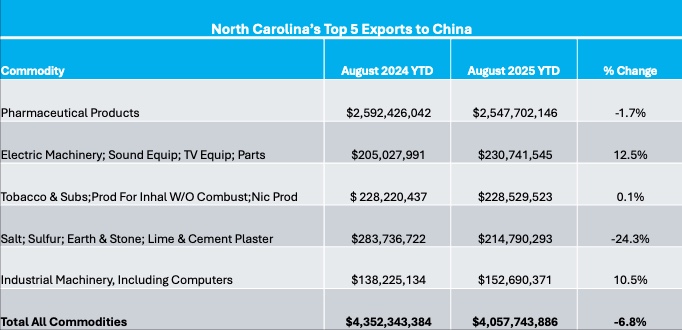
Pharmaceutical products are North Carolina’s top export to China, but they decreased from $2.6 billion to $2.5 billion, a 1.7% drop from the previous year. Electrical machinery and electronics, the state’s No. 2 export, increased from $205 million to $230.7 million, representing a 12.5% increase from the previous year. Tobacco and nicotine-related products (No. 3) increased slightly from $228.2 million to $228.5 million, a 0.1% increase from the prior year. Stone, lime, and cement products (No. 4) decreased from $283.7 million to $214.8 million, a 24.3% decrease from the previous year. Finally, industrial machinery, including computers (No. 5), increased from $138.2 million to $152.7 million, representing a 10.5% increase from the previous year.
On the import side, industrial machinery (No. 1) decreased from $1.5 billion to $1.1 billion, a decrease of 26.1% from the previous year. Electrical machinery and electronics (No. 2) declined from $688.1 million to $518.3 million, a 24.7% decrease from the prior year. Vehicle and auto imports (No.3) increased from $231.9 million to $245.7 million, a 5.9% increase this year. Organic chemicals (No. 4) saw the biggest increase this year at 107% up from last year, increasing from $105.6 million to $218.6 million. Finally, plastics and plastic articles (No. 5) decreased from $242.3 million to $213.8 million, representing an 11.7% decrease from the previous year.

“State exports into China have decreased from $4.4 billion to $4.1 billion, or 6.8%,” continued Harris. “At the same time, Chinese imports into North Carolina have declined from $4.7 billion $4.1 billion, or 13.8%.”
Despite increases in some commodities, overall trade with China is down, not only in North Carolina, but nationwide.
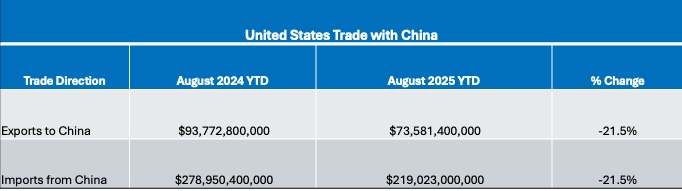
“The contraction is even more pronounced at the national level, where US exports to China and imports from China are each down 21.5%, underscoring the depth of the bilateral pullback,” Harris said. “China, however, has not experienced a comparable decline in global trade. Instead, it has expanded exports to other regions, with shipments to Africa, Southeast Asia, and Latin America rising 26%, 14%, and 7.1% so far this year.”
US exports to China decreased from $93.8 billion to $73.6 billion, and imports decreased from $279 billion to $219 billion year-to-date through August. Both imports and exports are down 21.5% from the previous year.
A recent article in The Wall Street Journal reported that China’s trade surplus this year surpassed $1 trillion for the first time. Yet, trade with the US is down. So while China remains a dominant trade partner on the international market, it is trading less with the US and more with other countries.
Brazil is a notable example of this, with 26% of its imports coming from China. The world watched as China turned to them as a trade partner for soybeans after American tariffs were implemented, and subsequently began to cut and eventually boycott US soybeans. In fact, following the recent trade deal, Brazil lowered soybean prices, and China increased its imports of Brazil’s soybeans.
All data are from the Economic Development Partnership of North Carolina and are year-to-date through August.