
This post was originally published on this site.
E-commerce Infrastructure Spending: Key Findings
Global eCommerce platform spend will reach $22.6 billion this year, showing the rise of long-term infrastructure costs for SMB retailers.
Companies with over $5 billion in revenue account for 51% of total platform spend, intensifying competition and raising pressure on smaller brands.
Open-source platforms like Magento reduce recurring licensing fees, helping SMBs redirect budget toward growth instead of subscription overhead.
SMBs are about to take a big blow in spending.
According to research by HG Insights, global e-commerce platform spending will hit a whopping $22.6 billion in the next 12 months.
The same study also noted that more than 43% of that spending comes from the Americas, with U.S. companies alone accounting for $8.4 billion (or 37%) of global spending.
For small-to-medium (SMB) e-commerce brands, these numbers are a sign that platforms aren’t just tools, but are becoming one of the largest recurring cost centers in digital retail.
That raises a single high-stakes question for SMBs: How cost-efficient is the platform you’re building on?
While enterprise companies earning over $5 billion annually represent 51% of all global spend, smaller brands are absorbing the impact of rising infrastructure costs without the same budget safety net.
According to HG Insights, more than 4.2 million companies fall into the $1M to $10M revenue bracket.
And yet, they collectively represent just 0.4% of total e-commerce platform spending.
This widening cost gap is where Magento Open Source becomes a strategic outlier, says e-commerce developer Bighorn Web Solutions.
Its extensible framework and lack of licensing fees offer a measurable long-term cost advantage for resource-conscious brands.
“Total cost of ownership is becoming the primary decision driver,” Bighorn CEO Caleb Bradley told DesignRush.
“Open-source platforms reduce recurring fees and let SMBs invest in growth instead of subscriptions.”
Understanding the Real Cost Center: Infrastructure
Even as e-commerce grows, infrastructure spending is accelerating faster.
HG Insights reports that the Finance & Insurance ($5.8B) and Manufacturing ($4.5B) sectors are among the biggest platform investors.
This illustrates that competitive digital commerce now requires increasingly sophisticated technical foundations.
For SMBs, this means traditional SaaS licensing models that are often priced per order, per store, or per feature create compounding costs that scale with revenue rather than capability.
Luckily, Magento Open Source avoids this entirely.
Because the platform itself carries no licensing fee, brands can allocate budgets toward hosting, development, performance optimization, and security, which typically create a more predictable long-term cost curve.
Bighorn explains that this shift changes the economic model of an e-commerce site.
Instead of ongoing subscription inflation, costs are tied to actual business needs.
Why Open Architecture Reduces Total Cost of Ownership
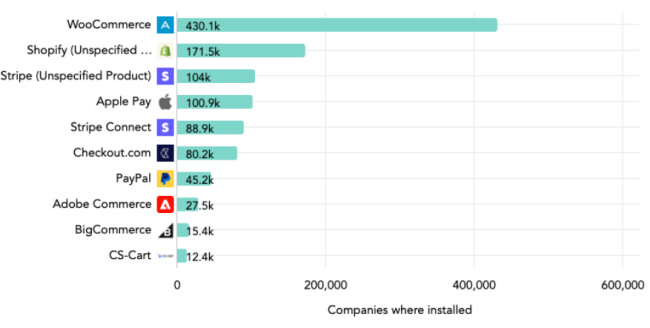
HG Insights found more than 4.2 million e-commerce platform installations in the U.S., and more than 430,000 installations for Automattic (WooCommerce) alone.
It’s clear proof that there is a strong demand for flexible systems.
Magento’s extensible architecture functions similarly but offers deeper customization without vendor lock-in.
SMBs scaling from a few hundred to a few thousand SKUs will find open architecture beneficial, as it can prevent expensive platform migrations later.
Bighorn Web Solutions emphasizes that Magento’s modularity allows SMBs to integrate payment systems, ERPs, PIMs, and fulfillment without rewriting the entire backend.
“Extensibility reduces long-term technical debt,” Bradley explained.
“If you outgrow a SaaS feature set, you pay for upgrades or switch entirely. With open source, you adapt the platform instead of abandoning it.”
Avoiding Hidden Recurring Fees
Companies with more than 5,000 employees account for 53% of all e-commerce platform spend, proving that enterprise-grade systems are becoming more expensive across the board.
But SMBs frequently experience the financial strain first because recurring SaaS fees scale automatically with volume.
Magento Open Source mitigates this by providing transparent cost composition: hosting, development, maintenance, and enhancements.
All without transaction-based charges.
This clarity gives SMBs control over budget allocation, especially during periods of rapid growth or seasonal spikes.
What All This Means for SMBs
The biggest mistake SMBs can make isn’t choosing the wrong platform.
It’s choosing a platform with a cost model that grows faster than their margins.
Magento Open Source offers a way to align infrastructure spending with real business needs instead of subscription tiers.
Brands that prioritize extensibility and predictable cost structures will scale more efficiently than those tied to vendor-driven pricing.
As infrastructure spending accelerates, the smartest SMBs will be the ones that stay in control of what they pay for.