
This post was originally published on this site.
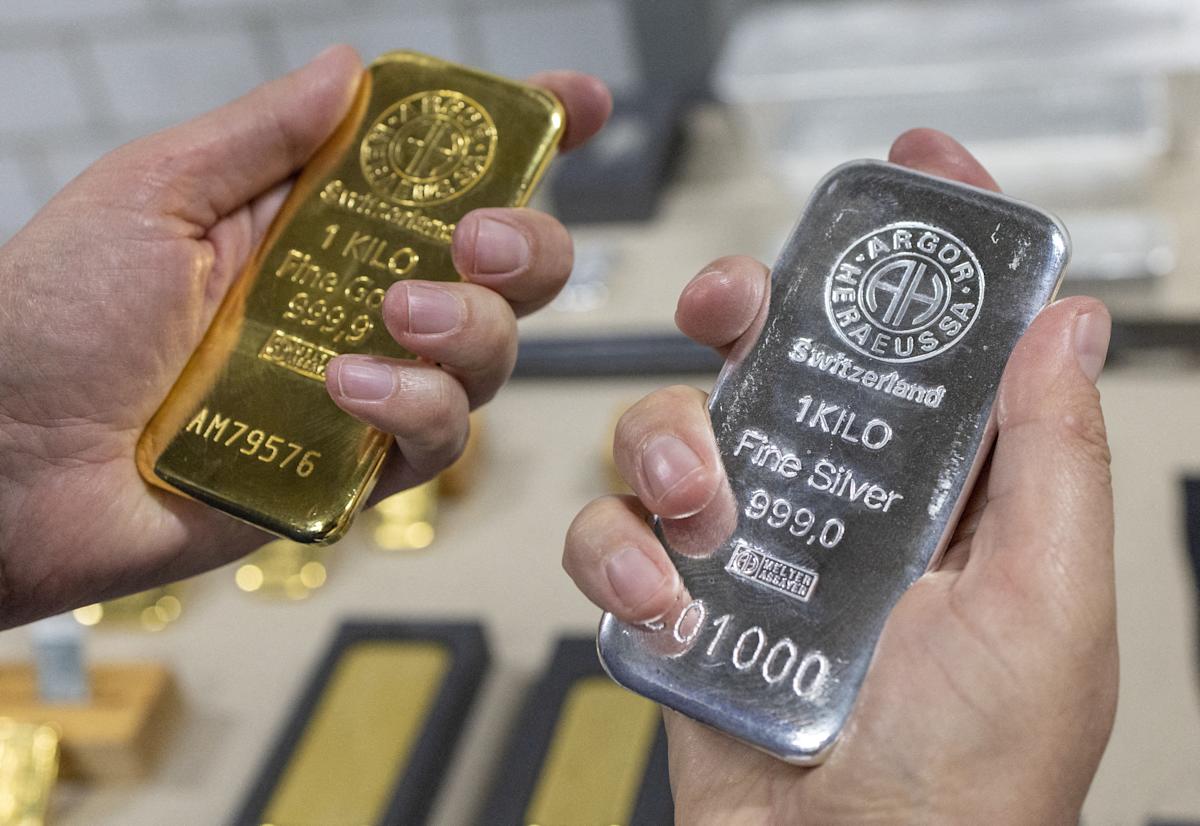
Gold (GC=F) and silver (SI=F) prices fell on Thursday as a stronger dollar and signs of easing US-China trade tensions reduced demand for safe-haven assets.
Gold futures (GC=F) climbed 0.2% to $4,958.40 a troy ounce, while spot prices lost 3.1% to $4,936.24 at the time of writing.
Spot silver (SI=F) plummeted 11% to $80.75 an ounce after reaching a record high of $121.64 last week, while silver futures fell 5.2% to $80.01.
Read more: Stocks lack direction as traders await BoE and ECB interest rate decisions
The decline came as the US dollar hovered near a two-week high, supported by US president Donald Trump’s nomination of Kevin Warsh as chair of the Federal Reserve. The move has fuelled speculation that the central bank could take a less dovish approach than previously expected, providing further support for the dollar.
“With the blink of an eye, volatility in the precious metals returns with silver (SI=F) falling 16% in quick time. It is common after a period of extreme volatility to experience a sequence of volatility aftershocks,” said Tony Sycamore, an analyst at IG.
Read more: Should you invest in gold?
“After the 20% plunge from $5,600, gold (GC=F) hit $4,400 before rebounding to $5,065. Extreme volatility like this typically brings aftershocks, and more turbulence is expected in the short term,” he added.
On the geopolitical front, Tehran and Washington are due to hold talks in Oman on Friday, according to officials from both countries. Separately, China may step up purchases of US grown soybeans, Trump said, following what he described as “very positive” talks with Chinese president Xi Jinping on Wednesday.
UBS (UBSG.SW) said that silver (SIL=F) prices would need to fall even further “to make the metal attractive to us.”
“In our view, an asset exhibiting 60-120% volatility requires an expected return of 30-60% to go long, which is not yet the case,” they said.
“Lower prices are therefore needed to make the metal attractive to us … we think investors should carefully consider the return required for an asset that has recently exhibited [such high] volatility.”
Oil prices fell on Thursday after Washington and Tehran agreed to hold talks in Oman on Friday, raising hopes of a diplomatic opening even as sharp differences remain over the scope of the discussions.
Brent crude (BZ=F) futures lost 1.6% to $68.33 a barrel, while West Texas Intermediate (CL=F) dropped 1.7% to $64.02 at the time of writing.
Iran has said it wants the talks to focus on its longstanding nuclear dispute with Western powers. The United States is pushing for a broader agenda that would also include Iran’s ballistic missile programme, its alleged support for armed groups across the Middle East and its domestic human rights record.
Oil (BZ=F, CL=F) prices had jumped about 3% on Wednesday after Trump said Iran’s supreme leader Ayatollah Ali Khamenei “should be very worried”.
Read more: Shell misses fourth-quarter profit expectations but launches another $3.5bn buyback
Analysts at Citi said risks to the upside remained. “Crude oil prices moderated because of discussions concerning the upcoming US-Iran negotiations which have eased immediate risk premium, but both we and market participants remain concerned about upside risks,” the bank said, citing US actions toward Iran and uncertainty over Indian purchases of Russian oil.
The pound was down 0.3% against the dollar at $1.3613 and fell by a similar margin versus the euro at €1.1530.
The US dollar index (DX-Y.NYB), which measures the currency against a basket of six major peers, rose 0.1% to 97.70.
Bank of England policymakers are widely expected to keep interest rates on hold at 3.75% as they attempt to balance efforts to rein in inflation with the need to support a weakening economy.
Read more: Bank of England set to hold interest rates at 3.75% but cuts loom
Inflation rose for the first time in five months in December, climbing to 3.4%, while the unemployment rate remained at a five-year high of 5.1% in the three months to November.
Deutsche Bank said it expected the Bank’s Monetary Policy Committee to leave rates unchanged as it also contends with the risk of “wage settlements stalling at a slightly uncomfortable 3.5%”.
Stocks: Create your watchlist and portfolio
Strong pay growth risks fuelling inflation, while higher borrowing costs threaten to weigh on economic growth. Deutsche Bank’s chief UK economist Sanjay Raja said the bank would therefore “lower its GDP projections a touch in the very near-term”.
In equities, the FTSE 100 (^FTSE) was lower on Thursday after hitting a record high the previous session. The UK blue-chip index was down 0.2% to 10,388 points.
Read more:
Download the Yahoo Finance app, available for Apple and Android.