
This post was originally published on this site.
Retirement pension investors’ tendency to invest in exchange-traded funds (ETF) is rapidly changing. Rather than putting weight on stable products such as corporate bonds and money market funds (MMF), there is a clear atmosphere of actively investing in aggressive products such as U.S. stock indexes and artificial intelligence (AI), secondary batteries, and semiconductors. Under the current regulations, retirement pension accounts cannot be directly invested in stocks, so subscribers are investing indirectly in domestic stock markets through ETFs.
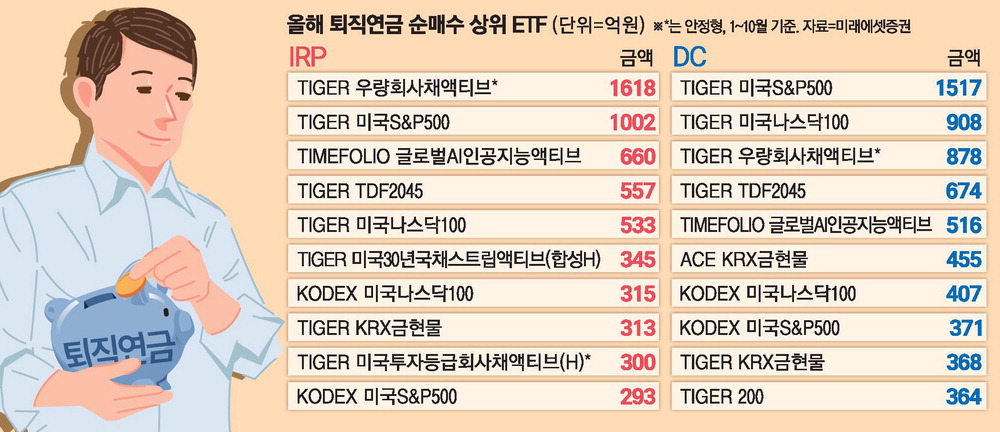
Maeil Business Newspaper asked Mirae Asset Securities, which has the largest pension investors and reserves among domestic securities firms, to analyze the top ETFs for net purchases of fixed contribution (DC) and personal retirement pension (IRP) accounts between January and October this year, and found that among the top 10 players, aggressive products accounted for nine in DC and eight in IRP.
In this analysis, short- and medium-term corporate bonds, high-quality corporate bonds, CD interest rates, and MMF were classified as stable, while sector and themed ETFs such as AI, secondary batteries, semiconductors, and Chinese electric vehicles were included in the attack type. Ultra-long-term bond ETFs with high interest rate sensitivity and high price volatility are classified as bonds but aggressive products. Ultra-long-term bonds are recognized as risky assets as stocks in the industry due to large price fluctuations caused by changes in interest rates.
In 2023 alone, among the top 10 net buying ETFs in IRP accounts, there were four stable products and three in DC accounts. At that time, mid-term corporate bonds and high-quality financial bonds accounted for a high proportion of the portfolio. In fact, the No. 1 net purchase ETF of IRP accounts was TIGER 24-10 corporate bonds (A+) active, and the No. 2 was TIGER 25-10 corporate bonds (A+) active. These products ranked second and third in DC accounts, respectively.
This year, this change has accelerated even more. Among the top 10 ETFs in IRP accounts, stable products were reduced to two, and only one in DC accounts. Even if the scope is expanded to the top 20 ETFs, there are only three and one stable type, respectively. In particular, in the case of DC accounts, 19 out of the top 20 are aggressive ETFs, which is interpreted as a stronger aggressive investment tendency.
According to individual stocks, by the end of last month, “TIGER Blue-chip Company Bonds Active” was the largest net purchase of 161.8 billion won in IRP accounts, absorbing basic bond demand. TIGER blue-chip corporate bonds selectively invest in domestic other financial bonds or A-grade blue-chip corporate bonds, and are considered suitable as pension investment products because they are relatively less affected by won-dollar exchange rates and stock market volatility. The product was also net purchased worth 87.8 billion won from DC accounts.
The progress of ETFs that follow the U.S. representative index is also remarkable. Until last year, only one or two products in the top 10 were invested in the S&P 500 or Nasdaq 100 in IRP and DC accounts, but this year, four were included each.
Analysts say that high-growth themed ETFs such as AI, which have attracted attention this year, are also at the top of the list, helping to expand aggressive investments. A case in point is that “TIMEFOLIO Global AI Artificial Intelligence Active,” which invests in global AI value chains, ranked third and fifth in net purchases of IRP and DC accounts, respectively. Gold-related ETFs, which broke record prices in the third quarter of this year, were also listed in the rankings.
Chung Hyo-young, head of Mirae Asset Securities’ pension consulting division, said, “As the stock market has recently shown a positive trend, pension investors’ sentiment for domestic and foreign stocks is generally increasing.” “Conservative investors who have been waiting and watching the market have begun to invest in pensions in earnest, which is also largely due to the inflow of new funds,” he explained.
[Reporter Kim Jihee]