
This post was originally published on this site.
Make better investment decisions with Simply Wall St’s easy, visual tools that give you a competitive edge.
-
Regions Financial (NYSE: RF) has amended its bylaws to expand shareholder rights and refine corporate governance provisions.
-
The changes address rules for special shareholder meetings and clarify officer indemnification, affecting how investors can engage with the company.
-
This governance update represents a material shift in how shareholder influence and corporate oversight are structured at Regions Financial.
Regions Financial, a regional banking group listed on the NYSE under the ticker RF, operates in a sector where governance practices are closely watched by regulators and investors. As banks work through evolving capital, risk and compliance expectations, updates to bylaws can shape how decisions are made and how shareholder voices are incorporated into that process.
For you as an investor, expanded rights and clearer meeting and indemnification rules may change how you think about control, board accountability and potential legal risk. While the practical impact will depend on how these provisions are used over time, this kind of governance shift is worth tracking alongside the usual financial and regulatory updates when you assess NYSE: RF.
Stay updated on the most important news stories for Regions Financial by adding it to your watchlist or portfolio. Alternatively, explore our Community to discover new perspectives on Regions Financial.
How Regions Financial stacks up against its biggest competitors
The by-law changes at Regions Financial give shareholders more defined levers to influence the company, particularly through the ability of a 25% ownership block to call special meetings and through clearer rules on director nominations and officer indemnification. For you, that can matter when evaluating how responsive the board may be to investor concerns compared with peers like Truist Financial and PNC Financial Services, and how governance structures might affect decisions on capital returns, partnerships or acquisitions.
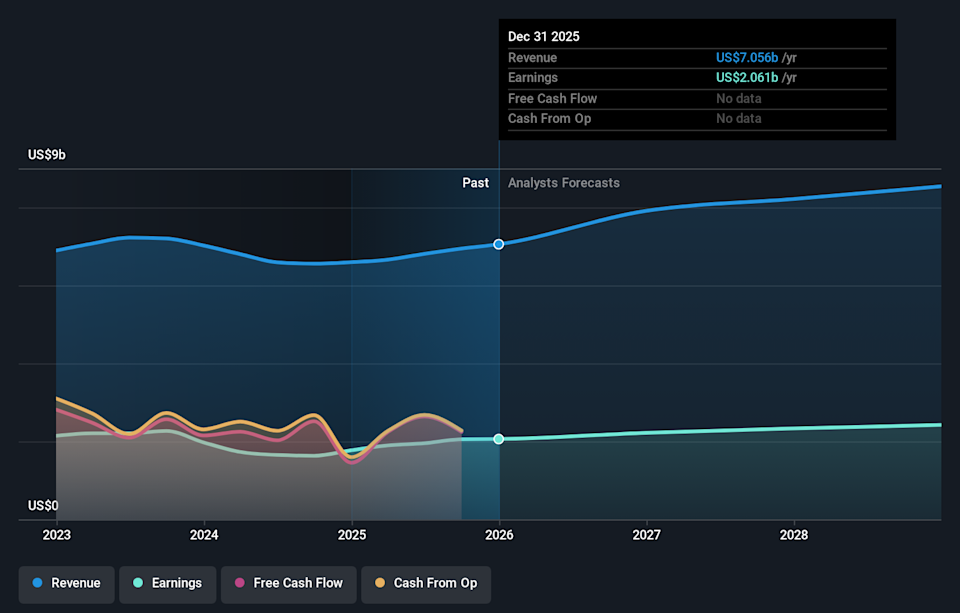
These governance updates sit alongside a broader story in which Regions is trying to balance earnings stability, dividend income and cautious risk management in a competitive regional banking group that includes players such as Fifth Third Bancorp and KeyCorp. Clearer shareholder rights and nomination procedures can support that longer term narrative by setting out how different investor groups could influence board composition and push for changes if they disagree with how management is handling credit quality, partnerships like the Worldpay tie up, or future capital allocation.
-
More defined rights around special meetings may give engaged shareholders a clearer path to raise concerns or push for changes when they think the board is not aligned with owners.
-
Transparent nomination and indemnification rules can reduce uncertainty about how board seats are contested and how executives are protected in legal disputes, which some investors see as part of a cleaner governance framework.
-
Easier coordination for a 25% shareholder group could increase the chance of campaigns that create short term pressure on management, which does not always align with every investor’s time horizon.
-
More detailed governance provisions can introduce complexity, so it is worth reading the fine print to understand how these rights work in practice before assuming they always favor minority holders.
From here, it is useful to watch how often investors try to use the special meeting and nomination tools, and whether large shareholders, insiders or outside groups signal any change in their engagement with the board. If you want to see how other investors and analysts are thinking about these governance moves in the context of Regions Financial’s broader story, check community narratives on this dedicated page.
This article by Simply Wall St is general in nature. We provide commentary based on historical data and analyst forecasts only using an unbiased methodology and our articles are not intended to be financial advice. It does not constitute a recommendation to buy or sell any stock, and does not take account of your objectives, or your financial situation. We aim to bring you long-term focused analysis driven by fundamental data. Note that our analysis may not factor in the latest price-sensitive company announcements or qualitative material. Simply Wall St has no position in any stocks mentioned.
Companies discussed in this article include RF.
Have feedback on this article? Concerned about the content? Get in touch with us directly. Alternatively, email editorial-team@simplywallst.com