

This post was originally published on this site.
It’s just about decision time for Detroit Red Wings general manager Steve Yzerman.
Even though the NHL trade deadline is still nearly six weeks away, the long Olympic break means there are only nine more Red Wings games between now and March 6. The Red Wings have had their pro scouting meetings, and the team on the ice couldn’t have done anything more to this point to convince their general manager to make a move.
Advertisement
Sitting tied atop the Eastern Conference, Detroit looks like a playoff team. But the Red Wings still have real questions on the blue line, and could really use a second-pair defenseman to beef up their outlook for the playoffs. There’s also a good case to be made for one more piece up front, ideally a top-six forward who could add some hard offense to the top of their lineup (though Marco Kasper’s recent surge may help there).
It’s an interesting market this year with so many teams still hanging around the playoff mix — including some presumed sellers. But rough years in New York, St. Louis and Vancouver also have the potential to put some interesting pieces in play.
So, who could the Red Wings target? What follows is not an exhaustive list, but it includes some of the top names who fit those needs between now and March 6, all pulled from Chris Johnston’s latest trade board.
Top-four defensemen
Justin Faulk, RHD, St. Louis
Faulk profiles as an ideal fit for the Red Wings’ biggest need. He’s an experienced top-four blue liner who can log big minutes, move the puck and chip in some offense. He’s also on a perfect bridge contract as Detroit continues to bring along Axel Sandin-Pellikka. He has this year plus one more at a very manageable $6.5 million cap hit, which would help the Red Wings insulate Sandin-Pellikka without blocking him long-term.
The reported asking price is high, with Elliotte Friedman saying it’s in the neighborhood of what Rasmus Andersson fetched for the Calgary Flames: Zach Whitecloud, a first-round pick, a second-round pick that can become a first if Vegas wins the Cup, and prospect Abram Wiebe. But since Detroit’s first-round pick now looks likely to fall in the 20s, I do wonder if parting with that pick gets a bit easier to stomach, and the Red Wings have a deep system of prospects to deal from.
Advertisement
Maybe he ends up being too expensive, but Faulk would certainly make that blue line look a whole lot more playoff-ready.
Mario Ferraro, LHD, San Jose
After Faulk, there’s a drop-off in the believed-to-be-available defense market, especially if the New Jersey Devils don’t end up moving Dougie Hamilton. But Ferraro logs a big workload in San Jose, averaging north of 20 minutes a night for six years running. He’s not big at 5-foot-11, but he eats pucks and throws his body around enough to be a passable No. 4 for a playoff team. The right side is Detroit’s bigger need, though.
Connor Murphy, RHD, Chicago
Murphy’s workload is way down in Chicago this season, with the Blackhawks’ young defensemen dropping him down to the third pair. But he’s been in the ballpark of 20 minutes for most of the rest of his career, is a right-hand shot, and is the kind of steady veteran stay-at-home defender teams are always looking to add for the playoffs. He and Ben Chiarot could form a more prototypical second-pair.
Chicago is already asset-rich, though, which gives the Blackhawks some leverage in deciding if they want to move one of their veteran leaders. But they also likely want to make space for Sam Rinzel down the stretch, too.
Carson Soucy, LHD, New York Rangers
I liked the Rangers’ second pairing of Soucy and Will Borgen when I saw them earlier this season, and Johnston noted Soucy’s comfort level playing either side of the ice, which would be valuable for the Red Wings. A right-hand shot would be ideal, but comfort on the off-hand is the next best thing. Plus, with some uncertainty about Simon Edvinsson’s status, a viable lefty who profiles as a No. 4/5 could prove valuable in its own right.
He’s a true rental, so the cost should be more manageable — perhaps a “B” prospect or a second- or third-round pick? — but the lack of defensemen on the market could drive that higher.
Advertisement
Brett Kulak, LHD, Pittsburgh
The Penguins’ current status as a playoff team makes this one hard to handicap. At a minimum, it could drive the price up on Kulak, who played 23 minutes a night for Edmonton in the Oilers’ Stanley Cup Final run last season. He’s probably more of a 4/5 in an ideal world, but he can play both sides and is averaging 20 minutes for the Penguins right now, with fairly solid underlying numbers. He would be a credible upgrade for Detroit.
I’d ballpark his value similar to Soucy in theory, but that’s where Pittsburgh’s playoff race comes into play; he’s more valuable to the Penguins this season than Soucy would be to New York.
Logan Stanley, LHD, Winnipeg
It might be a stretch to group Stanley in as top four, as he’s yet to average 17 minutes a night in his NHL career. Winnipeg played him less than 12 minutes a night in the playoffs last season. But at 6-7, teams will covet his size, and his eight goals this season are eye-catching, too (though his 14.8 percent shooting percentage is more than triple his career average, and thus feels destined to regress).
He’s a true rental, and only has 100 hits in a season once, but he warrants a mention nonetheless.
Robert Thomas would create an immediate one-two punch with Dylan Larkin for the Red Wings. (Peter Creveling / Imagn Images)
Top-six forwards
Robert Thomas, C, St. Louis
Of all the players on Johnston’s trade board, Thomas is the one who should make your eyes widen. A 26-year-old right-shot center, coming off back-to-back 80-point seasons, with five more seasons at a highly affordable $8.125 million cap hit? That’s a dream.
For that reason, I’m a bit skeptical Thomas actually moves at this deadline. He has a full no-trade clause if he wants to stay. But the Blues are at the bottom of the NHL standings, and if St. Louis is really listening on Thomas, he’s the kind of player it would make sense to go all-in for. He would immediately make Detroit more dangerous this year and give them a long-term top-six center to pair with Dylan Larkin.
Naturally, he would command a very high price. When you consider the term and cap hit, I could see it being in the ballpark of what Quinn Hughes fetched for Vancouver: three to four premium assets, one of which would assuredly need to be a young center. That’s a lot, no doubt. But prime-aged centers with term don’t come available often, and Thomas would immediately make Detroit’s present and future more imposing.
Advertisement
Bryan Rust, RW, Pittsburgh
As with Kulak, Pittsburgh being in a playoff spot (and a divisional seed, no less) complicates this one. It’s tough for the market that Penguins aren’t the obvious seller they appeared to be coming into the season, and Rust is also a heart-and-soul piece there in addition to being Sidney Crosby’s linemate.
He’s on the older side at 33, but if things start to tilt the wrong way in Pittsburgh leading up to the deadline, Rust would be a nice fit coming back to his home state as a legit top-six scorer who can bring the kind of hard, interior offense the Red Wings will need in the spring. I have to believe he’d cost at least a first-round pick (or equivalent prospect), but the two extra years of term on his deal would make that easier to stomach.
Vincent Trocheck, C, New York Rangers
Trocheck should be in high demand with the Rangers rebuilding, and as an Olympian for Team USA who plays a gritty two-way game down the middle. He was one of the Rangers’ most effective playoff performers in 2023-24 (20 points in 16 games) and is having another strong offensive season with 32 points in 38 games.
The questions here: Does Detroit really want to potentially disrupt what it has going on the second line right now, where Andrew Copp has 23 points in his last 26 games? If not, what’s a reasonable price to pay for someone who could end up the 3C? A first-round pick (or equivalent prospect) feels like just the starting point for a player who should have a wide market.
Steven Stamkos, C/RW, Nashville
Stamkos is back to scoring at a 40-goal rate for the Predators and comes chock-full of playoff experience and leadership. Yzerman knows him as well as anyone in the league. That being said, Detroit’s power play is already packed with right-shot snipers, and the two more years at an $8 million cap hit are risky for a player who turns 36 next week. It’s hard to ballpark the potential cost, but he’s an excellent player and a proven winner, so he merits a look.
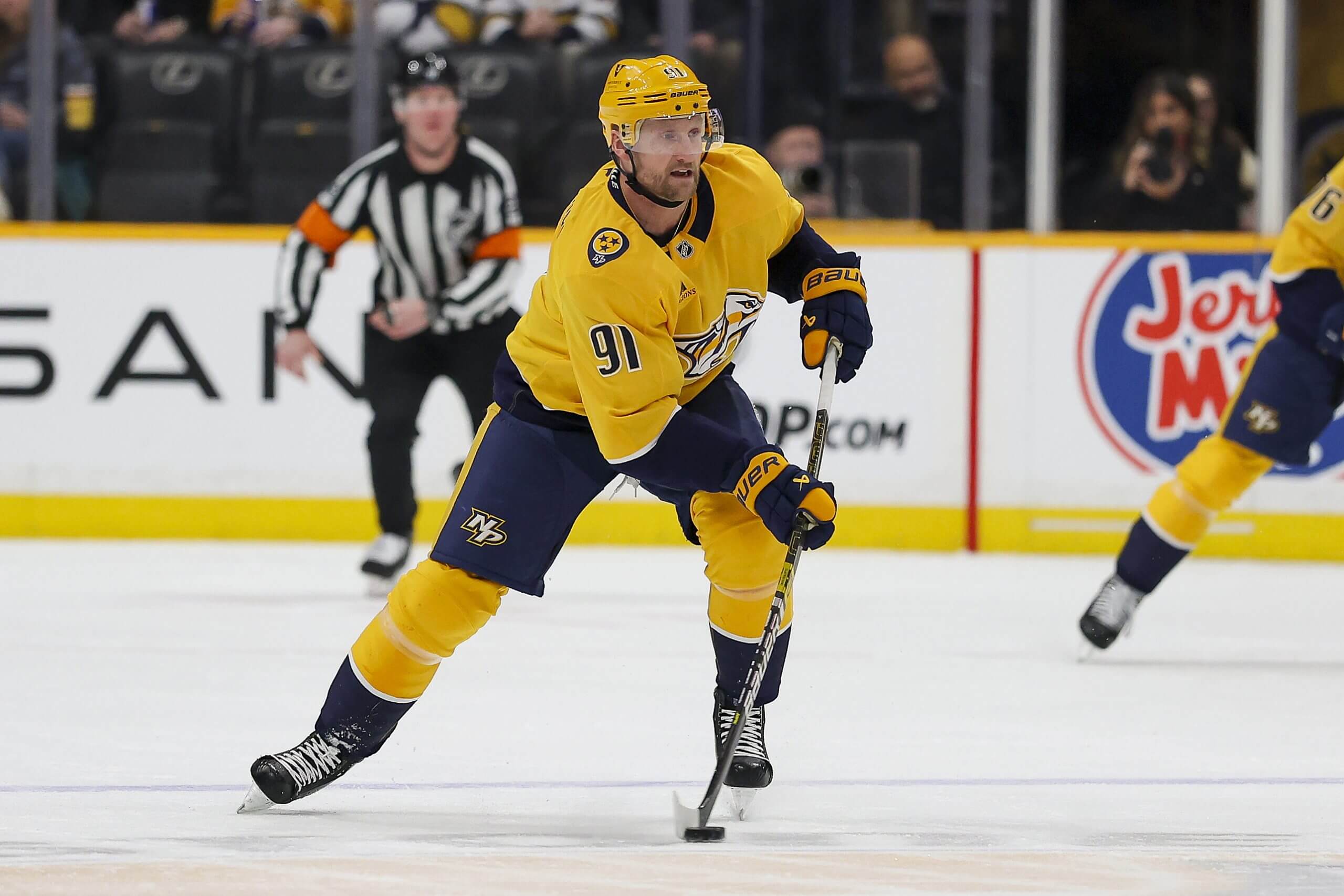
Steven Stamkos is back to his high-scoring ways with the Predators. (Steve Roberts / Imagn Images)
Blake Coleman, C/W, Calgary
Coleman is out right now, and it’s hard to see Detroit paying a big price for him. Yzerman tends to like term and the Red Wings are not a desperate up front. With 21 points in 44 games so far, it’s also a fair debate whether adding him would really be worth bumping down Kasper or Emmitt Finnie. But when he’s healthy, Coleman can bring the kind of hard offense the Red Wings will need in March and April, and he’s a proven quantity in the playoffs.
Jake DeBrusk, LW, Vancouver
It’s been a disaster year in Vancouver all around, and DeBrusk hasn’t been immune, with just 24 points through 50 games in his second season of a seven-year, $5.5 million AAV deal signed last summer. That makes the evaluation key here: is this dip in production more related to the Canucks, or to DeBrusk as he approaches 30?
Advertisement
The cap hit isn’t killer, but it’s a lot of term to take on for a middle-six scorer. If Detroit believes in the player, it’s not a bad AAV for a heavy winger who has regularly scored 25 goals and has some playoff track record. The contract could bring down the acquisition cost, too. But it’s not a deal to take on lightly, so the Red Wings would need to be certain.
Elias Pettersson, C, Vancouver
You can make a similar case for Pettersson as with Thomas, though Pettersson’s profile is a bit less of a natural fit for what the Red Wings typically look for (and significantly more expensive). He has a full no-move clause, too. Still, the upside is massive for a young center with term and point-per-game upside, and he’s worth checking in on just in case.