
This post was originally published on this site.
Despite receiving billions of American tax dollars last year in a controversial bailout backed by Donald Trump, Argentina’s president recommitted on Thursday to expanding his country’s trade with China at the World Economic Forum in Davos, Switzerland.
Javier Milei’s comments arguably kicked sand in the face of American farmers who warned last year that Trump’s bailout of Argentina would undercut the U.S. economy because of the nation’s deep trade relationship with China.
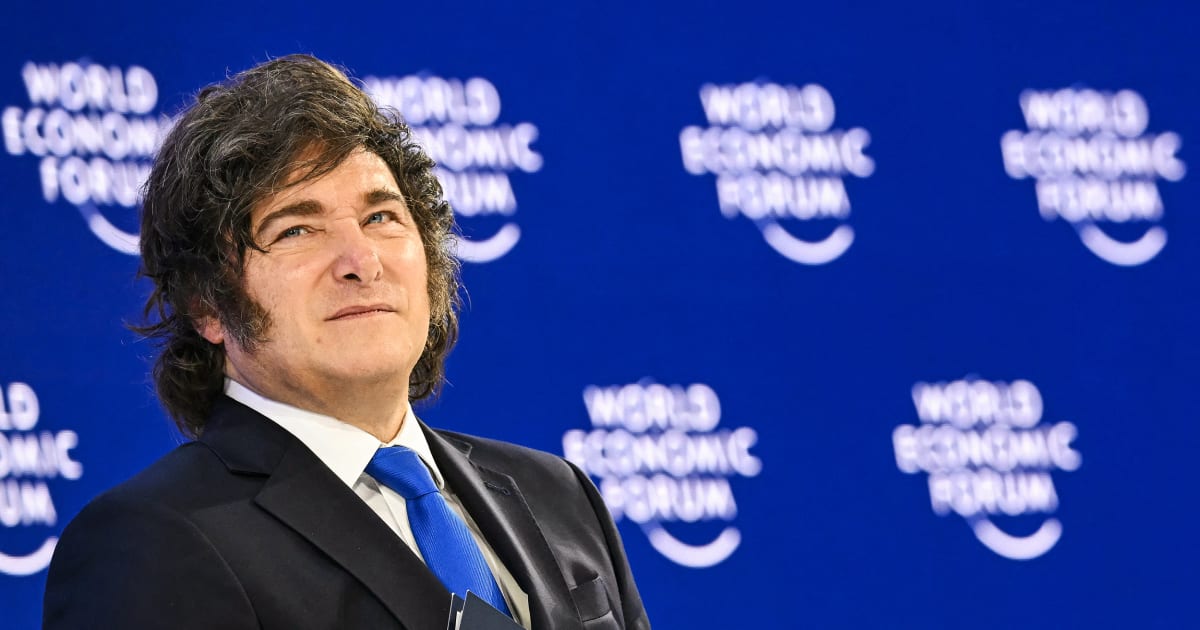
In an interview with Bloomberg News Editor-in-Chief John Micklethwait at the World Economic Forum on Thursday, Milei deftly balanced his ideological support for US President Donald Trump’s administration with his economic courtship of China, while making the case for free trade. ‘The way we see it, China is a great trading partner,’ Milei said, minutes after appearing at a Davos event with Trump as one of the founding members of the US president’s contentious ‘Board of Peace.’ ‘If you look at China’s weight in the world, you’ll understand I have to trade with China.’
When Trump announced the $20 billion taxpayer-funded bailout last year, he made it clear that its primary purpose was to prop up Milei and his far-right political party. Trump said that the money was “helping a great philosophy take over a great country” and that he wouldn’t be as generous if Milei lost his re-election bid. At the same time, in an apparent effort to legitimize the bailout, other Trump officials claimed the effort was intended to counter China’s influence in the country. (Earlier this month, U.S. Treasury Secretary Scott Bessent said, and the Central Bank of Argentina corroborated, that Argentina had fully repaid the funds it had drawn from the bailout.)
In response to Trump’s destructive trade war, China stopped buying U.S. soybeans and turned to Argentina instead. That prompted Trump to announce a $12 billion bailout he said would go to American farmers, paid for by revenue from his legally questionable tariffs. (Whether and how much that bailout will actually benefit farmers is an open question.) And as the Associated Press noted earlier this week, even though China has started buying soybeans from U.S. farmers again, Trump’s chaotic imposition of new tariffs has increased uncertainty about whether it will continue.
So, what can we take from Milei’s comments about his nation’s expanding trade relationship with China?
It’s simple, really. The Trump administration’s ostensible effort to kneecap China ended up undercutting American farmers and the American economy more broadly, and the country we bailed out with billions of American tax dollars responded by committing to increase trade with the U.S.’s largest economic rival.
That move also came within days of Canada, until very recently one of the U.S.’ closest allies, announcing its new trade deal with China. Trump’s policies are isolating the U.S. economy and sending nations around the world into China’s embrace — a remarkable display of self-sabotage by the guy who made his reputation with a book called “The Art of the Deal.”
The American public, meanwhile, is taking notice. A recent Economist/YouGov poll found that 70% of Americans say the economy is “fair” or “poor” under his leadership, and 71% believe the U.S. under Trump is “out of control.”