
This post was originally published on this site.
The trade
Sharks get: Left wing Kiefer Sherwood.
Canucks get: Second-round pick in 2026, second-round pick in 2027, defenseman Cole Clayton.
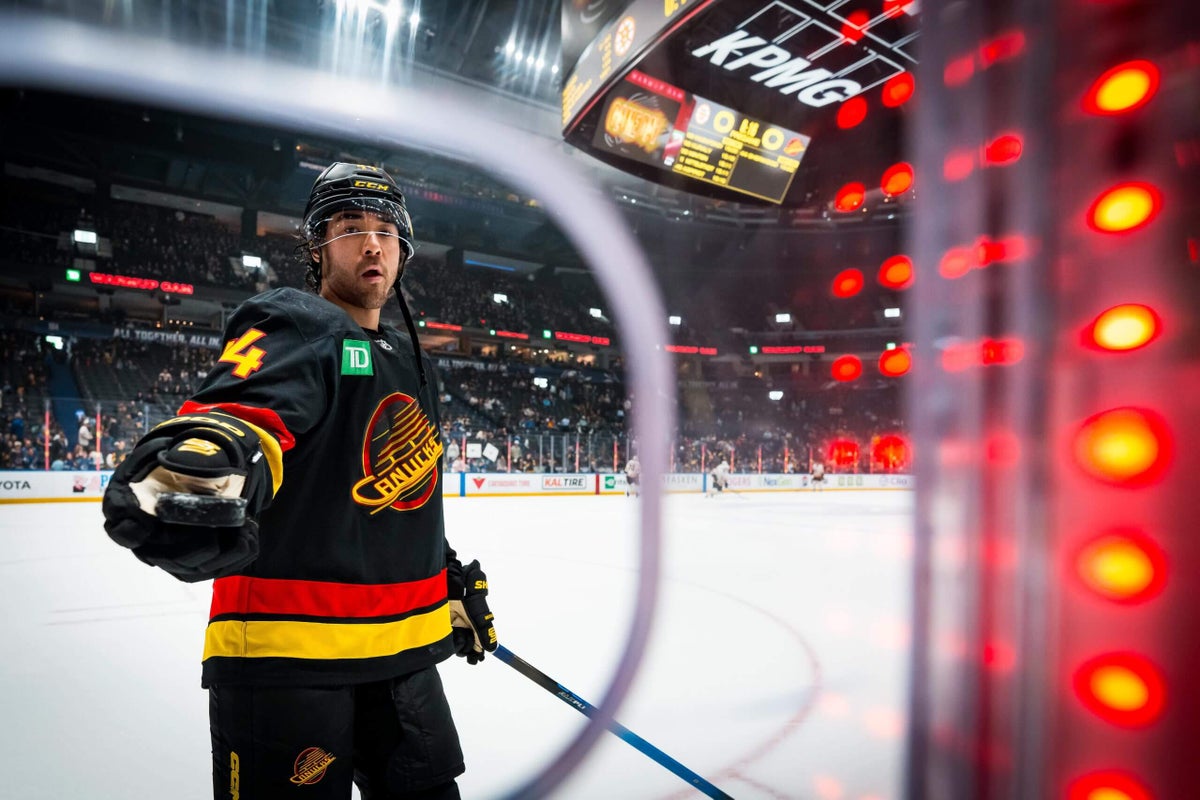
Harman Dayal: Sherwood is the exact kind of gritty middle-six goal-scoring winger that is in high demand ahead of the deadline.
He’s scored at a pace of 24 goals per 82 games since coming to Vancouver at the start of last season, has racked up the second-most hits in the league this season, and is a fast, pesky forechecker.
Advertisement
Sherwood probably won’t sustain the 31-goal pace he’s currently on — he’s played an elevated role, averaging 17:32 per game, which has included some first-unit power-play time because of how thin Vancouver’s forward group is and he’s riding a slightly elevated shooting percentage — but I wouldn’t expect a dramatic fall-off in his offensive production either. Sherwood has a lethal, high-velocity shot that allows him to beat goaltenders from distance off the rush and he shows underrated hands at times.
What will really make him a fan favorite in San Jose, though, is how much DAWG he has in his game. Sherwood plays every shift as if it’s going to be his last in the NHL — he hits everything that moves, gets under the opposition’s skin without taking undisciplined penalties, and forces turnovers on the forecheck with his speedy puck pursuit.
It is a tad surprising to see the Sharks buying one of the top rentals ahead of the deadline, but it is an understandable move. San Jose has arrived as a competitive team ahead of schedule and it isn’t far-fetched to think it could clinch a wild-card spot because of how weak the Western Conference is this year.
Importantly, I’d imagine GM Mike Grier traded for Sherwood with the intention of extending him beyond this season. The Sharks have $53 million in projected cap space for next year — they’ll easily be able to afford Sherwood’s next contract. Sherwood’s next contract will be expensive and could be risky, though, because he’s coming off a career year and will turn 31 in less than two months. That certainly gives some pause from San Jose’s viewpoint, and introduces some risk to this trade, even though I absolutely see the upside case and like the move overall.
From the Canucks’ perspective, Jim Rutherford and Patrik Allvin probably hoped to get a first-round pick for Sherwood, given not only his play but his minuscule $1.5 million cap hit. They weren’t able to accomplish that, which is a slight letdown, especially because Sherwood represented the Canucks’ most straightforward, marketable asset in this rebuild. However, Sherwood’s not quite as valuable as the three rental forwards — Brad Marchand, Brock Nelson and Mikael Granlund — that commanded a first-round pick at last year’s deadline. Scott Laughton and Tanner Jeannot weren’t really fair comparables for Sherwood’s trade value, either, as Laughton had an extra year of term remaining, while Jeannot was a 25-year-old under RFA control when Tampa Bay acquired him.
Advertisement
In the grand scheme of things, two second-round picks is a respectable, solid return for a middle-six rental winger, even though it won’t blow anyone away.
It’s also important that these aren’t likely to be late second-round picks, either. San Jose’s second-rounder this year will probably be in the middle of the pack, and if the Sharks somehow regress next year (which can always happen because progress isn’t linear for young teams), then their 2027 second-round pick could end up being relatively high too.
Sharks grade: B+Canucks grade: B
Shayna Goldman: The Kiefer Sherwoods of the world are the exact type of players general managers love to overspend on for the playoffs. Beyond just his hitting, he can be a hard-nosed playoff menace who makes life difficult for opponents when it matters most with his tenacious forechecking. Pair that with his speed, goal-scoring ability, and penalty killing, and it really ups his value. The cherry on top is his very reasonable $1.5 million cap hit for the rest of this season.
The big question was going to be what peak value was going to look like for Sherwood on the trade market. Bottom-six centers can bring back hauls with first-rounders. So can some utility wingers; two playoff runs with Blake Coleman cost a first-rounder, plus for the Tampa Bay Lightning. On the recent rental wing front, Anthony Beauvillier cost the Washington Capitals a second-rounder.
So Sherwood’s value is somewhere between the Coleman and Beauvillier range, since a team is only guaranteed one playoff push with him. But there are only so many inexpensive, effective utility players on the market this year — and not many offer Sherwood’s all-around value. So there was a real opportunity here for the Canucks to maximize the return for the winger, even as a rental.
A return of two seconds isn’t bad for Vancouver. It’s just kind of underwhelming. Unlike seasons past, the Sharks’ second-round picks aren’t as close in value to a late first from a contender, since they’re still right in the thick of the playoff race. The real question is whether this is the best return a team could have offered, and that’s where the timing of it comes into play. Did the Canucks jump too early at the Sharks’ offer, with so much time to spare between now and the deadline? Could the market have changed and upped the ante to a first-rounder? It’s entirely possible. But waiting too long wasn’t without its risks, either. It’s possible some buyers would have slipped out of the race by the deadline and deflated any potential returns. Playing Sherwood too much between now and then obviously could have led to injury, too.
Advertisement
The Sharks’ perspective is even more interesting here because Sherwood seemed like a better fit for a contender. A true playoff-caliber team could best maximize his exciting skill set in a middle-six capacity, and likely help elevate his game back up to his ceiling after some streaky play over the last two seasons. As fun as San Jose’s lineup has been this year, it’s not nearly as solid as a contender, so some of the weaknesses and potential red flags in Sherwood’s game could get exposed.
Still, this feels different than a fringe team like the Bruins or Rangers acquiring Sherwood and thinking he could be the final piece that makes them a true playoff-caliber team. San Jose has collected a lot of draft capital and bolstered its prospect pipeline over the years. So it can afford to move out picks for right-now talent, when their skillset can actually complement its roster — whether he is viewed as a rental or longer-term fit.
And while there are a lot of concerns on what that next contract could look like with his comps in mind, if the Sharks decide to extend Sherwood, it could age better there than most teams considering, 1) how young this roster is, 2) that rebuilding teams need veterans to support its up-and-coming core, and 3) how much cap flexibility this team has.
Sharks grade: A-Canucks grade: C+