
This post was originally published on this site.
In several ways, this was an unorthodox, atypical NBA trade deadline.
I explored many of those reasons and touched on some trade season superlatives once the dust settled. But with an astounding 28 deals made in the seven days preceding the deadline, we felt it was best to highlight, well, the best, even more.
But first:
Most jarring pivot: Wizards
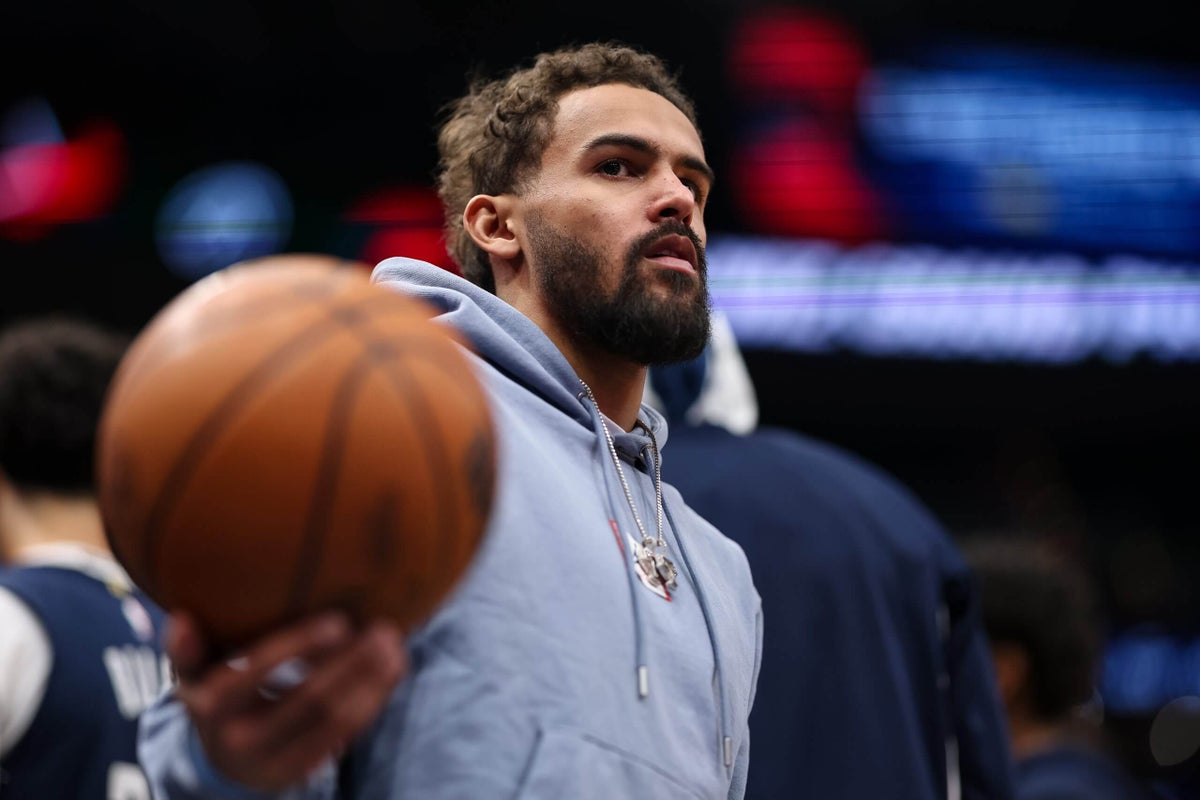
So we’re not rebuilding anymore, I guess? Couldn’t they have just kept Deni Avdija, who is younger and better than Trae Young and younger and healthier than Anthony Davis, and gone from there?
Advertisement
You can rationalize the Washington Wizards’ moves in a few ways. First of all, it cost them hardly anything; it’s hard to imagine the Wizards coming up with a better haul with their salary-cap space this summer.
Young and Davis are also highly complementary players, even if they’re joining forces about five years too late; Davis is a great lob target who can cover Young’s defensive porosity, a far more elite version of the prime Clint Capela who thrived next to Young; Young, meanwhile, can create the looks that Davis struggles to self-generate and prevent us from watching Davis try to iso guys from 20 feet, shoot a tough fadeaway, fall and concede a five-on-four the other way.
The cost Washington paid matters if you see a stock-trading angle to this. If Washington rehabilitates their reputations at all, the Wizards could be in position to profitably flip Davis and Young a year from now.
Additionally, having Young and Davis may actually help Washington’s young players, if you acknowledge that none of them are anywhere near good enough to shoulder 30 percent usage rates. Having primary shot creators helps the other guys play real basketball instead of turning into Jordan Poole; even if you think Kyshawn George, Alex Sarr and Tre Johnson have long-term upside to maybe someday be high-usage offensive fulcrums, they aren’t that close right now.
Finally, there is only so long a team can tolerate this much suckitude (that’s not a real word, but it’s a real issue). Washington’s internal plan was to stop the suffering once it guarded its top-eight protected pick to the New York Knicks this season, and the Wizards wanted to pivot toward something approaching respectability in 2026-27.
I have major concerns, however. First, the Wizards don’t know who they’re drafting yet. It’s a major issue, for instance, if Cameron Boozer is the best player on their board and they already have Davis and Alex Sarr; they’re essentially forced to either trade one at a discount or draft a player who isn’t as good.
Advertisement
Another concern lies in what the next contracts look like for Davis and Young. If the Wizards can get them to agree to short, non-max extensions, I would feel much better about this whole process. Young’s deal runs through 2027 if he picks up his player option, and Davis’ through 2028; going past 2029 with either of them would be a clear mistake, as would paying them anywhere near their max. The whole reason they were so cheap in the first place is that teams looked at their current contracts and flinched. Extending them into old age at the same numbers would immediately make them negative value propositions.
The other thing we might whisper about the decision to go with Young and Davis: The Wizards aren’t exactly batting 1.000 on some of these draft picks. Sarr was a hit, and George was an inspired choice from a weak draft. On the other hand, Bilal Coulibaly shows flashes and then disappears for three weeks, and Tank Commander Bub Carrington leads the team minutes even though he’s getting torched.
A bit oddly, they’ve been suppressing Justin Champagnie’s minutes to develop the other guys, but he’s only 24 and on a great contract and will arguably be their second-best player the rest of the way. As for the 2025 class of Johnson and Will Riley, we’ve had some mildly encouraging early returns, but we’ll see. (While we’re here: Second-round pick Jamir Watkins is an absolute hellhound on defense, but he’s 24 and a near-zero on offense; he could probably help a good team more than this one.)
Washington will have one more high draft pick this June, plus some interesting pick swaps in the out years. Even with two huge salaries in Young and Davis, the other key players are on rookie deals, and the Wizards are miles from the luxury tax; they can add one more veteran with their non-taxpayer midlevel exception this summer.
The good news: Basketball in D.C. will matter again next season. Did the Wizards abandon their methodical rebuild for a short-term sugar high, or is there a genuine pathway toward higher-end outcomes? What the extensions look like for Young and Davis likely holds the key to that answer.
Advertisement
Best decisions to cut bait: Sixers
Oklahoma City’s trade for Jared McCain was shrewd; with a huge tax bill coming in future seasons, the Thunder needed a cost-controlled player on a rookie deal, and one who can make open shots. It’s easy to imagine them putting McCain into Isaiah Joe’s role as Designated Sixers Castoff Bench Shooter and moving off Joe and one or two other vets to ease their tax burden and impending roster crunch. They need spots just to absorb their future first-round picks.
Nonetheless, Philly made the right choice. McCain’s value was never going to be higher as a Sixer, because he was the fourth guard behind Tyrese Maxey, VJ Edgecombe and Quentin Grimes, and even if Grimes left as a free agent, he’d always be stuck behind the other two. Additionally, the league has frowned in general on smallish, combo-guard offensive players; acquiring a late first-rounder and three good seconds for McCain is a pretty solid return in that light. As long as he was in Philly, his trade value was only going to decline.
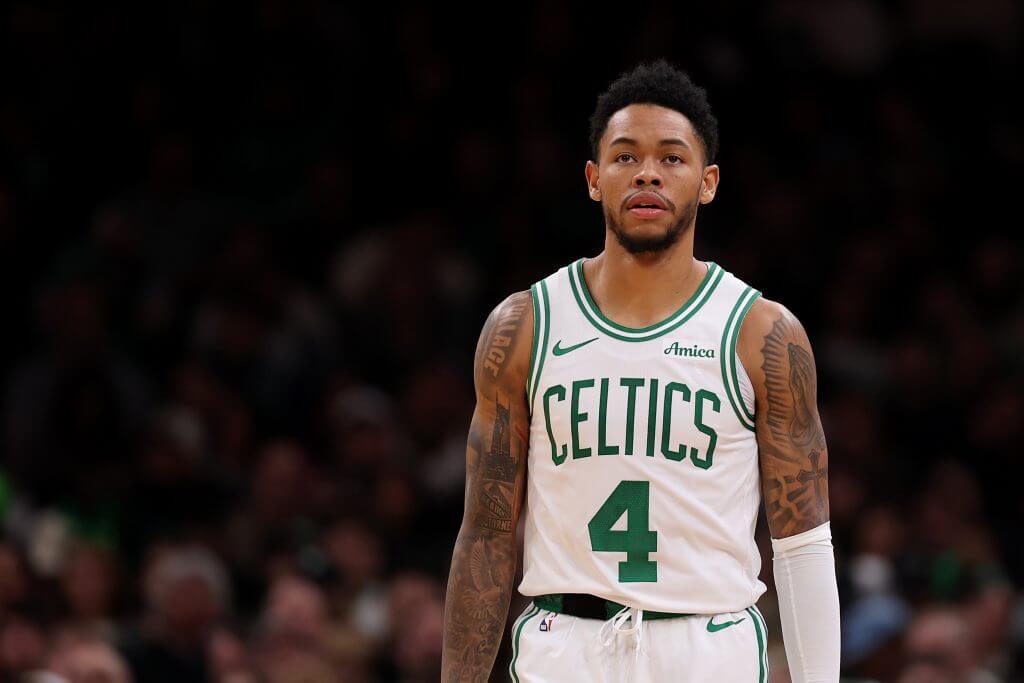
Anfernee Simons heading to Chicago was a big part of Boston’s in-season cost cutting. (Maddie Meyer / Getty Images)
Best rappel out of luxury tax: Celtics
Boston made three trades to extricate itself all the way out of the tax — the Celtics will end up clearing it by just a few dollars — including a particularly inventive one with Utah. The Celtics traded Anfernee Simons for Vučević to cut their $12 million overage roughly in half, and that’s when the real fun began. Swapping out the minimum deals of Josh Minott, Xavier Tillman and Chris Boucher weren’t complicated maneuvers, but figuring out how to replace them was.
The league requires teams to carry at least 12 players at all times and to have 14 for all but 14 days of the season. So the Celtics were left with three empty roster spots to fill; signing a veteran into those spots would have carried them right back over the tax. Even signing an undrafted rookie would have cost the same in the league’s tax calculation.
The exception, however, is something called a “draft rookie” — a drafted player who is in his first season at the league minimum. Those players count against the luxury tax for barely half the amount that a veteran does. If Boston could somehow fill all three spots with “draft rookies,” at least for a short time, it would just barely skirt the tax.
Two of those rookies were already on hand in Amari Williams and Max Shulga, both of whom are currently on two-way deals. But Boston needed a third. Enter the trade of Boucher to Utah for the rights to two-way John Tonje, the 53rd pick in the 2025 draft.
Whether Tonje is actually any good at basketball scarcely matters; the key was that he gave the Celtics another draft rookie. It cost them a future second to unload Boucher and get Tonje back, but now Boston is out of the tax and can stay out; in fact, the Celtics can even add a veteran in the buyout market later this season once Tonje has burned some clock with a low-cost presence in that 14th spot.
Advertisement
If Boston stays out of the luxury tax again next year, the Celtics will reset the clock on the repeater tax; even if they don’t, they avoided a stiff repeater tax this year without materially impacting their basketball team.
Most abrupt exit: James Harden
Houston, Brooklyn, Philadelphia, the Clippers. Are you seeing a pattern? James Harden bailed again, this time exiting LA just as it was in a stretch of winning 14 out of 17. Instead, he eyed greener pastures in Cleveland, where he’d possibly be more likely to win a title and certainly would be more likely to get an extension.
Harden’s $43 million player option for next season gave him some security; even though only $13 million of it is guaranteed, it’s unfathomable that the Clippers would cut him after the year he’s having. Nonetheless, being able to opt out and sign a new deal in Cleveland this summer (he was not extension eligible) seemed his preference. It could help Cleveland, too, if he takes less money in 2026-27 and also entices Donovan Mitchell to extend his own deal (he has a player option of 2027-28).
For instance, a three-year, $110 million deal for Harden would likely allow the Cavs to stay below the second apron (and thus unfreeze the 2033 first-round pick that will get frozen this June) without needing to inflict too much pain on the rest of the roster. Such a move would allow Harden to stay with Mitchell in Cleveland until he quits on them too until the 2028-29 season, when Harden would be 39.
The one question for the Cavs is whether they took on too much age risk by going 10 years older in the Garland-Harden swap. It’s fair to ask if this was the adage that, “if all you have is a hammer, everything looks like a nail.” Harden was virtually the only quality guard in the entire league where a straight-up swap with Garland worked despite tax apron restrictions on both sides. And arguments about Harden as a ceiling-raiser fall a bit flat when one looks at his playoff history.
But the positive case seems stronger. The Cavs are trying to contend right now and just couldn’t count on Garland to stay healthy. Also, Harden may fit this roster better. He’s hardly anyone’s idea of a great defender, but his size and strength negate the Cavs’ issue of having two small guards and constantly trying to hide them on defense. Cleveland just needs him to be its third-best player for two seasons. That feels doable.
Best pickup for free: Atlanta’s Jock Landale
Desperate for size due to Porziņģis’ lack of availability and a season-ending injury to third center N’Faly Dante, Atlanta somehow parachuted into the Utah-Memphis trade for Jackson and came away with productive center Jock Landale. He immediately delivered 26 points, 11 rebounds, five assists and four blocks in a close win over that same Jazz team (when it comes to tanking, that is some serious three-dimensional chess by Utah). Amazingly, all it cost the Hawks was minimal cash considerations.
Advertisement
Best confirmation of a terrible extension: Jakob Poeltl
How many moves would have been available to the Raptors if they had simply not extended Jakob Poeltl for three years and $62 million in additional guaranteed money this summer? Every entreaty by the Raptors to improve their frontcourt basically hit the same roadblock of no team wanting Poeltl’s contract; in the apron era, you simply can’t have $26 million in nonperforming money across multiple seasons, and the concern is that, if Poeltl is already this at age 30, what is he going to look like at 33?
If Poeltl had just stayed on his original deal, with a player option for $19 million this season, Toronto likely could have been in the market to flip him for Ivica Zubac or Sabonis or another quality center to cement its otherwise pleasantly surprising roster. Instead, Poeltl has become one of the league’s most untradeable players.