
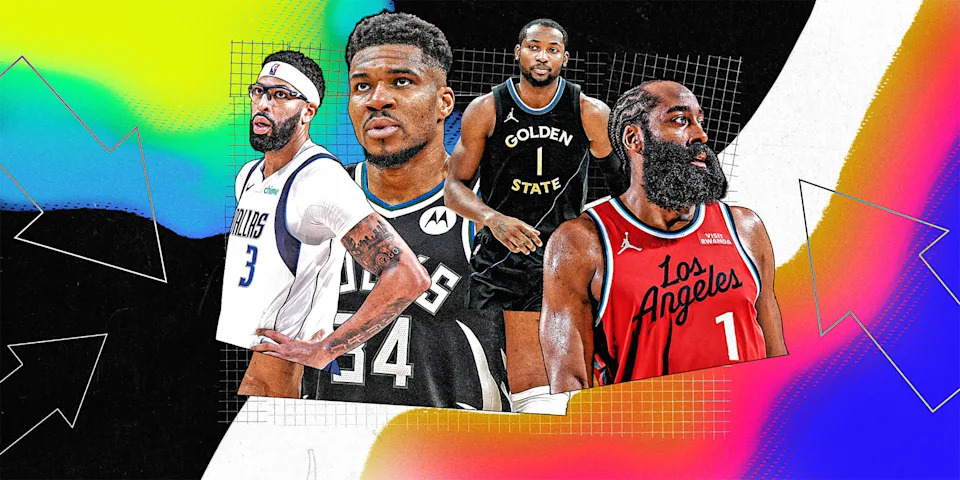
This post was originally published on this site.
It would’ve been unfair to expect the 2026 NBA trade deadline to match its predecessor in sheer tonnage of stunnage; “Luka Dončić got traded out of nowhere in the middle of the night” is a pretty tough act to follow, after all. But despite pundits and observers continuing to wonder aloud about whether the ongoing ripple effects of the 2023 collective bargaining agreement, and the myriad challenges facing high-spending teams trying to navigate the strictures of the first and second aprons, the days leading up to Thursday afternoon’s deadline featured a flurry of movement.
It turns out that, in an environment in which 20 teams participate in the postseason, NBA decision-makers found plenty of ways to hustle and flow within the CBA’s confines. It turns out there were still plenty of front offices committed to trying to add talent for the stretch run. And, of course, it turns out there were plenty of others eager to balance their ledgers and bolster their draft-pick war chests in the hope that tomorrow they’ll find better things.
Advertisement
[Check out the NBA trade tracker for full details on every move]
The result was a breathtaking sprint through the approach to Thursday’s 3 p.m. ET buzzer. And as the pencils-down buzzer drew nearer, the rumors rolled in and the deals got done, I sat here, like Frank T.J. Mackey, quietly judging them.
What follows are my first-draft-of-history impressions of which teams scored and which ones stumbled in this season’s grand NBA roster reshuffling. There will likely be more winners than losers because, between you and me, the world’s tough enough right now, man. Might as well find a scrap or two of joy where you can, you feel me?
We begin with the biggest move of the week — the one that wasn’t made.
Winner: Milwaukee Bucks
At the risk of oversimplifying things: The only reasons to trade Giannis Antetokounmpo were if the two-time MVP absolutely, positively demanded in no uncertain terms that he be dealt by Thursday afternoon, or if another team absolutely, positively bowled Milwaukee over with a Godfather offer too good to refuse.
Advertisement
For all the reporting about Giannis’ representatives communicating in one oblique form or another to the Bucks that the time had come for them to consider unwinding their 13-year relationship in pursuit of a respectful and mutually beneficial conscious uncoupling, or whatever the hell the language was, it appears he never actually said, “I want you to trade me.” (In fact, Antetokounmpo went out of his way on Tuesday to reach out to Bucks beat reporters Jim Owczarski of the Milwaukee Journal Sentinel and Eric Nehm of The Athletic and tell them that, deep down, in his heart of hearts, he wanted to stay in Milwaukee, win another championship in Milwaukee, and retire a Buck.)
And for all the reporting about the teams most interested in his services, none of them actually had that kind of offer.
The Warriors could sell their post-Stephen Curry draft future, the big-ass salaries of an injured Jimmy Butler and an aging Draymond Green, and a bunch of young players who’ve never looked capable of making Joe Lacob’s purported second timeline viable. The Timberwolves and Knicks never had the draft capital to make a serious push, would’ve had to trade multiple core rotation pieces to try to find it, and never got there. And if the Heat’s best offer was, as Barry Jackson of the Miami Herald proposed, Tyler Herro, Kel’el Ware, another young player or two, Terry Rozier’s expiring contract, two first-round picks and two or three swaps … well, you can hardly blame the Bucks for not believing that would set them up for a quick bounce-back to perennial postseason pushes. (It hasn’t worked out all that hot for Miami, after all.)
Advertisement
So the Bucks went through the process, put prospective suitors through their paces, got the lay of the land, found the market wanting … and decided not to take a bad deal just for the sake of content creation, knowing that, when the season ends in just a few short months, plenty more teams will have more draft picks, more financial flexibility and, potentially, more motivation to pony up their best offers after suffering postseason disappointment.
[Subscribe to Yahoo Sports NBA on YouTube]
Maybe Jon Horst was never really all that motivated to move. I don’t blame him. Giannis is one of the three or four best players in the world. He’s arguably the most important player in franchise history. Maybe, after years of moves aimed at trying to put together championship-caliber teams around him, the Bucks as presently constituted don’t have much of a future. But I’m not convinced that any of the offers available to them before Thursday would’ve dramatically improved their future outlook, either, and I don’t think sacrificing one of your saints just to turn the page makes sense — as a way to use assets, as a business strategy in your market, as a risk of karmic affront to the basketball gods, or in any other context.
Deciding to walk away from the table on Thursday doesn’t solve the Bucks’ problems. But it didn’t compound them by guaranteeing that the next time Giannis Antetokounmpo takes the court, he does so in another jersey. And that ain’t nothing.
Advertisement
The Most Stressed Out Winner Imaginable: Jon Horst
OK, Mr. General Manager. (“Well, ‘manager.’ We would just say ‘manager.’”) You successfully avoided taking a step off the curb and getting hit by a bus. Now, you get to:
-
Luck into a top-five pick in what evaluators say has a chance to be a generationally great top of the 2026 NBA Draft;
-
Either nail that pick to give Giannis an instant-impact contributor/future superstar to play next to or auction it off to the highest bidder in exchange for multiple high-quality players and more future draft capital;
-
Use the multiple first-round picks that you’ll be able to deal come the end of this league year and whatever other assets aren’t nailed down to drastically improve his supporting cast and the Bucks’ overall talent level;
-
Present Giannis with the four-year, $275 million maximum-salaried contract extension for which he becomes eligible on Oct. 1;
-
Hope you’ve done enough to once again secure his signature on it;
-
If you haven’t, begin sifting through a whole new round of offers, and start the process all over again.
Good luck! Enjoy!
Winner: Teams That Will Have More Draft Picks Available This Summer
I’m not saying I’m dialing up those Lakers Photoshops yet. I’m just monitoring the situation.
A bowling-ball-shouldered giant future Hall of Famer no longer sees a championship future with the team he’s been with since he was a teenager; he doesn’t want people to be mad at him for saying so and trying to get himself to a place where he does see said future; everything gets awkward; he doesn’t actually wind up moving at the deadline.
Advertisement
History doesn’t repeat itself, but it rhymes.
Loser: All of Us Who Waited Breathlessly, Following the Second-by-Second IV Drip of Sourced Scuttlebutt About Giannis’ Future, Expecting a Resolution by Thursday, Only to Be Told to Put Our Phones Down and Go Home to Our Families
Oh, well. Maybe we’ll learn our lesson next time …
Loser: All of Us Who Are About to Do All of That Again All Summer
… but probably not.
Winner: James Harden
Harden went into the week on a team that, while one of the hottest in the NBA, still projects as a play-in team in the Western Conference, likely drawing dead in the first round of the playoffs (if the Clippers even made it that far); with just $13.3 million of his contract for next season guaranteed; and with an uncertain path to a lucrative multi-year extension that would carry him past his 38th birthday. He exits the week as the starting point guard for a team projected to have home-court advantage in Round 1 in the East (and that now ranks as a favorite to win the weaker conference), and with (it is heavily assumed due to his willingness to waive his implied no-trade clause and most of his $2.3 million trade kicker) a pathway to said lucrative multi-year extension.
Advertisement
Harden might not have infinite wiggles. But this week proved definitively that, even after doing this a half-dozen times, the Beard remains inarguably wiggly.
Winner: Donovan Mitchell — Mover, Shaker and Weight-Throwing Motivator
On Tuesday, I theorized the Cavs’ sudden interest in Harden stemmed from a sudden awareness of the precarity of their position with Mitchell, who is eligible for a contract extension this summer, holds a $53.8 million player option for 2027-28, and could intimate an interest in declining both to threaten an exit from Cleveland if he didn’t feel Koby Altman and Co. were doing everything they could to maximize his chances of winning a championship.
Advertisement
On Wednesday, Jason Lloyd and Joe Vardon of The Athletic reported that I was barking up the right tree …
The Cavs began the year as the favorites to win the Eastern Conference, but the season has not gone according to plan. They were also feeling the pressure from their best player, Donovan Mitchell, to make changes ahead of Thursday’s trade deadline under the threat of a contract extension he may or may not sign […]
Three league sources said Mitchell, who has one guaranteed season left on his three-year, $150 million deal and a player option for 2027-28, conveyed, either personally or through his representatives, that he did not think the organization should stand pat for the rest of this season and wait for potential moves in the summer.
… a notion Jake Fischer echoed with some supporting reporting:
“People don’t realize the Cavs are in the same position with Donovan as the Bucks are with Giannis,” one veteran front office executive told The Stein Line. […]
Rest assured, then, that the Cavaliers don’t make the Darius Garland-for-James Harden swap without Mitchell’s blessing.
“If Don wants it, [it’s happening],” said one league source with knowledge of the Cavaliers’ inner-workings.
Mitchell wanted Harden. He got him.
“We both know that it’s going to be an adjustment,” Mitchell told Tony Jones of The Athletic on Wednesday. “But we’re excited. I’m excited about what he can do for me as a player, and I’m excited about what he can do for our team as a whole. We want the same thing. We both want a championship.”
Whether they’ll be able to reach that lofty goal remains in doubt. What’s now beyond doubt, though: The Cavs are no longer a team built around a “core four,” a confederacy of All-Star equals. They’re Mitchell’s team. They’ll go as he goes — as far as he can take them on the court, and where he insists they move off it.
Advertisement
Loser: The Reputation of Darius Garland’s Feet
Wait. That sounds gross. This one’s dumb. Dump it. Trash it.
Let’s try again:
Loser: Collective Confidence in Darius Garland’s Health
On its face, trading a 26-year-old two-time All-Star for a 36-year-old making the same amount of money sounds nuts. There’s a reason why teams don’t typically trade up in age by a full decade; it’s because older guys are less likely to remain healthy and productive than younger guys. In this case, though, the Cavs eagerly signed up for the older dude.
Maybe there’s nothing to that beyond the reported fact that Mitchell had grown weary of the state of play in Cleveland and that Altman saw an opportunity to upgrade at the position and improve the Cavs’ present-tense chances even if it meant reducing their long-term odds. But — and you’ll have to pardon my Windy fingers here — it feels at least notable that the team that drafted Garland and has employed him since 2019, who would know better than anybody exactly what’s in the medical file regarding the issues with the big toes in both of his feet that hobbled him last postseason and have cost him 26 games and counting this season, decided to move on from him … right before he becomes eligible for a contract extension this summer.
Advertisement
The NBA is an increasingly unforgiving place for small guards, even under the best of circumstances, and the way Garland’s exit from Cleveland unfolded invites at least some skepticism that he’s going to be operating under the best of circumstances. Here’s hoping such skepticism is unfounded; I’m a huge fan of Garland’s game, and he has a huge opportunity to become the cornerstone of the next era of Clippers basketball. I’m just saying: Let’s keep an eye on how long it takes him to come back, what he looks like when he does, and how those wheels fare as he moves into what should be his prime.
Winner (Kinda?): Jonathan Kuminga
He finally got traded! Steve Kerr doesn’t have him to kick around anymore! Now it’s time for him to get all those minutes, touches and scoring opportunities as a starting wing and top offensive option on the …
[checks notes]
Advertisement
… Atlanta Hawks, who have All-Star triple-double machine Jalen Johnson at power forward, former No. 1 pick Zaccharie Risacher at small forward, and Most Improved Player candidate Nickeil Alexander-Walker and defensive demon Dyson Daniels at the guard spots?
Hmm. Well, at least the drive to the arena will look different.
Loser: Everyone Who Had to Write Multiple Columns and Devote Multiple Podcast Segments to The Jonathan Kuminga Saga
It’s me. Hi. I’m the problem; it’s me.
Loser: Golden State Warriors
After Jimmy Butler went down, Antetokounmpo was the only move on the board that seemed like it could’ve meaningfully revitalized their chances of competing for an NBA championship. When it became clear to the Warriors that Milwaukee wasn’t going to open that particular door, they pivoted to Atlanta, shipping out Kuminga and Buddy Hield in exchange for Kristaps Porziņģis — who seems like an ideal shot-blocking stretch-5 to put next to Draymond Green, except for the fact that he’s spent much of the last year battling illness, has missed 35 games this season, and hasn’t suited up in nearly a month.
Advertisement
If Porziņģis is actually able to play down the stretch, he could really help. More likely, though, Golden State’s deadline business amounts to turning Kuminga and Hield into one larger expiring contract, moving Trayce Jackson-Davis for a second-round pick, getting a little bit of breathing room under the second apron, and … that’s about it. Not exactly the most inspiring transaction cycle for a team led by an about-to-be-38-year-old legend still throwing lightning bolts and playing at an All-NBA level. So it goes.
Winner: Ending Your Years-long Skulking at the Bottom of the Standings in Pursuit of Good, Old-Fashioned Decency
Hey there, Washington Wizards and Utah Jazz!
I wouldn’t say I’m convinced that dealing for Trae Young and Anthony Davis will suddenly send Washington skyrocketing into contention for home-court advantage in the Eastern Conference next season. (I’m definitely reluctant to give the Wiz a big thumbs up for their opportunistic buy-low moves until and unless I know they haven’t undone that good work by spending like $90 million a season for their new veterans.) I’m more bullish on the prospect of Utah pairing Jaren Jackson Jr. with Lauri Markkanen and a re-signed Walker Kessler in a supersized frontcourt that, flanked by Keyonte George and Ace Bailey, is bursting at the seams with positional size and offensive skill. (Though, for what it’s worth, JJJ certainly has his skeptics.)
Advertisement
In general, though, while I don’t begrudge going-nowhere teams deciding that the best option available to them is a managed retreat, teardown and long rebuild, I also support teams that have been terrible forever trying, at long last, to be good. (I’m a little traditional that way.) Since moving Mitchell and Rudy Gobert, the Jazz have been functionally irrelevant to the broader NBA discourse; the Wizards have labored in that condition for most of the last several decades. I’m not saying they should start printing the Game 3 playoff programs just yet; I just respect the swing.
Winner: Getting Your Work Done Early, Like a Respectable Deep Seal in the Post (Shouts Out to Thomas Bryant)
Heading into the season, a handful of teams projected to have boatloads of cap space in the summer of 2026. But with the 2026 free agency class heavy on expensive vets on the wrong side of 30, and with cap-space-flush teams like Washington and Utah unlikely to win battles for the affection of sought-after targets against bigger markets and better teams, those teams instead opted for what’s increasingly being called “pre-agency.”
The Wizards swooping in on Young and Davis; the Jazz snagging JJJ.; the Wolves (not a cap-space-flush team, but still qualifying!) dealing for Ayo Dosunmu (whom Minnesota likely wouldn’t have been able to sign this offseason). All of these deals allowed teams to bring in players that they might not have had access to come the summer, giving them both a few-months head-start in getting them acclimated to a new structure and, crucially, gaining control over the players’ valuable Bird rights. Making those deals now ensures that those teams don’t wind up scrambling to throw good money after bad later, and affords them a leg up on the arduous process of sketching out a vision for what comes next so that you can hit the ground running next season. Procrastination: so last year.
Advertisement
Winner, Passive Income/Compound Interest Division: Oklahoma City Thunder
The defending NBA champions entered deadline week holding three first-round picks in the 2026 NBA Draft — belonging to the Clippers (from the 2019 Paul George/Shai Gilgeous-Alexander trade), the 76ers (from the 2020 Al Horford trade) and the Rockets (from the 2019 Chris Paul/Russell Westbrook trade) — with a top-eight-protected potential fourth coming from the Jazz (from the 2021 Derrick Favors salary dump). But with 15 guaranteed salaries on the books for next year, and with injured recent first-rounders Nikola Topić and Thomas Sorber in line to enter the fold, they don’t really have any place to put all those dudes. Champagne problems for an organization still learning how to open Champagne bottles.
So the Thunder took one of those firsts, plus three second-round picks from their cache of future assets, and turned them into Jared McCain — a player whose struggles in his first 30-odd games after returning from a torn meniscus in his left knee landed him on the outskirts of Nick Nurse’s rotation, but who’s begun to come on of late, knocking down 15 of his last 26 3-pointers in a Sixers uniform.
Advertisement
Oklahoma City — currently sitting atop the West at 40-12, with the NBA’s best defense and a top-four offense — doesn’t exactly need a whole hell of a lot to feel confident in its chances of vying for a second NBA championship. But for a team that ranks 15th in 3-point makes, 16th in 3-point attempts, 15th in 3-point accuracy and 18th in the share of its shots that come from long range, an active and accurate movement shooter — 38.1% from deep on more than 10 attempts per 100 possessions thus far in his career — who can give Mark Daigneault someone else who can create with the ball in his hands in the second unit feels like a worthwhile addition to the portfolio. Particularly when it comes at the fairly negligible cost of never-quite-developed/surplus-to-requirements fourth-year big Ousmane Dieng (later re-routed to the Bucks) and what’s likely to be a mid-20s pick that the Thunder would have a hard time rostering next season.
It seems like a pretty reasonable bet that a steady diet of opportunities in what’s proven to be an awfully good developmental system in Oklahoma City could help McCain recover the form that had him looking like the Rookie of the Year favorite before his injury last season. That would make him awfully useful, not only for this year’s title defense, but also over the next several seasons of his cost-controlled rookie-scale contract — especially for a Thunder team that’s about to get extremely expensive.
With extensions for Gilgeous-Alexander, Jalen Williams and Chet Holmgren kicking in, the Thunder are about to face a salary crunch that will likely lead to some tough decisions on perimeter players like Luguentz Dort, Aaron Wiggins and Isaiah Joe — another former Sixer sharpshooter who wound up carving out a role for himself in OKC. McCain might be next in line.
And, by the way? With the Clippers shedding two of their three best players and the Jazz adding a two-time All-Star before the deadline, Oklahoma City’s odds of landing a pair of mid-lottery picks look to have increased. It’s pretty cool when, without you doing anything, your money keeps making money. (Shouts out to Benny in “In the Heights.”)
Advertisement
Winner: Indiana Pacers
In what’s largely been a miserable season in Indianapolis, Kevin Pritchard and Co. had one very important goal: to find a new starting center capable of replacing Myles Turner as a viable long-term answer at the position in time for Tyrese Haliburton’s return next season. And about 45 minutes before the final buzzer, they went out and got the best one on the market.
Indiana had been linked with Ivica Zubac for weeks. And while the price was fairly steep — the Pacers’ unprotected 2029 first-round pick, plus an interestingly protected 2026 first (Indiana keeps it if it’s 1-4 or 10-30; the Clips get it if it lands 5-9) that converts to an unprotected 2031 first if it doesn’t convey this year, plus a Dallas 2028 second-rounder, talented swingman Bennedict Mathurin and reserve center Isaiah Jackson — the return is worth it.
The 7-foot, 240-pound Zubac is absolutely rock-solid. He was an All-Defensive Second Team selection last season who perennially ranks near the top of the NBA in defensive field-goal percentage allowed at the rim, and should provide a high-level organizing principle for a Pacers defense that ranks 21st in points allowed per possession this season without Turner. He’s a monster on the glass who’s in the top 10 in both offensive and defensive rebounding rate this season.
Advertisement
He’s a sure-handed finisher on the interior who’s made more than 60% of his shots for seven straight seasons, a capable dribble handoff hub when stationed at the elbows, and a physical screener who demands help defenders’ attention when he rolls to the rim; it’s easy to imagine him replicating the pick-and-roll rhythm he found with James Harden as soon as he gets a few reps with Haliburton, one of the few players on the planet arguably as adept as Harden at facilitating in the two-man game.
Zubac also fits the Pacers’ timeline like a glove. He turns 29 next month, and he’s making less than 13% of the salary cap (an absolute steal) on the extension he signed in L.A. in the summer of 2024 that runs through 2028, which lines him up with Haliburton, Pascal Siakam, Andrew Nembhard, Obi Toppin, Aaron Nesmith and T.J. McConnell — a.k.a., the core of the team that just went to Game 7 of the NBA Finals.
If you’re forced to have a gap year, all you can do is try to make it a productive one. Landing Zubac makes this one a smashing success for Indiana, and puts the Pacers in position to return to contention atop the Eastern Conference as soon as next season.
And if the Pacers land one of those top four picks in June’s draft … oh, man.
Loser: Miami Heat
You already knew the Heat were the hardest-working, best-conditioned, most professional, unselfish, toughest, meanest, nastiest team in the NBA. On Thursday, though, they added another title:
Without landing Giannis to vault them into the upper reaches of the Eastern hierarchy or taking a moderately smaller swing for Ja Morant, the Heat wound up sitting out the trade deadline entirely. No infusion of talent; no shuffling the deck; no breath of fresh air for a team that’s gone 14-18 with a bottom-10 offense and a negative point differential since the start of December.
Advertisement
Maybe a healthy return from Herro, who’s played only 11 games this season while battling ankle and toe injuries, functions as that jolt, and maybe Erik Spoelstra’s able to find just enough offensive juice to allow his Bam Adebayo-led top-five defense to grind the gears of higher-seeded opponents come April and May. Without having landed any reinforcements, though, maybe by the time spring rolls around, the Heat will wind up doing what they did on Thursday: sitting out, and watching everybody else get active.
Loser: Sacramento Kings
[sigh]
OK. You know what? That’s on me.
After weeks and weeks of reports and rumors about all the myriad players Scott Perry would look to move as he set about overhauling the league’s least cohesive or coherent roster — an accumulation of aggregation that led me to consider Sacramento one of the more interesting teams to keep an eye on at this deadline — the sum total of the Kings’ activity was to use Keon Ellis (a player that half the league was reportedly interested in employing, and in whom the Kings themselves evidently had little interest) to dump the rest of the three-year, $44.4 million contract of Dennis Schröder (which the Kings gave him seven months ago) for the right to pay De’Andre Hunter (who has graded out above replacement level twice in a seven-year career) $48.2 million over the next two seasons.
Advertisement
That’s it. That’s all.
The Kings, by the way, are an NBA-worst 12-40, sitting in the bottom four in both offensive and defensive efficiency. And once Zach LaVine picks up his $49 million player option for next season — which, given the lack of interest in him on the market this year, seems like a pretty safe bet — they will have nearly $200 million committed for next season, leaving them barely under the luxury tax line with nine players under contract. Hallelujah; holy s***; where’s the Tylenol?
Winner: Cleveland Cavaliers
Well, the second part of Tom’s big plan didn’t come to fruition, but the Cavs should still feel pretty damn good about where they stand after the deadline.
Advertisement
Cleveland exits the deadline with Harden, a pretty significant upgrade over the current, injury-inflected version of Garland; Schröder, another credible ball-handler and ball-pressuring defensive irritant with a ton of experience who gave great minutes to Detroit last postseason; and Ellis, who was a bona fide game-changer in Sacramento when he had the opportunity to play off a primary creator in De’Aaron Fox, and whose game should play up now that he’s being stationed next to Mitchell and Harden. And by moving off Lonzo Ball, they opened up a roster spot to be able to convert Nae’Qwan Tomlin from a two-way contract to a standard deal, ensuring that Kenny Atkinson will be able to keep the long, super-active second-year wing in his rotation through the rest of the regular season and into the playoffs.
The Cavs still have plenty of work to do: figuring out the ball-handling, playmaking timeshare between Harden and Mitchell; getting big men Evan Mobley and Jarrett Allen reps and rhythm with a new primary pick-and-roll playmaker; finding the most synergistic lineup combinations with three new pieces coming in; etc. All told, though, they look deeper, more talented and more dangerous now than they did on Monday — a team better positioned to make the deep playoff run that has eluded them, and, in the process, to convince Mitchell that the grass wouldn’t be greener somewhere else.
Winner (I think): Los Angeles Clippers
When the Clips were 6-21 on Dec. 19, plenty of smart people wondered whether they’d pull the plug, strip the remnants of the Kawhi/PG-era roster down to the studs, and set about the difficult business of rebuilding when you don’t control your own first-round draft picks until 2030.
Advertisement
When the Clips then promptly won 16 of their next 19 games — a run so stunningly prolific that it resulted in a man literally eating his own words — you wondered whether they’d go the other way, rebuffing interest from would-be suitors and instead considering adding talent to potentially propel them further up the Western standings.
In the end, though — and likely spurred on by Harden’s insistence on finding new digs — Lawrence Frank acted as if he was at the controls of a team that had largely run its course and needed to start planting seeds for a new tomorrow. (Sorry.)
Out goes Harden, replaced by Garland, an All-Star point guard a decade his junior. Out goes Zubac, returning a package headlined by Mathurin — a legit 23-year-old, 6-5 scorer who still needs to iron out some of the wrinkles in his game and enters restricted free agency this summer — and two potentially very valuable Pacers draft picks to start restocking the draft cupboard. You’d imagine youngsters Kobe Sanders, Jordan Miller and Yanic Konan Niederhauser will get plenty of opportunities down the stretch, as what began the season as the league’s oldest team now starts to look toward the future.
Kawhi stays put for now, but with Garland and Isaiah Jackson now the only non-rookie-scale money on the books beyond 2027, the Clips still have a ton of financial flexibility with which to hit the reset button in two years’ time. It’s something of a whimper of an end to an era that began with a literal earthquake. But maybe that’s better than continuing to chase an outcome that was no longer in the cards.
Loser: The League’s View of Ja Morant
After weeks of welcoming offers for Morant, the Grizzlies ultimately hung onto him on Thursday. As beat reporter Damichael Cole of the Memphis Commercial Appeal put it, the Grizzlies “held firm on their price” — a price that, according to Yahoo Sports national NBA reporter Kelly Iko, executives around the league had largely expected would drop after Memphis moved Jackson, its second trade of a foundational star for draft capital since the end of last season. (The Grizzlies made another pick-focused deal on Thursday, taking little-used veteran Eric Gordon off Philly’s hands in exchange for a second-rounder.)
Maybe that was the right call. In the last six games he’s actually played — a half-dozen appearances since Christmas, which, granted, not exactly the most ringing endorsement — Morant has averaged 23.5 points and 9.3 assists in 29.2 minutes per game, driving to the basket 17.5 times per game, shooting 53.7% from the field (including 74.2% in the restricted area), 38.9% from 3-point land and 84.2% from the free-throw line on more than six attempts per game, and the Grizzlies have won his minutes. That version of Ja — one that can still get downhill, can finish on the interior, can get to the line and act as an offensive engine — is one that has value.
Maybe Zach Kleiman sees a scenario in which Morant returns to the floor after his sprained elbow heals up, puts together a string of healthy and impressive performances, and offers the league enough evidence that he hasn’t lost his All-Star/All-NBA fastball — that he’s still got enough left in the tank to be worth betting on. Maybe that’s enough to bring in some more significant offers come the offseason, enabling Morant to pursue a fresh start elsewhere and allowing Memphis to recoup something approaching value for the beleaguered face of their franchise.
Maybe, though, the lack of aggressive offers over the last month is an indication that Morant’s last three years — the suspensions, the injuries, the seemingly constant internecine drama, the inconsistent production and on-court decline — have left an awfully sour taste in an awful lot of mouths. At 26 years old, the NBA at large seems to be more or less out on Ja Morant. Here’s hoping he gives the league a reason to change that point of view.
You win some, you lose some: New York Knicks
Give Leon Rose credit for this much: When he makes a mistake, he moves quickly to try to correct it.
When the Knicks signed Guerschon Yabusele this summer, it looked like a coup. The 29-year-old big man was coming off an excellent run for the French national team at the 2024 Summer Olympics and a strong season for the Philadelphia 76ers, and seemed like a quality complementary power forward/center to play alongside and behind Karl-Anthony Towns and Mitchell Robinson under new head coach Mike Brown. The theory never panned out in reality, though, as Yabusele’s shooting, defensive work and overall two-way production cratered. With the Knicks getting outscored by 3.4 points per 100 possessions in his minutes, Yabusele quickly found himself out of Brown’s rotation — a $5.5 million salary slot largely gone to seed.
So, with the Knicks passing on a Giannis pursuit and suddenly scorching after having left their post-NBA Cup slump behind, Rose set about Ctrl+Z’ing the error. Step 1: Work with Yabusele on waiving the player option for the second year of his contract, turning him into an expiring — and, thus, much more movable — contract. Step 2: Move said amended contract to Chicago, in exchange for wing Dalen Terry. Step 3: Re-route Terry (along with a pair of second-round picks) to New Orleans for Jose Alvarado — whom the Knicks had reportedly been after for weeks.
The 27-year-old Alvarado gives Brown a veteran backup point guard to pair with second-year man Tyler Kolek off the bench — an undersized option at 6-foot-even, yes, but one who plays aggressive, disruptive, opportunistic point-of-attack defense the full length of the court. He was born in Brooklyn, he played high school ball in Queens, and he plays with his hair on fire 100% of the time. If all he does is throw his body around and get a few steals and deflections here and there, the fans at Madison Square Garden will love him; if he can make his 3s, he’ll become a folk hero faster than you can say, “Yes, I can shoot.” Alvarado also makes $1 million less than Yabusele this year, giving the Knicks another $1 million in breathing room under the second apron, which will allow them to be able to add a player in the buyout market.
It was a tidy bit of business for Rose, replacing a player who didn’t fit New York’s style or needs with one who did while saving money and opening up more options to tinker on the edges of the roster before the start of the playoffs. But just as the vibes were threatening to get a little too immaculate …
… Fred Katz and James L. Edwards III of The Athletic reported that reserve guard Miles McBride needs core muscle surgery, which will put him on the shelf for quite a while. How long? Maybe right up until the start of the playoffs, according to Jeff Stotts of In Street Clothes:
That’s a pretty significant bummer, considering McBride — averaging 12.9 points in 28 minutes per game, shooting 42% from 3-point range on nearly seven attempts a night, all career highs — has been one of New York’s best players this season, according to multiple advanced metrics. But if McBride’s able to make it back for the postseason, the Yabusele-for-Alvarado swap, combined with the recent uptick in form across the roster, and especially on the defensive end, could give the Knicks everything they need to go toe-to-toe with anyone they’ll face in the Eastern Conference playoffs.
Winner: Minnesota Timberwolves
In the grand scheme of things, Tim Connelly’s decision on the night of the 2024 NBA Draft to trade an unprotected 2031 first-round pick and a 2030 pick swap to the Spurs for the right to draft Rob Dillingham now looks pretty disastrous. In the here-and-now, though, Thursday’s reversal of course — moving Dillingham, who’s underwhelmed through two pro seasons, along with fellow former draftee Leonard Miller and four second-round picks, to the Bulls for Ayo Dosunmu — seems like a perfect fit to fortify the Wolves’ biggest weakness as they seek a third straight trip to the Western Conference finals.
All season long, Minnesota has seemed a guard short — the natural consequences of both letting Nickeil Alexander-Walker go to Atlanta in favor of re-signing big men Julius Randle and Naz Reid and 19 years in the NBA catching up to Mike Conley Jr. Enter Dosunmu, a tough, physical, 6-4 combo guard with a 6-8 wingspan who can check scorers at either backcourt spot, get to and finish at the rim, serve as a complementary ball-handler, and knock down triples at a 45% clip.
He’s a better all-around player than Bones Hyland, who’s been serving as Minnesota’s main source of reserve backcourt punch. He should fit neatly next to either Anthony Edwards or Donte DiVincenzo. In a season where the likes of Dillingham, Terrence Shannon Jr. and Jaylen Clark have been hit-or-miss, he adds another bona fide two-way option for Chris Finch to turn to in the crucible of a playoff series. And while Dosunmu is ticketed for free agency this summer, the Wolves now hold his Bird rights, allowing them to go over the cap to retain him.
This, it’s fair to say, is not exactly the headline-making haul that Connelly had in mind when he entered deadline week. But with Giannis off the board, he still found a way to make the Wolves better, tougher and deeper — a team other Western powers won’t be eager to face, and maybe one capable of making it even further than its predecessors. (Now go bring Conley back, after his trade to the Bulls, re-trade to the Hornets and subsequent waiving makes him eligible to return to the team that just employed him, and the vibes will be all the way right.)
No longer will Arturas Karnišovas sit idly by and allow pundits to jest and jape in his general direction for his lack of trade-deadline activity. After three years without a single transaction, last year he sent Zach LaVine to Sacramento. And this year, he went berserk, making seven deals.
Seven! That’s so many! Arguably too many!
After all the wheeling and dealing was done, Chicago had bought in bulk on two commodities: small guards and second-round picks. Like, so many second-round picks:
And in the course of bidding farewell to longtime center Nikola Vučević (on his way to be a Sort Of Al Horford in Boston), Dosunmu, Kevin Huerter and Coby White (a UNC product who I bet will look pretty good in Charlotte), they wound up bringing back Dillingham, Anfernee Simons, Jaden Ivey and Collin Sexton, to add to a backcourt mix that already featured Josh Giddey (who has played only four games since New Year’s Eve with a hamstring strain) and Tre Jones. Yabusele and ex-Suns reserve Nick Richards will join Jalen Smith, Matas Buzelis and Patrick Williams in the frontcourt mix.
Isaac Okoro’s in the mix. Mac McClung, now, too.
That is … not a very good team. Which, maybe, is the point.
Chicago currently sits 10th in the East, in its ancestral homeland of the play-in tournament, but just one game up on the red-hot Hornets … to whom they just traded a pretty good player in White, who ought to fit very neatly into their high-octane offensive system. If the Hornets pass the Bulls, and if the Bulls sink a little deeper into the lottery, it could improve their chances of rising in the first round of the draft.
They don’t have a prayer of catching the likes of the Kings, Pelicans, Pacers, Nets, Wizards and Jazz, and really improving their odds. But every little bit of hurt helps; a version of the Bulls that feeds a ton of minutes to Ivey and Dillingham, allowing them to play through mistakes and see what they can do, could wind up paying dividends for Chicago on multiple levels.
Just so long as nobody calls it a rebuild. We’re not using that word, OK? That word is off-limits.
And failing that … well, at least they added some second-rounders instead of selling them. That’s something, right?
Low-key Winner: Charlotte Hornets
The Hornets have been pretty awesome for the past month, as the core of LaMelo Ball, Brandon Miller and Kon Knueppel has really taken off. I thought they did nicely to balance fostering that growth and continuing to think about the big picture. They moved Sexton to Chicago for White — a move that could make them better right now — and Mason Plumlee to Oklahoma City for Ousmane Dieng (later re-routed to the Bucks) while also adding four future second-round picks to their coffers. They also rented out their financial flexibility to take Tyus Jones off Orlando’s hands and turn him into a flyer on ex-Spur and Wizard Malaki Branham, and picked up $3.5 million in cash for taking big man Xavier Tillman Sr. to help the Celtics duck under the luxury tax.
None of that’s going to change the balance of power in the East or anything. But for years, Charlotte just kind of meandered through the wilderness in the lower reaches of the conference, doing stuff that didn’t necessarily seem to cohere to any particular long-term vision or cohesive plan. That’s changed under new ownership and management; for the past couple of seasons, the Hornets have just kept stringing together solid move after solid move, putting them in position to overhaul their roster, return to competitive play, and still have plenty of flexibility and assets to give them the chance to make even more tweaks and additions down the road. Three cheers for mature, functional leadership!