
This post was originally published on this site.
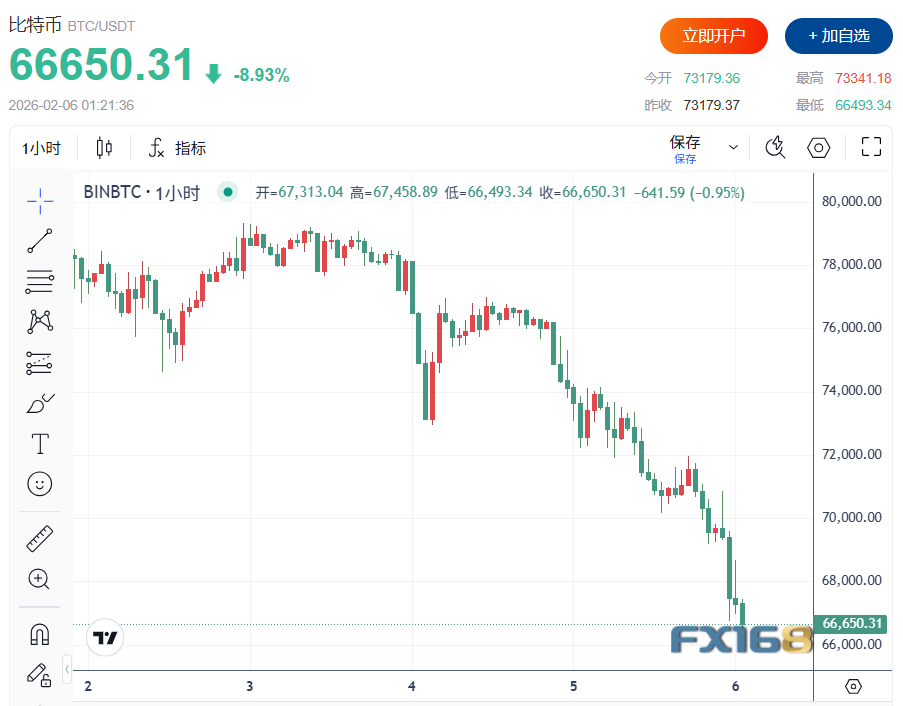
FX168 Financial News Agency (North America) reported on Thursday (February 5) that Bitcoin fell below the $70,000 mark, hitting its lowest level since November 2024 during intraday trading. As technology stocks retreated, forced liquidations intensified, and institutional capital flows reversed, confidence in Bitcoin’s attributes as ‘digital gold,’ a ‘store of value,’ and a safe-haven asset continued to waver, suggesting that short-term downward volatility may remain difficult to subside.
On Thursday, Bitcoin dropped below $67,000. This asset was once hailed as ‘digital gold’ and a unique store of value.
The decline in digital assets, including Bitcoin, deepened as investors reassessed the token’s practical utility. For a long time, Bitcoin has been viewed by its proponents not only as a hedge against inflation and macroeconomic uncertainty but also as an alternative to fiat currencies and traditional safe-haven assets like gold.
 However, recent developments have not supported these views. After briefly surging above $126,000 in early October, Bitcoin has been on a continuous downward trajectory.
On Thursday, Bitcoin fell to $66,493.34, its lowest level since at least November 2024. The cryptocurrency broke below $70,000 earlier in the trading session, triggering further selling pressure. Bitcoin has plummeted by 20% this week alone.
(Source: FX168)
In a note to clients on Wednesday, Deutsche Bank analyst Marion Laboure stated, ‘In our view, this ongoing sell-off indicates that traditional investors are losing interest, and overall market pessimism toward cryptocurrencies is rising.’
As some of the ‘sensational narratives’ surrounding Bitcoin failed to materialize, investor caution increased. Bitcoin largely moved in tandem with risk-on assets such as equities, particularly evident amid recent geopolitical and macroeconomic disruptions in Venezuela, the Middle East, and Europe. Its adoption as a means of payment for goods and services remains limited.
Bitcoin Underperforms Gold
Over the past year, Bitcoin has fallen nearly 30%, while gold has risen by 68% over the same period.
Other cryptocurrencies have also experienced significant declines. Ethereum retreated 23% this week, set to mark its worst weekly performance since November 2022 (when it dropped 24% in a single week). Solana fell to $88.42 on Thursday, nearing a two-year low, with a weekly decline of 24% as well.
Some traders pointed out that $70,000 is a key observation level, and a breach below it could trigger further declines for Bitcoin.
James Butterfill, Head of Research at CoinShares, stated that $70,000 is becoming a ‘key psychological threshold,’ adding: ‘If this level cannot be defended, prices are likely to retreat to the range of $60,000 to $65,000.’
Bitcoin’s recent decline occurred against the backdrop of intensified selling pressure in U.S. tech stocks. The State Street Technology Select Sector SPDR ETF, which tracks the technology sector, fell 2.8% on Wednesday after already dropping 2.2% the previous day.
Meanwhile, volatility in precious metals has also increased: silver plummeted again on Thursday, while gold came under pressure and weakened.
Forced liquidations (where traders’ positions are automatically sold by the system when Bitcoin hits specific price levels) continue to weigh on the market. According to Coinglass data, as of Thursday, cumulative forced liquidations of long and short positions in the cryptocurrency market exceeded $2 billion this week.
Bitcoin has been on a steady downward trajectory for over three consecutive months, currently retracing more than 45% from its October peak. Other cryptocurrencies, including Ethereum and XRP, have seen even larger declines.
Maja Vujinovic, CEO of FG Nexus Digital Assets, said in an interview with CNBC’s ‘Worldwide Exchange’: ‘The straight-line bull market that many people anticipated hasn’t really materialized. Bitcoin is no longer reliant on hype-driven narratives; the main storyline has lost some focus, and trading is now driven more by pure liquidity and capital flows.’
Reversal of Institutional Demand
In the past, large institutional investors were credited with supporting Bitcoin prices in the cryptocurrency market; however, it now appears that these participants are the ones selling.
CryptoQuant released a report on Wednesday stating, “Institutional demand has seen a substantial reversal.”
CryptoQuant noted that U.S. spot Bitcoin ETFs net purchased approximately 46,000 Bitcoins in the same period last year but have turned to net selling in 2026.
The report also highlighted other concerning signals: “Bitcoin fell below its 365-day moving average for the first time since March 2022 and has cumulatively declined by 23% over the 83 days since — performing worse than during the bear market phase at the beginning of 2022.”
Moving averages are used to track an asset’s price over a specific period, smoothing out short-term fluctuations to identify trends.
CryptoQuant stated that Bitcoin’s latest decline suggests “potential downside targeting the range of $70,000 to $60,000.”