
This post was originally published on this site.
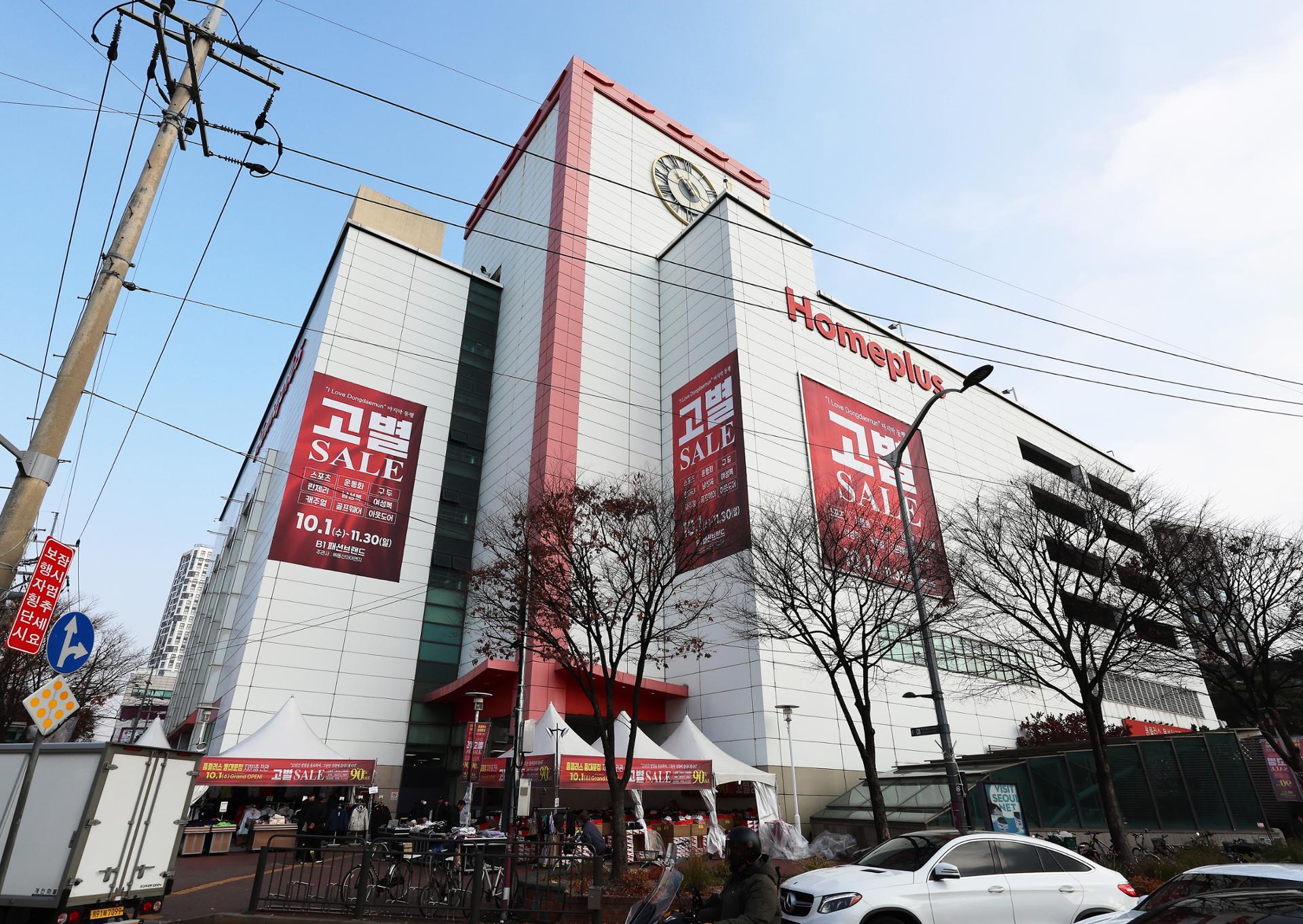
Posters on Homeplus’ Dongdaemun Store in Seoul read “Adieu Sale” in this Nov. 30, 2025, file photo, as the company plans to close certain stores due to its court receivership process. Yonhap
A 15-year-old Korean law designed to protect small, self-employed vendors in traditional street markets from large superstore chains, is now stifling offline distributors as they struggle to keep up with fast-growing e-commerce platforms, leading to growing calls to modernize the outdated law.
Under the Distribution Industry Development Act, mandatory closures, limits on operating hours, and other regulations on big-box retailers were scheduled to expire automatically after a set date unless renewed in November last year, but the National Assembly pushed the expiration date back to 2029. Introduced in 2010 and extended in 2015, 2020 and again last year, the measure will now be in force for nearly 20 years.
While some support the law for its original intent, others argue that it has undermined the competitiveness of major offline supermarkets like Emart and Homeplus, while simultaneously driving up consumer demand for online platforms such as Coupang.
Experts say the restrictions on offline distributors should be eased to create a fairer market environment for both offline retailers and online platforms.
The declining market share of major superstores such as Emart, Homeplus and Lotte Mart is becoming increasingly evident. According to the Ministry of Trade, Industry and Energy, offline retail sales in Korea accounted for 65 percent of the total market in 2024 and 2025, down sharply from 80 percent in 2016. Meanwhile, the number of large superstores fell to fewer than 390 as of November, a significant drop from 425 in 2019.
E-commerce, meanwhile, has continued to expand. Coupang’s sales in 2024 reached 41.3 trillion won ($29 billion), about 40 times its 2016 total of 1 trillion won. Over the same period, Kurly’s sales surged 127-fold, rising to 2.2 trillion won from 17.3 billion won.
A key factor behind this contrasting retail landscape is the way the controversial law has restricted offline retail giants. Under the law, big-box retailers must close two days per month, with local governments deciding whether these closures fall on weekdays or weekends. In addition, the stores are prohibited from operating between midnight and 10 a.m.
Whenever discount supermarket chains open a new store, they are legally required to submit a report detailing how the store will avoid negatively impacting local street markets and outlining plans to collaborate with local vendors in developing the shared commercial area.
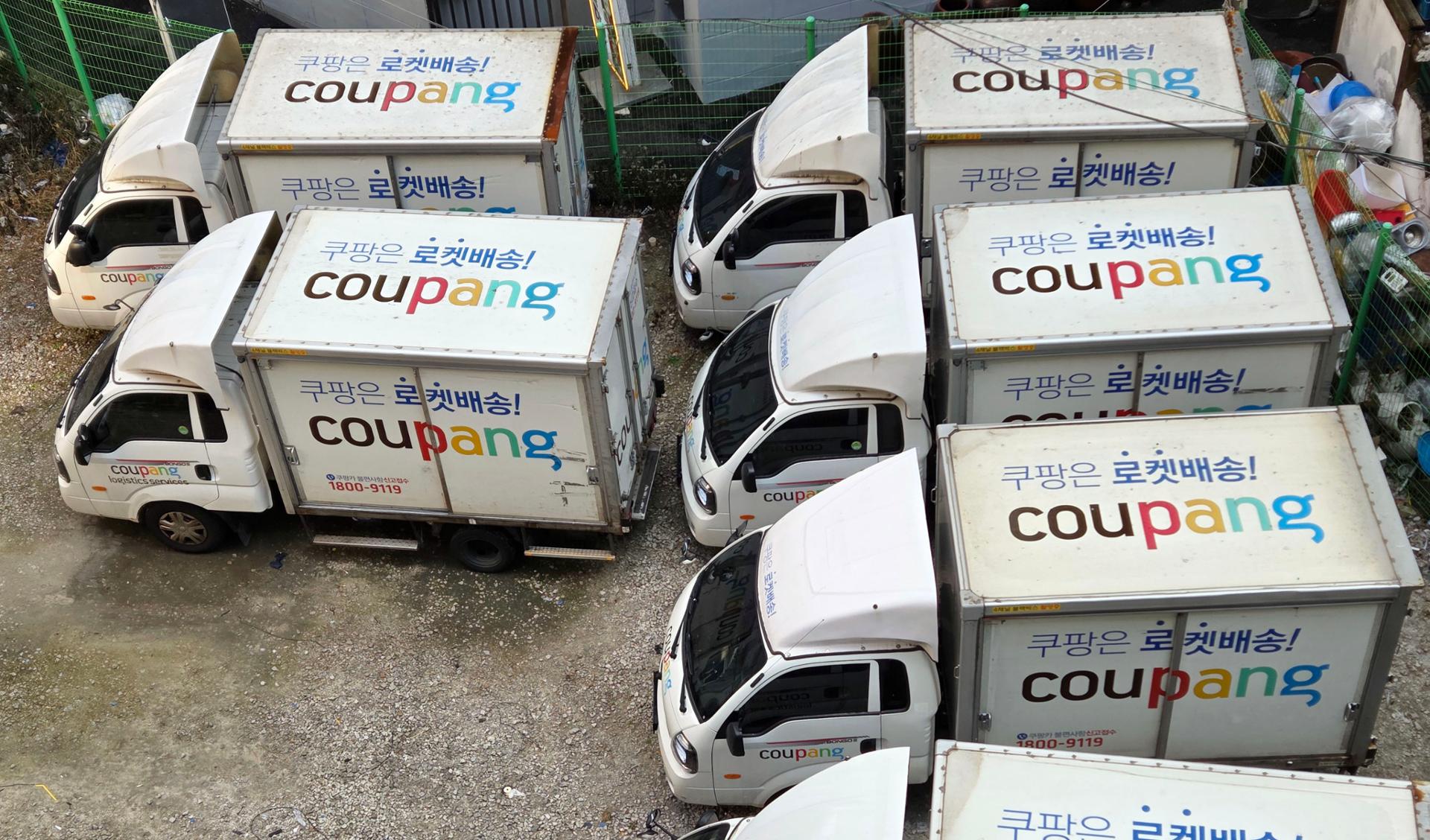
Coupang delivery trucks are parked at one of the company’s 100 logistics and fulfillment centers in Seoul, Dec. 14, 2025. Yonhap
The disparity widened further during the COVID-19 pandemic, as consumers increasingly turned to online platforms while staying at home. The period from 2020 to 2022 is widely seen as accelerating a massive shift toward e-commerce.
The sharpest decline was seen at Homeplus. In March 2025, the No. 2 offline retailer in Korea filed for corporate rehabilitation with the Seoul Bankruptcy Court and is now struggling to generate cash to pay salaries for its 100,000 employees and reassure suppliers, many of whom are hesitant to continue deliveries for fear of unpaid bills.
On Dec. 23, 2025, Emart employees’ labor union issued a statement criticizing the law. Opening with the rhetorical question, “Who gave rise to the monster that is Coupang?” the statement argued that a combination of offline regulations and the COVID-19 pandemic has fueled Coupang’s rapid growth, resulting in its unprecedented dominance in the e-commerce sector.
“Now the country calls for truly reasonable regulations that enable fair market competition between online and offline, between an irresponsible foreign company and Korean firms,” the union said, noting that Coupang’s governance under Korean American board Chairman Kim Bom-seok has come under scrutiny after he refused to appear at National Assembly hearings regarding the company’s massive data breach affecting more than 33 million customers.
Cho Sang-hoon, head of the industry research department at Shinhan Securities, said the controversial law has been “killing” offline giants rather than improving their competitiveness, which would have given consumers more choices.
“There have been proposals by lawmakers in 2020 and later on to mitigate the law in favor of the offline distributors to give the suffocating firms some breathing space by allowing them to deliver purchased goods to customers while their stores are closed. But those pending bills were either scrapped following the National Assembly election in 2024 or still await passage. It’s regretful the bills never passed,” Cho said.
He said the law was introduced at a time when the market expansion of large firms at the expense of self-employed street vendors and concerns over unfair competition were receiving more attention than ever. “Economic democracy,” a popular slogan during the 2012 presidential election, helped justify the law, he added.
“Now it’s rather a showdown between online and offline. The measures should no longer divide the market between large-sized firms and the small-sized self-employed,” Cho said.