
This post was originally published on this site.
The spirit of cooperation has apparently touched the European Union and India, which, after 18 years, announced Monday that they have concluded negotiations for a free trade agreement.
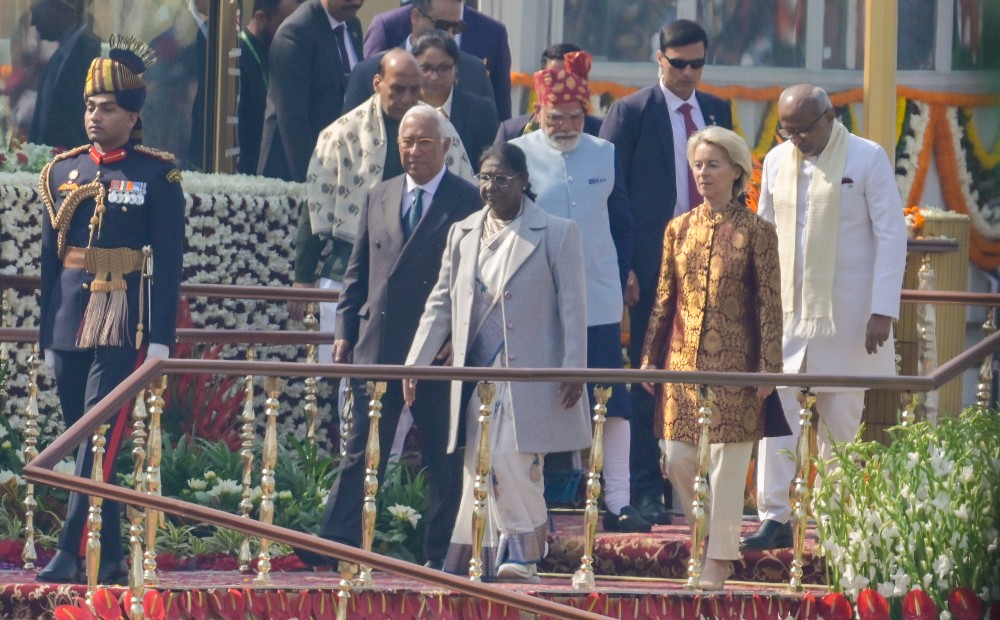
“Official-level negotiations are being concluded and both sides are all set to announce the successful conclusion of FTA talks on Jan. 27, Tuesday,” at the India-EU Summit in New Delhi, Indian Commerce Secretary Rajesh Agrawal said, adding that the deal will spur bilateral investments and trade that will benefit both economies. European Commission President Ursula von der Leyen and President of the European Council Antonio Costa will meet with Prime Minister Narendra Modi on Tuesday.
The deal is projected to see signatures in 2026, and come into effect in 2027.
While the full details have not been released, the agreement will likely center around providing duty-free access for India-made products like textiles, apparel, leather goods, footwear, chemicals, jewelry and electronical machinery. The EU’s tariffs on Indian goods ring in at less than 4 percent on average, but tariffs on labor-intensive categories like these can reach about 10 percent.
Tariffs on European goods entering the Indian market are higher, reaching over 35 percent on cars and their parts, though the average duty rate hovers around 9 percent to 10 percent.
A free trade agreement would drastically draw down or completely eradicate tariffs on the majority of traded goods, and such an arrangement has become an increasingly palatable prospect for both parties in recent months.
Tensions between Trump and world leaders across Europe and Asia continue to flare over geopolitical concerns (see: the purchase of Russian oil, U.S. annexation of Greenland). India (along with Brazil) faces the highest tariffs of any U.S. trading partner, at 50 percent. The U.S. still represents India’s biggest export market, taking in about 17 percent of its exported products, according to data from the World Bank.
While there was much fanfare earlier this month regarding the EU-Mercosur Partnership Agreement (EMPA), which will facilitate trade and cooperation between the EU’s 27 member nations and Argentina, Brazil, Paraguay and Uruguay, which was finalized by the European Council, the deal appears to have hit a snag.
On Wednesday, the European Parliament narrowly voted to pass a motion to seek legal guidance from the Court of Justice of the EU regarding the Mercosur deal’s compliance with existing EU treaties—a process that could further delay its implementation after more than two decades of negotiations between Latin America and Europe. A decision from the court could take up to 24 months.
The agreement has been mired in controversy due to the concerns of some European nations about its impacts on local and regional producers, especially farmers. France and its president, Emmanuel Macron, have been vocal critics of the deal, saying that opening up European markets to an influx of cheaper products will undermine local agricultural operations.
European Commission President Ursula von der Leyen is eager to see the deal pushed through, along with leaders from countries like Italy and Germany.
German Chancellor Friedrich Merz pushed for a provisional implementation of the EMPA, calling the European Parliament’s decision to delay “regrettable.”
“It misjudges the geopolitical situation. We are convinced of the agreement’s legality. No more delays. The agreement must now be applied provisionally,” he wrote on X.
Italy’s prime minister, Giorgia Meloni, joined Merz in pushing for a “swift entry into force.”
In order for a provisional application to take place, one member state must ratify the EMPA. Paraguay has said it is prepared to do so as early as this week.
A delay that could last years is not a welcome outcome for companies that were gearing up for relaxed trade terms that could help their businesses now.
Ornare, a Brazilian based firm that specializes in high-end, customized furniture and interior design solutions, opened a sprawling hub in Milan about a year ago to generate more European business. The group’s international CEO, Stefan Schattan, said the recent signing of the EMPA represented “an important turning point for companies operating across borders, especially in sectors where design, quality, and long-term partnerships matter.”
“Beyond its macroeconomic impact, it signals that closer integration between these regions is both possible and necessary for a more resilient global market,” he said.
The firm has imported a handful of new Italian machines to upgrade its production processes with plans to invest further in hardware, finishes and precision industrial equipment. “Reducing the high taxes we face today would make this process far more efficient and cost-effective,” he said.
With showrooms in Milan and Lisbon, Schattan said the agreement could streamline trade flows and provide legal certainty for companies like Ornare operating across borders. “Beyond tariffs, the agreement emphasizes innovation, sustainability and regulatory alignment, he added.
Italy-based fine linens maker Frette, which services the hospitality sector, is also eager for the deal to go through, as it would open up a lifeline for business that has all but dissipated.
According to CEO Filippo Arnaboldi, Frette’s penetration in Brazil and Argentina has deteriorated due to political changes. “Brazil is a potential consumer market and also for hospitality,” he said, but “right now our sales are zero because the duties are really high.”
“If this free trade agreement goes through, it will open up the market and all the luxury brands are going to benefit from that,” he added.
Arnaboldi is also hopeful about the impacts of an EU-India agreement, as Frette has a vested interest in India as a production and export market. While the company makes most of its linens in Italy, it also produces finished products in India for hospitality projects in the U.S. and Europe, the Middle East and Africa (EMEA).
Arnaboldi sees the potential of a duty drawdown in any capacity as a win. “If this free trade deal goes through between India and Italy it would currently be extremely beneficial,” he said.
Currently, Frette pays a 10 percent tariff on products exported from India to the European market. Of course, that rate is eclipsed by the 57 percent duty on about 60 percent of the company’s Indian exports headed to the U.S.
Still, of the duties on Indian goods, he said, “If it went to zero it would be amazing.”
— With contributions from Sofia Celeste, WWD