
This post was originally published on this site.
Modi’s government presents annual budget, focusing on sustaining growth despite volatile financial markets and trade uncertainty.

Published On 1 Feb 2026
Indian Prime Minister Narendra Modi’s government has unveiled its annual budget, aiming for steady growth in an uncertain global economy rocked by recent tariff wars.
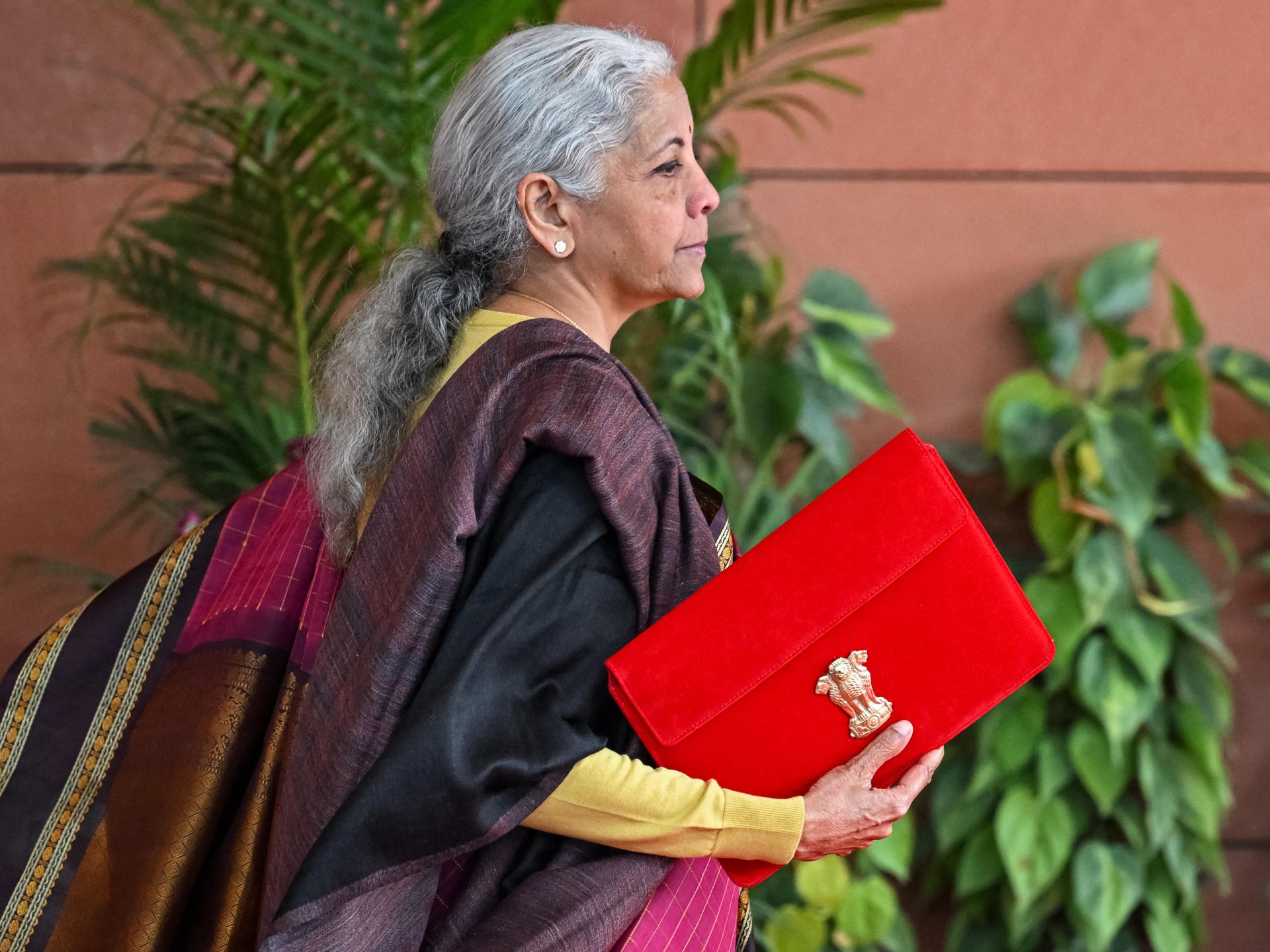
Finance Minister Nirmala Sitharaman presented the budget for the 2026-2027 financial year in Parliament on Sunday, prioritising infrastructure and domestic manufacturing, with a total expenditure estimated at $583bn.
Recommended Stories
list of 3 itemsend of list
India’s economy has so far weathered punitive tariffs of 50 percent imposed by United States President Donald Trump over New Delhi’s imports of Russian oil. The government has sought to offset the impact of those duties by striking deals, such as its trade agreement with the European Union.
Despite the past year’s challenges, the Indian economy has remained one of the world’s fastest growing.
The budget for the new financial year, which starts on April 1, projects gross domestic product (GDP) growth in the range of 6.8 to 7.2 percent, according to the government’s annual Economic Survey presented in Parliament. It is a shade softer than this year’s projected 7.4 percent but still outpaces estimates by global institutions such as the World Bank.
To keep growth strong, the government said it will spend 12.2 trillion rupees ($133bn) on infrastructure in the new fiscal year, compared with 11.2 trillion rupees ($122bn) last year. It will also aim to boost manufacturing in seven strategic sectors, including pharmaceuticals, semiconductors, rare-earth magnets, chemicals, capital goods, textiles and sports goods while stepping up investments in niche industries like artificial intelligence.
Advertisement
Despite plans to prop up growth with state spending, the government is aiming to bring down the federal government debt-to-GDP ratio from 56.1 percent to 55.6 percent in the next financial year and the fiscal deficit from its current projected level of 4.4 percent of GDP to 4.3 percent.
Sitharaman offered no populist giveaways, saying New Delhi would focus on building resilience at home while strengthening its position in global supply chains, marking a departure from last year’s budget, which wooed the salaried middle class with steep tax cuts.
Before the budget presentation, Modi on Thursday said the nation was “moving away from long-term problems to tread the path of long-term solutions”.
“Long term solutions provide predictability that fosters trust in the world,” he said.
Modi’s government has struggled to raise manufacturing from its current level of contributing under 20 percent of India’s GDP to 25 percent to generate jobs for the millions of people entering the nation’s workforce each year.
It has also seen a sharp decline in the value of the rupee, which has recently weakened to all-time lows after foreign investors sold a record amount of Indian equities. Those sales have added up to $22bn since January last year.
“Overall, this is a budget without fireworks – not a big positive, not a big negative,” Aishvarya Dadheech, founder and chief investment officer at Mumbai-based Fident Asset Management, told the Reuters news agency.