
This post was originally published on this site.
The vibes are high in Minnesota — sorry, “Quinnesota.”
Since defenceman Quinn Hughes shockingly landed in the “State of Hockey” last week, the Wild have been going, well, wild. They are 3-0 with Hughes in the lineup and have outscored opponents 16-4. Minnesota has won six in a row overall and is riding a 13-game home point streak (11-0-2) into its matchup against the Edmonton Oilers on Saturday afternoon at Grand Casino Arena.
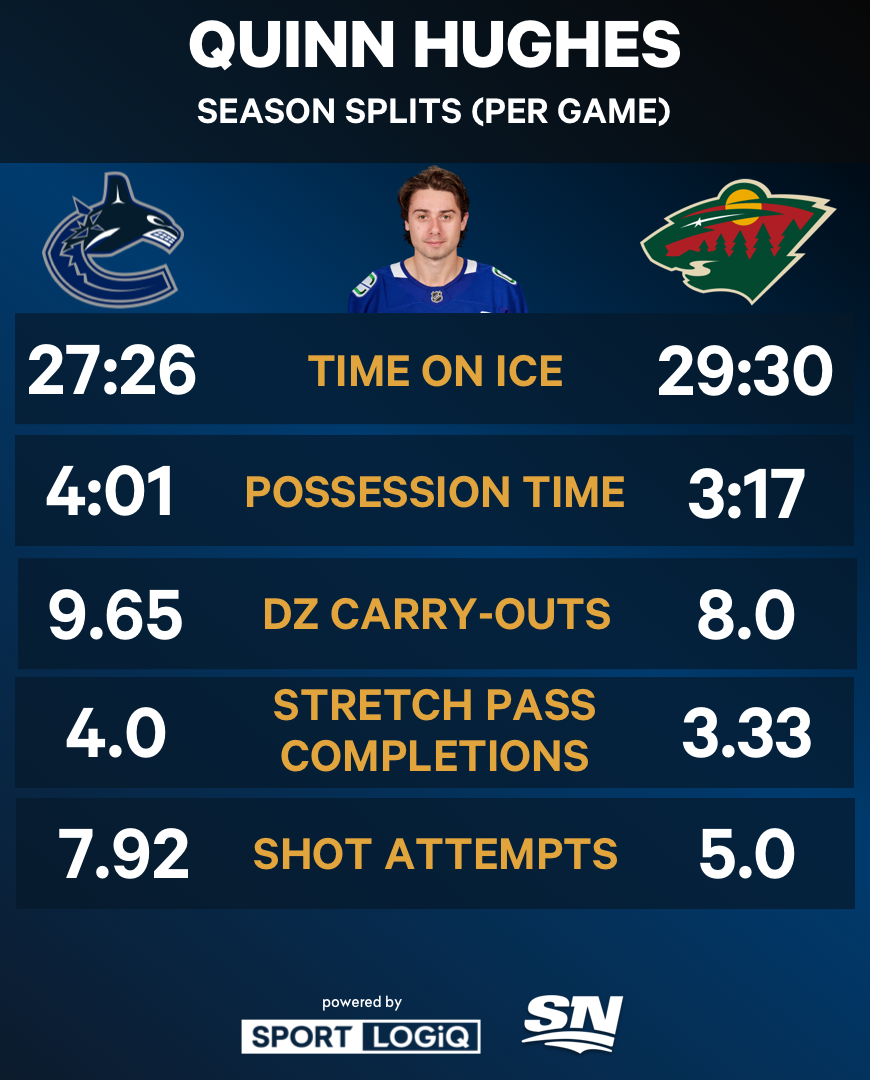
Wild coach John Hynes has not held back Hughes from playing big minutes. Hughes has averaged 29:30 of ice time over the past three games, including a career-high 32:02 in the Wild’s win against the Columbus Blue Jackets on Thursday. (The Wild were missing injured defencemen Jonas Brodin and Jake Middleton, both of whom play significant minutes.)
Although Hughes is playing a lot more than he did with the Vancouver Canucks (27:26 per game) to start his Wild career, he is not having to do as much heavy lifting. His possession time, for example, is down 44 seconds per game. That speaks to the top-tier talent surrounding Hughes in Minnesota, specifically up front. Forwards Kirill Kaprizov (1:49) and Matt Boldy (1:39) both rank inside the top 15 this season in possession time per game at the forward position.
Hughes also has a new defensive partner, Brock Faber, who is comfortable handling the puck. The two Americans, who could be partners at the upcoming Winter Olympics, have found instant success. Minnesota has generated 63.5 per cent of the expected goals at five-on-five during the 65-plus minutes when Hughes and Faber have shared the ice.
“He makes it (really) easy to be his D-partner,” Faber told reporters. “For me, I just need to learn to be outs for him and use my feet to keep up with him. I think we should be able to mesh really (well) together. … As a D-partner of his, you can really do no wrong (with) how gifted of a skater and player he is.”
Opponents should be nervous whenever Hughes and Faber link up with the Wild’s top line of Kaprizov, Boldy and centre Joel Eriksson Ek. In 18 minutes as a five-man unit, they have generated 73.3 per cent of the expected goals at even strength.
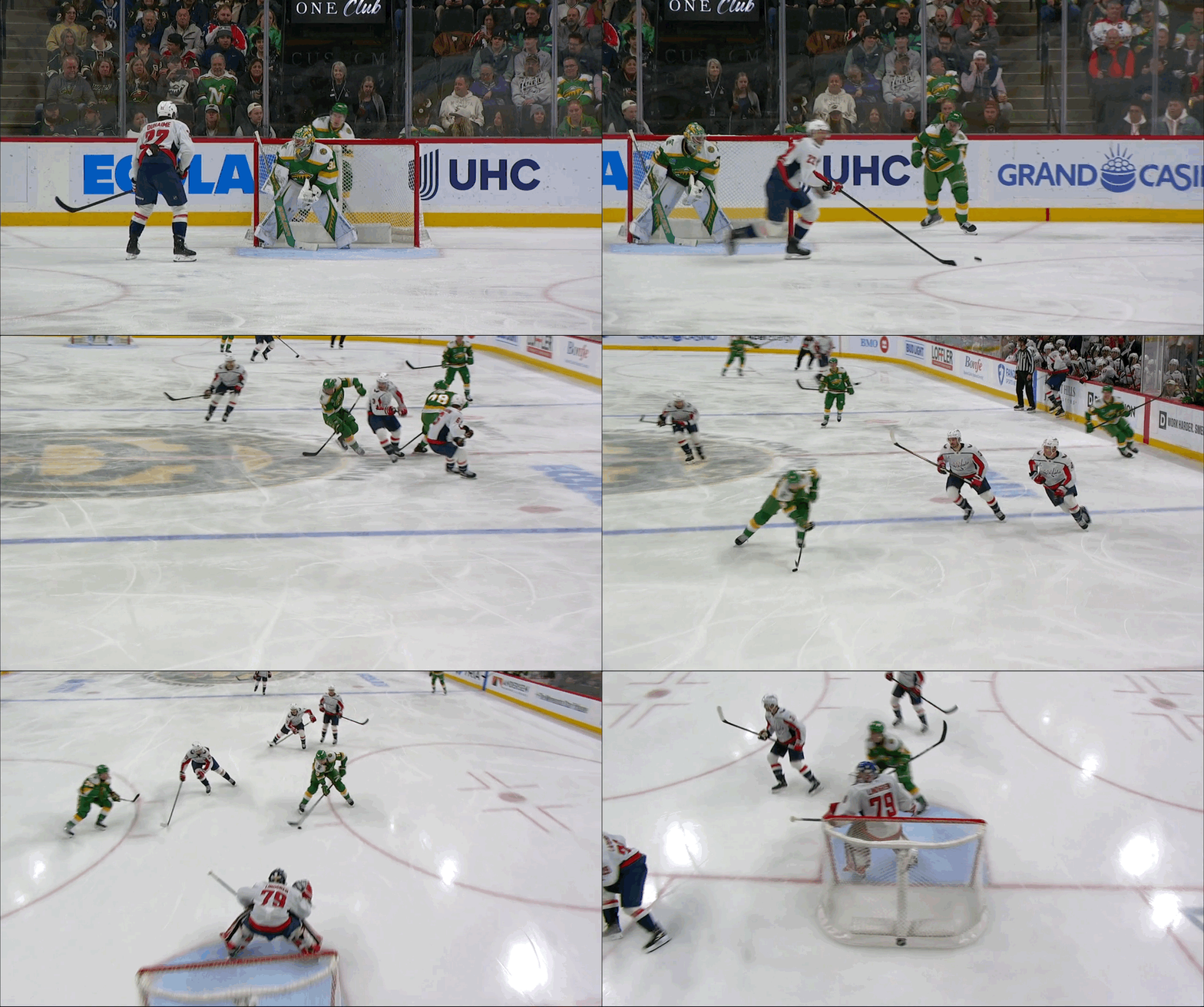
Hughes’ presence has been most felt on the rush, where the Wild had struggled mightily before his arrival. Minnesota averaged an NHL-worst 4.78 rush scoring chances per game without Hughes, who has helped raise that number to 7.33 per game since entering the lineup. Hughes has been on the ice for nine of Minnesota’s 22 rush chances over the past three games.
The Wild have executed a successful play following 25 of Hughes’ 28 controlled exits (89.3 per cent) and 10 of his 12 controlled entries (83.3 per cent). His stretch-passing ability, which is paralleled by few others in the league, has sparked the Wild’s rush attack.
If the Wild played in any other division, they would be in the driver’s seat. But they play in the Central Division, a.k.a. the “group of death.” Minnesota is 18-3-2 since Nov. 1. The problem is that Dallas (18-4-3 over that span) and Colorado (18-1-3) are also practically unbeatable.
Based on the current standings, Minnesota would start the playoffs on the road despite being on pace for one of the best seasons in franchise history. It has been 10 years since the Wild last advanced past the first round, having lost their opening-round matchup in each of their past eight post-season appearances.
Hughes credited Wild management for “sacking up” and trading a haul to acquire him. The franchise hopes he can put it over the top in the playoffs.
“At some point in time, we have to get to the second, third and fourth (rounds of the playoffs),” Wild general manager Bill Guerin told The Athletic. “This is a step in (that direction) because you need guys like (Hughes) to get there. But I believe in this team. Yes, our division is a meat grinder, but I only worry about us and helping us compete for (the Stanley) Cup. And Quinn Hughes helps us further advance toward that.”