
This post was originally published on this site.
As an independent e-commerce seller running a small online store specializing in consumer electronics, staying competitive means constantly monitoring prices across major marketplaces like Amazon, eBay, and regional sites. A year ago, my manual checks were eating up hours every day, and automated scripts kept getting blocked. That’s when I dove deeper into the world of residential proxies and discovered a game-changing provider that allowed me to build a robust, automated price tracking system without constant interruptions.
In this post, I’ll share my personal journey—from struggling with free proxies to adopting premium rotating residential proxies—and how it transformed my business operations.
The Challenges of Price Monitoring Without Proper Proxies
When I first started automating price checks, I relied on simple scripts in Python. At first, it worked fine for a handful of pages, but as I scaled to hundreds of product listings daily, websites began detecting my activity:
- IP bans after just a few dozen requests
- CAPTCHA challenges that halted my scripts
- •Inaccurate data due to geo-restricted pricing
I tried free proxy lists initially, thinking they’d save money. Sites offering daily updated free HTTP proxies, free HTTPS proxies, and even free SOCKS5 proxies seemed promising for testing. However, reality hit hard:
- Many were slow or completely dead
- Security risks, like potential data leaks
- Low success rates, often below 50%
This led me to explore paid options, focusing on residential proxy services that mimic real user traffic.
Discovering a Reliable Proxy Provider
After testing several services, I landed on OkkProxy, which offered exactly what I needed: a massive pool of over 100 million real residential IPs covering more than 200 countries. What stood out was their emphasis on high anonymity, fast response times (under 0.5 seconds), and support for both rotating and sticky sessions.
I started with OkkProxy’s rotating residential proxies, perfect for web scraping and price monitoring. The automatic IP rotation helped me avoid bans, while city-level targeting allowed me to fetch localized pricing accurately.
They also provide other types, like static ISP proxies for long-term sessions and mobile proxies for tasks needing ultimate undetectability.
Key Features That Made the Difference for Me
Here’s a quick comparison of proxy types I considered and why OkkProxy’s residential plan won out:
| Proxy Type | Best For | Pool Size | Rotation/Sticky | Pricing Model | My Success Rate |
| Free Proxies | Basic testing | Varies (limited) | Manual | Free | ~20% |
| Datacenter Proxies | Speed, but easily detected | Large | Rotating | Cheap per IP | ~50% |
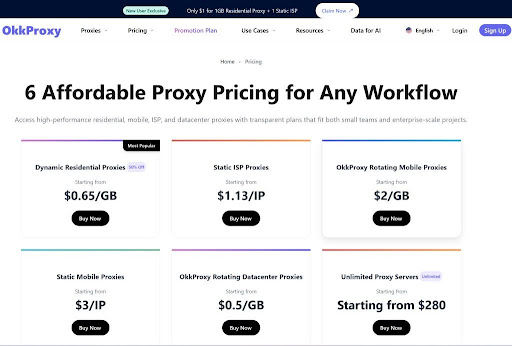
| Residential Proxies (OkkProxy) | Web scraping, price monitoring | 100M+ IPs | Both | Pay-per-GB (~$0.65/GB) | 99%+ |
| Mobile Proxies | High-anonymity tasks | Large | Sticky | Per IP or GB | High |
The unlimited bandwidth on certain plans and 99.99% uptime meant my scripts ran smoothly 24/7.
Starting Small: Testing with Free Resources
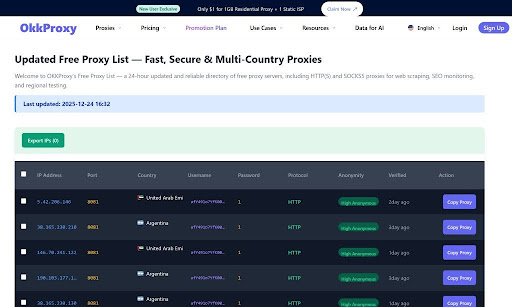
Before committing to a paid plan, I used OkkProxy’s free proxy list to prototype my setup. It provides daily updated free proxy IPs supporting HTTP, HTTPS, and SOCKS5 protocols—great for initial testing of regional access or SEO monitoring.
While free proxies have limitations (like potential instability for heavy use), they were ideal for validating my scripts. Once proven, switching to premium residential proxies was seamless, boosting reliability dramatically.
Results: How It Boosted My Business
After integrating OkkProxy’s proxies:
- Daily price checks scaled from 100 to over 5,000 products
- Reduced manual work by 90%
- Caught competitor discounts faster, adjusting my prices to increase sales by 25%
- Expanded to international markets with accurate geo-targeted data
The investment paid off quickly, especially with flexible pricing starting low and scaling as needed. OkkProxy currently offers a $1 trial price, making it incredibly easy to test their service with minimal risk before committing to a larger plan.
FAQs About Using Proxies for E-Commerce and Scraping
What are residential proxies and why are they better for price monitoring?
Residential proxies use real home IP addresses, making your requests look like ordinary users. This bypasses anti-bot systems common on e-commerce sites, unlike datacenter proxies, which are easily flagged.
Are free proxy lists safe for business use?
For casual testing, yes—like checking a free proxy list for quick access. But for reliable, secure operations, premium services are essential to avoid risks like slow speeds or data exposure.
How do I choose between rotating and static proxies?
Rotating for high-volume scraping (e.g., dynamic price tracking), static (ISP or mobile) for sessions needing consistent IPs, like account logins.
Can proxies help with other tasks beyond price monitoring?
Absolutely—SEO data collection, ad verification, market research, and multi-account management on social platforms.
Is it ethical and legal to use proxies for web scraping?
As long as you respect website terms, avoid personal data, and use ethically sourced proxies (like those from OkkProxy), it’s common practice for public data gathering.
In conclusion, finding the right residential proxies for web scraping and monitoring was a turning point for my business. If you’re facing similar blocks or scalability issues, I highly recommend exploring providers like OkkProxy. Their combination of vast IP resources, affordable plans, and reliable performance made all the difference for me.