
This post was originally published on this site.
The financial accounts of the general government sector cover transactions in financial assets and liabilities as well as the stock of financial assets and liabilities.
The net lending (+) / net borrowing (-) (also known as surplus/deficit), together with the gross debt of the general government, are among the most important indicators in government finance statistics.
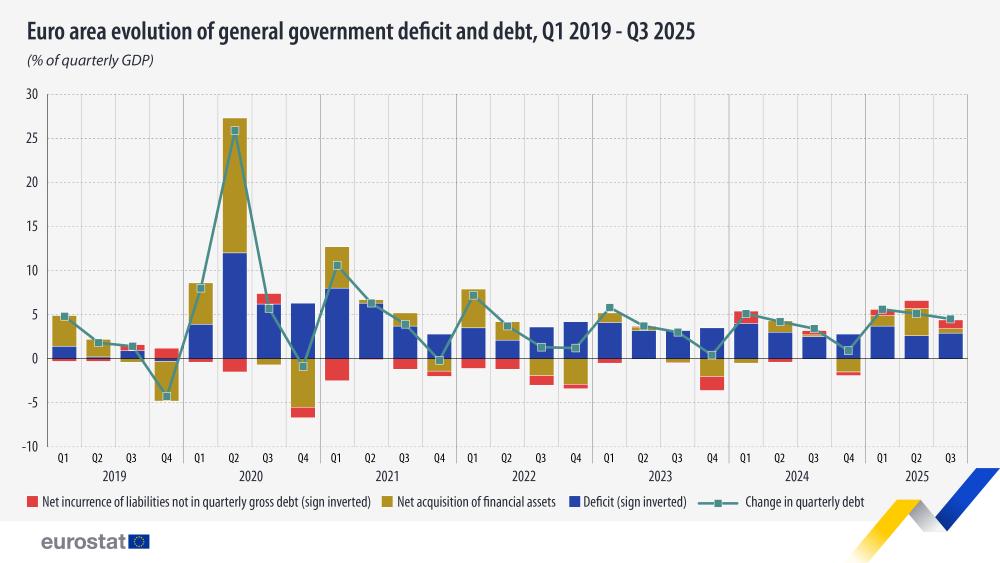
Generally, the movement in government debt can be linked with the government balance: in case a deficit is observed, one would expect to see an increase in debt, and in case of a surplus, some of it could be used to repay debt. However, this is not necessarily the case. Deficits can also be financed by the sale of financial assets, or alternatively, debt can be raised to finance the acquisition of financial assets. Therefore, the evolution of quarterly debt is also linked to the net acquisition of financial assets. The incurrence of liabilities not covered in the definition of the general government gross debt (mainly ‘other accounts, payable’), as well as the valuation differences and discrepancies, also play a role in explaining the change in debt.

Source datasets: gov_10q_ggnfa, gov_10q_ggfa, gov_10q_ggdebt
In the third quarter of 2025, the financing of the deficit (2.9% of quarterly GDP) explained the main part of the change in gross debt (4.5% of quarterly GDP) of the euro area. At the same time, the financing of the net acquisitions of financial assets (0.5% of GDP) and the repayment of liabilities not included in the general government gross debt (1.0% of GDP) also impacted the debt. Other differences between the change in debt and the deficit comprise notably certain revaluations of debt, adjustments between transactions and the change in stock at face value as well as discrepancies (0.1% of quarterly GDP).
This information comes from data on quarterly government finance statistics published by Eurostat today. The article presents a handful of findings from the more detailed Statistics Explained article on government finance statistics – quarterly data.
In 2020 and 2021, due to COVID-19 containment measures and policy responses to mitigate the impact of those measures, the change in debt was mainly influenced by large deficits, as well as acquisitions of financial assets.