
This post was originally published on this site.
Adapting to AI Shopping: Key Findings
Google’s AI shopping upgrades streamline the eCommerce experience for AI Mode and Gemini App users, forcing eCommerce brands to adapt.
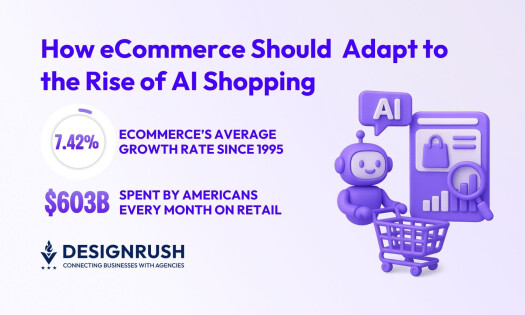
eCommerce has grown an average of 7.42% per year since 1995, making Google’s AI shopping upgrades a direct response to shoppers shifting billions toward online buying.
Americans spent $603.8 billion per month on retail in early 2025, with 18.3% flowing through eCommerce.
Online shopping used to start with keywords. Now, it’s set to start with a conversation.
Google has recently rolled out AI shopping updates across AI Mode and the Gemini App.
The updates introduced conversational shopping and other agentic features like automated price tracking and local inventory checks.
Both AI Mode and the Gemini App are paired with Google’s Shopping Graph, allowing deeper conversational shopping queries. This lets users better describe products instead of relying solely on keywords and filters.
Questions asked in AI Mode will now display shoppable image grids, as well as side-by-side results if users ask to compare products.
The new tools mark a huge leap in how consumers discover, evaluate, and, ultimately, purchase products online.
Editor’s Note: This is a sponsored article created in partnership with Customer Paradigm.
Google’s focus on streamlining online shopping for its users isn’t a surprising move, as eCommerce continues to integrate itself into everyday life in the U.S. and across the world.
While in-store retail is still the preferred shopping method in the U.S., eCommerce is growing at a remarkable pace.
According to statistics from Capital One Shopping, ecommerce’s share of total retail sales has risen an average of 7.42% every year since 1995.
And during the first six months of 2025, Americans spent an average of $603.8 billion per month on retail, with 18.3% flowing through ecommerce.
Given these numbers, it’s easy to see why Google is beefing up its AI products to assist online shoppers.
However, these new features are also part of a growing problem for eCommerce brands.
AI Shopping Tools Are Reshaping Discovery and Buying
Online visibility has been a big problem for many brands, as reports have shown that AI search engines account for less than 1% of referral traffic.
Now, the competition expands into whether these new AI tools actually choose to recommend your catalog to users.
And if it doesn’t?
Well, it’s as if your eCommerce brand doesn’t even exist.
A brand can have inventory, reviews, SEO, and ads, but if AI Mode or Gemini fails to surface it, the shopper’s journey simply moves on without them.
“Google has effectively removed steps from the buying journey. If brands don’t modernize their product data and checkout flows, AI will route shoppers to someone who has,” said Jeff Finkelstein, Founder of Customer Paradigm.
In other words, AI shopping has reshaped eCommerce, raising the bar for operational readiness.
Brands must now compete on the clarity of their catalog, the reliability of their data, and the precision of their fulfillment systems.
“AI isn’t looking for the best product. It’s looking for the product it can understand, verify, and deliver without friction,” added Finkelstein.
How eCommerce Brands Should Respond
Brands now operate in a retail environment where AI systems mediate the earliest and most decisive moments of discovery.
As such, success hinges on how easily those systems can parse the product, understand its value, and escort the shopper toward a purchase.
This is why experts like Customer Paradigm recommend brands take the following steps:
1. Strengthen and Expand Product Feed Metadata
Simply put, AI cannot recommend what it cannot interpret.
To ensure content is as appealing to AI algorithms as possible, brands must structure their data in a way that AI can understand what a product is, who it serves, and why it matters:
- Add precise attributes for size, fit, materials, use cases, compatibility, and variants so AI can map your product to real user intent.
- Rewrite descriptions in natural conversational language that mirrors how people phrase questions in AI Mode.
- Standardize naming conventions to avoid mismatches between feeds and ads.
2. Integrate Accurate Local Inventory and Store-Level Data
AI shopping assistants now behave a lot like the world’s most efficient store clerks.
When a shopper asks whether something is available, they check every signal you’ve given them and respond with either confidence or silence.
To keep pace, brands will want to:
- Connect inventory systems, POS, and ERP to your product feeds with near real-time updates, so availability reflects reality, not yesterday’s batch export.
- Align pricing, fulfillment logic, and stock status across all channels to avoid contradictions.
- Surface low-stock or limited-location items early so the system avoids recommending products that cannot be fulfilled.
3. Prepare Checkout and Payment Systems for AI-Initiated Flow
According to a Baymard study, 18% of consumers abandon their carts due to long or complex checkout processes.
With AI now funneling shoppers to the checkout page faster than ever, that means a poor process leads to faster abandonment.
But that also means a great checkout process leads to less abandonment.
To achieve this, brands should:
- Ensure checkout supports major accelerated payment methods (Google Pay, Apple Pay, Shop Pay) and test under mobile, low-bandwidth, and high-traffic conditions.
- Reduce friction in every form field and speed up mobile performance, especially for first-time visitors.
- Stress-test the handoff from AI Mode to checkout so buyers aren’t greeted with a loading spinner.
4. Build Trust Signals That AI Models Can Read
It’s no secret that consumers are more willing to buy more from brands they feel they can trust.
This is especially true today, with fake reviews, hallucinated AI answers, and other fraudulent information online.
To establish yourself as a credible and trustworthy brand, implement these steps:
- Maintain a steady flow of verified reviews rather than sudden surges that alarm both shoppers and machines.
- Make return policies and shipping details easy to understand, both visually and structurally.
- Keep product information identical across sites, feeds, and marketplaces to avoid giving algorithms mixed messages.
Give AI Something Solid to Work With
Google’s upgrade doesn’t simply freshen up the shopping experience.
It rearranges who gets seen, who gets skipped, and which brands earn a place in the conversation at all.
Taking that into account, eCommerce brands need to make sure their fundamentals, such as clean data and optimized checkouts, are solid.
And while these details may feel unglamorous at times, these are quickly becoming the only levers that determine whether AI voices for your brand or it moves on to your competitor.