
This post was originally published on this site.
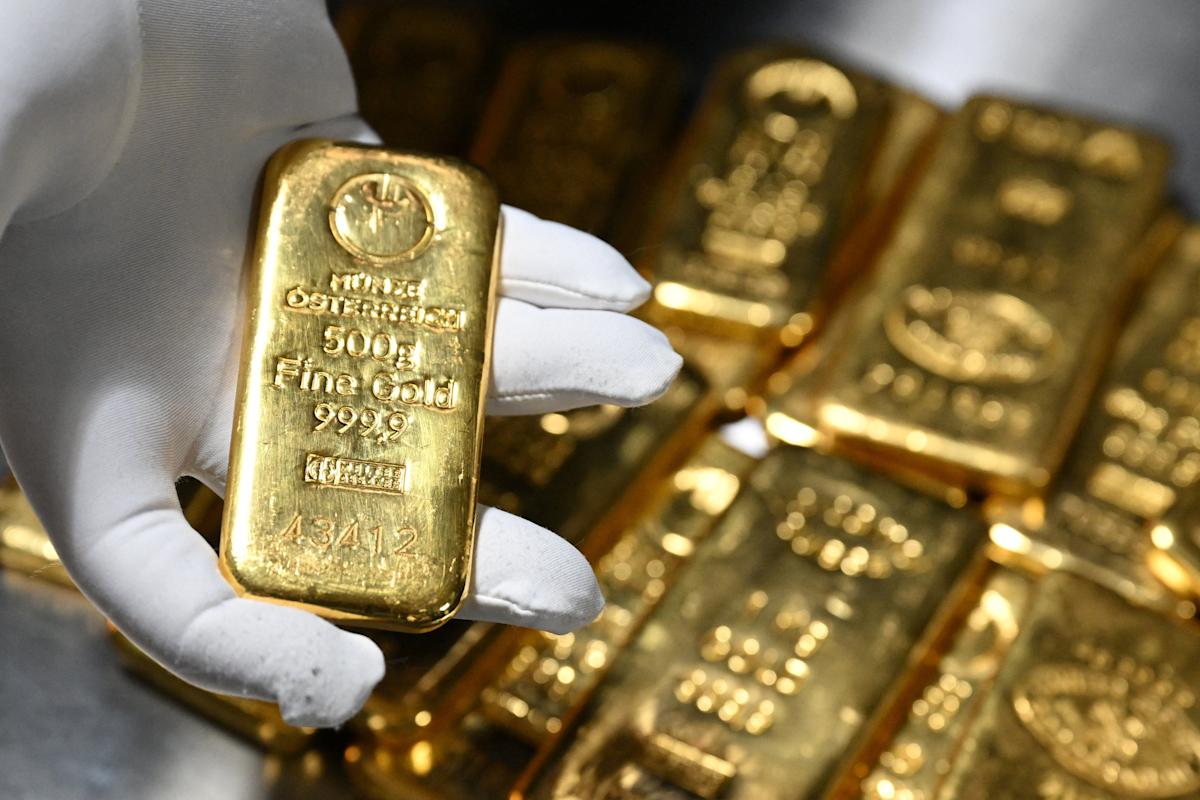
Gold has surged above $5,500 an ounce, extending a blistering rally that has seen the metal gain almost 30% so far this year, amid growing concerns over geopolitics, US monetary policy and the outlook for the dollar.
Gold futures (GC=F) rose 4.5% to $5,579.80 a troy ounce, while spot prices climbed 4.8% to $5,543.86 at the time of writing. Prices touched a fresh all time high of $5,594.82 earlier in the session, just three days after breaking through the $5,000 level for the first time.
The rally has been fuelled by renewed safe haven demand, firm central bank buying and a weakening US dollar. The US dollar index (DX-Y.NYB), which measures the currency against a basket of six major peers, slipped 0.3% to 96.16, near a four-month low.
Chris Beauchamp, chief market analyst at IG, said: “That sound you hear is that of 2026 gold (GC=F) targets being furiously revised higher, as the price keeps climbing, and given renewed impetus by Trump’s comments on the dollar. This will have fans of the debasement trade cheering in their seats, as it reinforces their thesis. Each time precious seem at risk of running out of bullish momentum, something comes along to rescue it. So long as international investors keep dumping the dollar, the future for gold looks bright indeed.”
Read more: Should you invest in gold?
Soni Kumari, an analyst at ANZ, said: “Gold (GC=F) prices are [rising on)] safe haven demand because of the strange geopolitical situation and even the political situation in the US, [which is] not looking great. There are concerns around Fed independence. And when that happens, investor trust in the financial system gets shaken up.”
Investors have grown increasingly uneasy about the independence of the US Federal Reserve following a criminal investigation by the Trump administration into chair Jerome Powell, efforts to remove Fed governor Lisa Cook and the looming nomination of Powell’s successor in May.
Edward Meir, analyst at Marex, said: “Growing US debt and uncertainty created by signs that the global trade system is splintering into regional blocs as opposed to a US centric model (are leading investors to pile into gold).”
Gold (GC=F) has risen more than 10% this week alone and is up $1,000 this January. The surge has also lifted other precious metals, with silver (SI=F) up 65% since the start of January and hitting $120 an ounce for the first time on Thursday.
Sterling edged higher against the US dollar on Thursday, hovering near four-month highs, as weakness in the greenback persisted and investors continued to favour hard assets such as gold (GC=F).
The pound rose 0.2% to $1.3828 and gained 0.1% against the euro to €1.1551.
Moves in currency markets came after Trump said on Tuesday that the dollar was “doing great”, signalling little concern about its recent decline. The US currency fell 9% last year and is down more than 2% so far this month.
Stephen Innes, managing partner at SPI Asset Management, said the shift reflected growing interest in the so called debasement trade, as investors lose confidence in traditional fiat currencies and seek protection against inflation and rising government debt.
Read more: UK dividends forecast to grow to £88.8bn in 2026
“Gold (GC=F) is responding to something more structural and more uncomfortable. The slow realisation that the anchors of the system are lighter than advertised,” he said.
“Gold is the inverse of confidence. When belief in policy coherence weakens, gold ceases to behave like a hedge and instead acts as an alternative. That is what we are watching now.”
“This is not fear of recession. There is doubt about fiat stewardship.”
Oil prices rose to a four-month high on Thursday as growing fears of a possible US military strike on Iran heightened concerns about supply disruptions in the Middle East.
Brent crude (BZ=F) futures rose 1.3% to $68.24 a barrel, while West Texas Intermediate (CL=F) rose 1.5% to $64.14 at the time of writing.
The gains reflect a rising geopolitical risk premium as tensions between Washington and Tehran escalate. US president Donald Trump has stepped up pressure on Iran to curb its nuclear programme, including threats of military action, while a US naval group has arrived in the region.
Iran is the fourth largest producer in OPEC, pumping about 3.2 million barrels a day, and any disruption to its output could have significant implications for global supply.
Stocks: Create your watchlist and portfolio
Suvro Sarkar, energy sector team lead at DBS Bank, told Reuters: “The main driver of oil (BZ=F, CL=F) prices remains geopolitical risk premium surrounding Iran and the Middle East, though unplanned outages in Kazakhstan and US (Winter Storm Fern) have had a temporary impact as well.”
Some analysts said the heightened risk of conflict was already being reflected in prices. Analysts at Citi said in a note: “The potential for Iran getting hit has escalated the geopolitical premium of oil (BZ=F, CL=F) prices by potentially $3 to $4 (per barrel).”
They added that further escalation could lift Brent (BZ=F) prices to as high as $72 a barrel over the next three months.
In equities, the FTSE 100 (^FTSE) was higher on Thursday morning, up 0.6% to 10,212 points.
Download the Yahoo Finance app, available for Apple and Android.