
This post was originally published on this site.
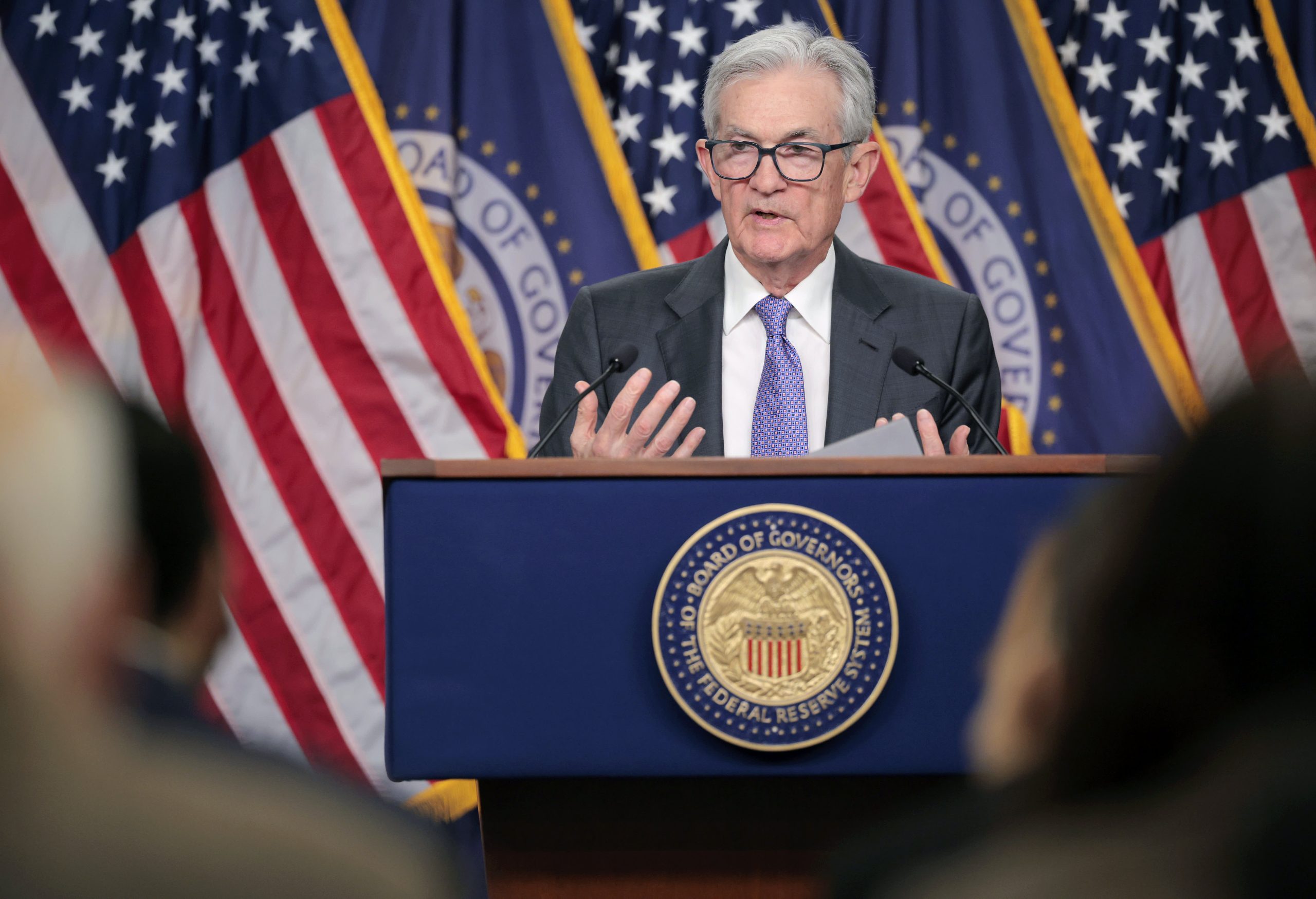
This is CNBC’s live blog covering the Federal Open Market Committee meeting and Chair Jerome Powell’s press conference.
The Federal Reserve kept its overnight lending rate steady at a range of 3.5% to 3.75%.
Available indicators suggest that economic activity has been “expanding at a solid pace,” according to the Federal Open Market Committee’s post-meeting statement. Policymakers also noted that the unemployment rate has shown some signs of stabilization.
At his press conference, Fed Chair Jerome Powell said, “Many of my colleagues think it’s hard to look at the incoming data and say that policy is significantly restrictive at this time.”
The Fed’s decision comes at a hectic time for the central bank. President Donald Trump last week told CNBC that he may have narrowed his search for a new Fed chair to one candidate. The Justice Department has also been investigating Powell, a move that’s raising concerns about the Fed’s independence.
Where to find solid yields on cash as Fed pauses
The Fed’s decision to hold rates steady means investors don’t have to worry about yields on their cash falling.
“Yields on savings products such as high-yield savings accounts and CDs are likely to remain unchanged for now,” said certified financial planner Stephen Kates, a financial analyst at Bankrate.
Money market funds have been a popular choice for cash investors. The annualized seven-day yield on the Crane 100 list of the largest taxable money funds is 3.5%, as of Tuesday.
Certificates of deposit with one-year maturities range between 3.25% and 4%, depending on the issuer.
To see what specific money market funds and CDs are offering right now, read the CNBC Pro story here.
— Michelle Fox
Powell’s strong defense of central bank independence
Powell offered a strong defense of central bank independence, arguing it is a cornerstone of modern democracies and a safeguard against the politicization of monetary policy.
“The point of independence is not to protect policymakers or anything like that. It just is that every advanced economy, democracy in the world has come around to this common practice. It’s just an institutional arrangement that has served the people well, and that is to have a separation between — to not have direct elected official control over the setting of monetary policy,” he said.
His comments come after Trump has gotten increasingly vocal about controlling the Fed. That has happened through persistent criticism of Powell and his colleagues, his own appointments, as well as saying that he thinks the president should be consulted on interest rate decisions.
“The reason is that monetary policy can be used, you know, through an election cycle to affect the economy in a way that will be politically worthwhile,” Powell said. “If you lose that, it’s going to be hard to retain it, and we haven’t lost it. I don’t believe we will… it’s enabled central banks generally not to be perfect, but to serve the public well.”
— Yun Li
Powell says the Fed can ‘loosen policy’ once prices fall
Fed Chair Powell said that once prices fall, the central bank would look to cut back on policy.
He expects to see, “the effects of tariffs flowing through goods prices peaking and then starting to come down, assuming there are no new major tariff increases that are begun.”
“And that’s what we expect to see over the course of this year. If we see that, that would be something that tells us that we can we can loosen policy,” he added.
— Itzel Franco
Powell says Cook’s case is ‘perhaps the most important’ in Fed history
Powell’s decision to attend the oral arguments at the Supreme Court this month in the Cook case were seen as an unusual step for a Fed chair to take.
“I will tell you why I attended,” Powell said in response to a reporter’s question. “I would say that that case is perhaps the most important legal case in the Fed’s 113-year history. And I, as I thought about it, I thought it might be hard to explain why I didn’t attend.”
“In addition, Paul Volcker went to a Supreme Court case famously, [in] I guess 1985 or so, so it’s precedented, and I thought it was an appropriate thing, and I did it,” Powell said.
At issue in the Cook case is whether a sitting president can fire a Federal Reserve governor in the manner in which Trump has attempted. The president has alleged Cook committed mortgage fraud by claiming two different properties as her main residence in 2021, before she joined the board. The Federal Reserve Act says a president can remove a member of the board of governors only “for cause.”
—Christina Cheddar Berk
Powell says hard to say Fed is restrictive right now
Despite two dissents, Powell said that colleagues were mostly supportive of taking a pause after three consecutive cuts.
“There was broad support on the committee for holding today,” he said, “including among non-voters.” He did acknowledge the dissents for another rate cut, though.
Additionally, Powell said that he thinks the federal funds rate is “loosely neutral.” He also said that was another area the committee broadly agreed with him.
“Many of my colleagues think it’s hard to look at the incoming data and say that policy is significantly restrictive at this time,” he said.
— Davis Giangiulio
Powell says the forecast is overall stronger since last FOMC meeting
Powell said that the growth outlook looks stronger currently compared to where things were last year.
“If you look at the incoming data since the last meeting, [there is] clear improvement in the outlook for growth,” he said. “Inflation performed about as expected, and as I mentioned, some of the labor market data came in suggesting evidence of stabilization. So it’s overall, a stronger forecast, really.”
Powell added that the committee would continue to make their interest rate cut decisions “meeting by meeting” based on incoming data.
“After the three recent rate cuts, we’re well-positioned to address the risks that we face on both sides of our dual mandate,” he added. “[We] haven’t made any decisions about future meetings, but the economy is growing a solid pace. The unemployment rate has been broadly stable, and inflation remains somewhat elevated. So we’ll be looking to our goal variables and letting the data light the way for us.”
— Lisa Kailai Han
Powell says it’s ‘not appropriate’ to comment on recent dollar volatility
Powell said he does not comment on the U.S. dollar when asked about recent volatility in the greenback.
“We don’t talk about the dollar. We don’t talk about what moves it around,” Powell said. “It’s just not appropriate for us to do.”
Powell said the Trump administration and the Treasury Department in particular have oversight over the currency.
The U.S. dollar index fell to multiyear lows on Tuesday after President Donald Trump brushed off its drop. But it rose on Wednesday after Treasury Secretary Scott Bessent ruled out a potential U.S. intervention in the currency market.
— Alex Harring
Powell sees core inflation hitting 3% but is still confident
Core inflation likely hit 3% in December but still is on track to get back to the Federal Reserve’s target, central bank Chair Powell said.
As measured by the Fed’s preferred personal consumption expenditures price index, the end-year picture showed continued goods inflation though easing in services, Powell added. The Fed targets 2% inflation, and Powell said he’s still confident it will get there once the impact of tariffs wanes.
“These elevated readings largely reflect inflation in the goods sector, which has been boosted by the effects of tariffs. In contrast, disinflation appears to be continuing in the services sector,” he said.
—Jeff Cox
Powell: ‘Monetary policy is not on a preset course’
Powell on Wednesday said future interest rate moves were not yet decided.
“Monetary policy is not on a preset course,” Powell said during his press conference. “We will make our decisions on a meeting-by-meeting basis.
Powell said the Fed is “well positioned” to determine future adjustments to the policy rate depending on what economic data shows.
— Alex Harring
Powell says economy is on a ‘firm footing’
The Federal Reserve chairman said the U.S. economy has started the year on a firm footing.
“The U.S. economy expanded at a solid pace last year and is coming into 2026 on a firm footing,” Powell said. “While job gains have remained low, the unemployment rate has shown some signs of stabilization and inflation remains somewhat elevated.”
— Spencer Kimball
Powell to face questions on Fed independence, Lisa Cook, says Art Hogan
It was no surprise the Federal Reserve kept rates unchanged and that there were two dissenters, said Art Hogan, chief market strategist at B. Riley Wealth.
Instead the “real action” will be at the press conference, as Chair Powell faces questions about the White House’s pressure on the central bank and the Trump administration’s efforts to remove Fed Governor Lisa Cook, he said.
“Powell’s public appearance at the Supreme Court in support of Cook, the FOMC governor, can reasonably lead one to anticipate he will emphasize the importance of central bank independence in setting monetary policy, preserving the Fed’s credibility, and managing the economy,” Hogan said.
— Michelle Fox
Goldman Sachs Asset Management expects further cuts later this year
The Federal Reserve may be on hold for a while, but it will likely resume later this year, according to Kay Haigh, global co-head of fixed income and liquidity solutions at Goldman Sachs Asset Management.
“The Fed is likely on an extended pause with strong activity data and signs of stabilization in the labor market suggesting little need to take out further insurance,” he said. “However, we expect easing to resume later in the year as a moderation in inflation allows for two further ‘normalization’ cuts to take rates back to levels seen by the median FOMC member as neutral.”
— Michelle Fox
Miran calls for quarter-point decrease
Federal Reserve Governor Stephen Miran — President Trump’s recent pick for the central bank — was more hawkish at the January policy meeting.
Miran voted for a quarter-percentage point cut to federal funds rate, according to the central bank’s statement released Wednesday. He previously argued for a half-point decrease.
See what changed in the January Fed statement here.
— Alex Harring
Federal Reserve holds steady on key interest rate

Central bank policymakers kept the key interest rate at a range of 3.5% to 3.75%, a move that was widely expected by traders.
The Federal Open Market Committee highlighted an improving economic view.
“Available indicators suggest that economic activity has been expanding at a solid pace. Job gains have remained low, and the unemployment rate has shown some signs of stabilization,” the post-meeting statement said. “Inflation remains somewhat elevated.”
Read more about the Fed’s decision here from CNBC’s Jeff Cox.
—Darla Mercado
Where markets stand as the Fed’s decision approaches
The major averages were mostly near the flatline at about 1:48 p.m. ET as the Federal Reserve’s rate announcement neared.
The S&P 500 traded about 0.1% lower, while the Dow Jones Industrial Average was little changed. The Nasdaq Composite was last higher by roughly 0.2%.
The 10-year Treasury yield was last higher by about 3 basis points, trading at 4.26%. The rate on the 2-year note was up nearly 2 basis points, trading at 3.59%.
—Darla Mercado
What the Fed decision means for consumer borrowing and savings rates
At a time when many U.S. households are concerned about affordability, the central bank’s decision means consumers may have to wait a little longer for relief from high borrowing costs — at least when it comes to some types of loans.
Generally, short-term rates, like credit cards, are closely pegged to the fed’s benchmark. Longer-term rates, like mortgages, are more influenced by inflation and other economic factors.
While the central bank has no direct influence on deposit rates, those yields tend to be correlated to changes in the target federal funds rate — so holding that rate unchanged will keep savings rates above the rate of inflation, which is a rare win.
— Jessica Dickler
Allianz Trade sees just one rate cut in 2026
Though the market anticipates up to two rate cuts this year, Allianz Trade sees just one reduction in 2026 as the Federal Reserve contends with economic pressures.
“[Federal Open Market Committee] policymakers are divided on the balance of risks between weak hiring and persistent inflation,” Maxime Darmet, Allianz Trade’s senior economist for the U.S., France and the U.K., said in a written commentary.
He said that growing evidence that the rollout of artificial intelligence is powering GDP growth, along with a stabilizing labor market, should convince Fed policymakers to keep rates near their current levels for the remainder of the year. The current interest rate range is 3.5% to 3.75%.
“We continue to expect only one 25bps rate cut in 2026, most likely in June,” he added. “The economy can clearly operate with Fed rates at 3.5%. Lower rates would be unwarranted as they would reignite inflation risks.”
—Darla Mercado
Rick Rieder emerges as frontrunner to replace Powell in prediction markets
BlackRock’s fixed-income chief Rick Rieder has emerged as the frontrunner in prediction markets to succeed Powell as Fed chair when his term ends in May. Traders on Kalshi are giving the Wall Street veteran a 43% chance, well ahead of former Fed Governor Kevin Warsh at 29%.
Rieder’s odds rose after Trump called him “very impressive” in a CNBC interview at the World Economic Forum. A separate Bloomberg News report, citing people familiar with the matter, said White House officials generally view Rieder favorably.
By contrast, National Economic Council Director Kevin Hassett has seen his odds fall to 8% on Kalshi, after Trump told reporters he would miss Hassett at the NEC and would prefer he remain in the role.
— Yun Li
What to expect at the conclusion of the Fed’s January meeting
The Federal Reserve will likely keep its key interest rate steady at a range of 3.5% to 3.75% at the end of its policy meeting on Wednesday.
While the decision itself won’t provide much action, traders are going to keep a close ear on Fed Chair Powell’s press conference, which kicks off at 2:30 p.m. ET. They’ll be seeking clues on where policy might be heading longer term.
Traders will also have another development on their minds: the fireworks surrounding the central bank in Washington. President Trump recently told CNBC that he may have winnowed down the list of potential Fed chair candidates to just one individual.
Read more here from CNBC’s Jeff Cox on what to expect from the end of the Fed’s January meeting.
—Darla Mercado