
This post was originally published on this site.
NEW YORK (WABC) — They’re called “ghost students” and they’re draining the resources of community colleges and stealing tax payer financial aid funds.
“You’re stealing from people who really have the least already,” said Dr. David Stout, President of Brookdale Community College in New Jersey. “It’s infuriating.”
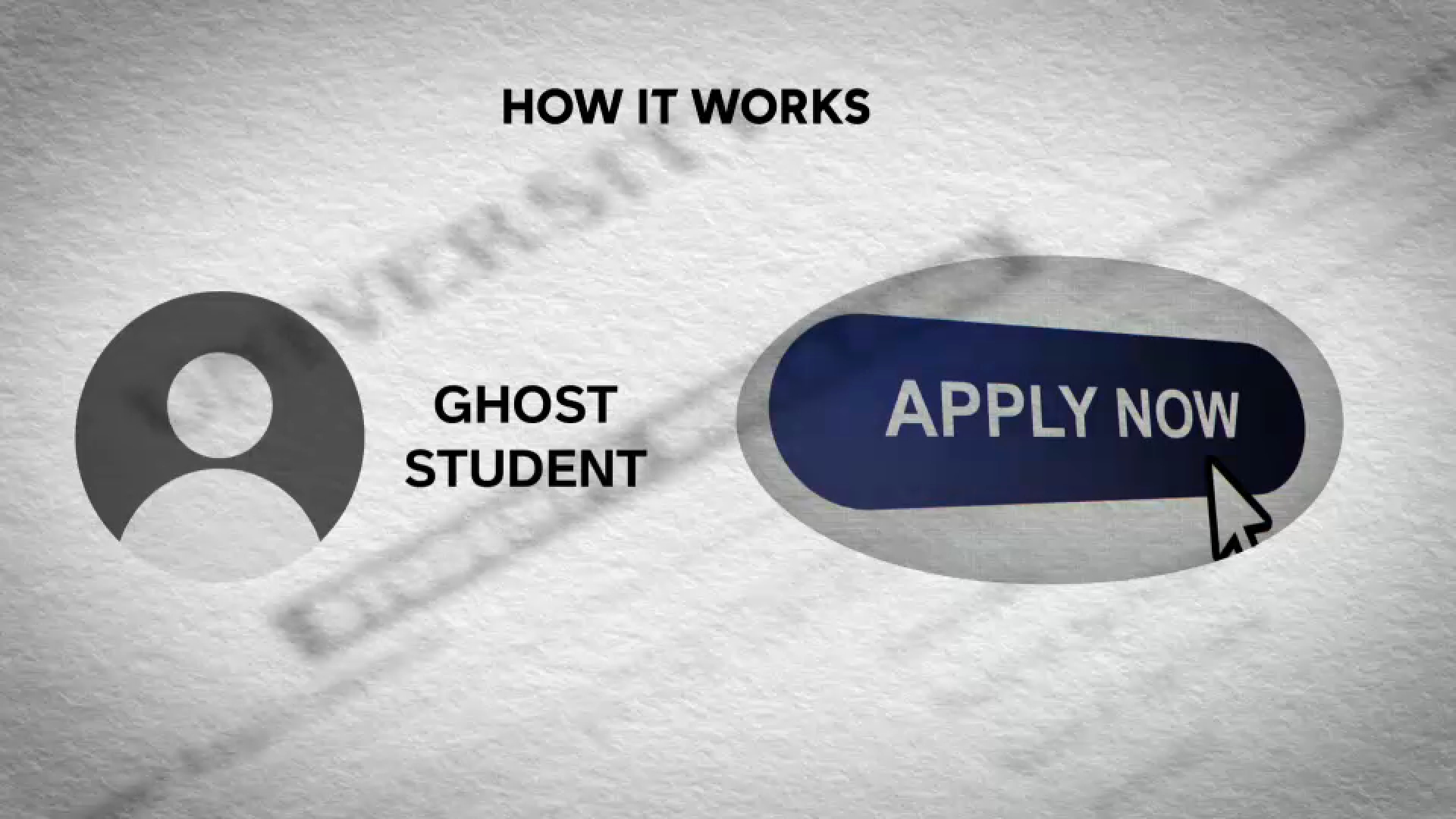
Scammers are stealing people’s identities, often through data breaches, to apply for online college classes. Once they apply for financial aid and get the money, they disappear.
It’s a sophisticated scheme and community colleges are often targeted because of their open enrollment policies.
At Brookdale Community College, they’ve been receiving about 1,000 ghost student applications each year for the past three years.
“Knowing that there are individuals out there that are trying to steal from our community college students and individuals who are trying to steal from our community and from our taxpayers is infuriating,” said Dr. Stout.
Since the pandemic started, it wasn’t rare to have students across the country sign up for his college’s online courses. But three years ago, when one of his financial aid workers noticed a bump in enrollment, the president’s team investigated.
“So she dug a little bit deeper and found that there were seven students that all shared somewhat common credentials and it was at that point that we realized that we were the victims of ghost students,” said Dr. Stout.
“Of course I’m furious that we may have individuals who try to take advantage of the open door policies that community colleges have,” said Dr. Stout.
He said there’s no evidence that any of the fake students who applied at Brookdale received financial funds, they were discovered first. Since then, the college says it has put mechanisms in place to root out fake applicants.
Eyewitness News reached out to other colleges in the area who say they’ve also put new screening practices in place.
At the City University of New York, a spokesperson said ghost applicants make up less than 1% of its applications. In a statement, a college spokesperson said: “Thanks to our careful screening process none were accepted or provided financial aid, but we continue to strengthen our policies to reduce the number of these applications. For example, the University recently introduced CAPTCHA to screen out bots and fake applicants.”
Nassau Community College has also taken precautions.
A spokesperson said. “while we cannot disclose specific security measures, the college’s IT, financial aid, and admissions departments have been working together to protect the integrity of our admissions and financial aid processes and mitigate the risk this type of fraud poses to our institution.”
Eyewitness News partnered with ABC News to show how this is a growing problem across the country.
The Inspector General’s Office with the U.S. Department of Education says they have 200 open investigations nationwide.
“We see in some of these fraud schemes where people are enrolled in two or three different schools at the same time receiving aid at all of them,” said Jason Williams, the U.S. Dept of Education Assistant Inspector General for Investigation.
Some schools are now using special software to screen applicants.
“It takes a tremendous amount of administrative work to go through and verify that they’re fraudulent,” said Dr. Stout.
The Brookdale Community College President says they’re in contact with other colleges in the area on a continuous basis to share information and ways to prevent ghost applicants from getting enrolled.
———-
SHARE YOUR STORY
Do you have an issue with a company that you haven’t been able to resolve? If so, 7 On Your Side wants to help you!
Fill out the form below or email your questions, issues, or story ideas by filling out the form below or by emailing 7OnYourSideNina@abc.com. All emails MUST INCLUDE YOUR NAME AND CELLPHONE NUMBER. Without a phone number, 7 On Your Side will not be able to respond.
You can also contact Dan Krauth directly:
Email your questions, issues, or story ideas to 7OnYourSideDan@abc.com
Facebook: DanKrauthReports
Twitter: @ DanKrauthABC7
Instagram: @DanKrauth
Copyright © 2026 WABC-TV. All Rights Reserved.