
This post was originally published on this site.
The European Union and South American bloc Mercosur will sign a long-delayed free trade agreement on Saturday in Asuncion, Paraguay, creating one of the world’s largest free trade zones. The Mercosur bloc is composed of Argentina, Brazil, Paraguay, Uruguay and Bolivia.
Bolivia will not be included, however, as it became a member of the bloc only recently and was not involved in the negotiations. The Andean country would be able to join in the coming years.
The pact, 25 years in the making, will eliminate tariffs on more than 90% of bilateral trade between the EU and Mercosur.
Together, the blocs account for about 30% of global GDP and more than 700 million consumers.
President of the European Commission Ursula von der Leyen and European Council President Antonio Costa were due to attend the signing ceremony, alongside regional leaders.
“And this is how we create real prosperity — prosperity that is shared. Because, we agree, that international trade is not a zero-sum game,” von der Leyen said on Friday.
Brazil’s President Luiz Inacio Lula da Silva, a key backer of the deal, will not attend but has praised the agreement calling it historic and a boost for multilateralism.
What are details of the EU-Mercosur deal and roadblocks?
The trade deal would slash tariffs with the goal of expanding goods trade that is even split. In 2024, this trade was worth €111 billion ($128.8 billion).
- The deal includes the EU’s 27 member countries, although Austria, France, Hungary, Ireland and Poland voted against it
- The accord is expected to benefit EU exports such as cars, wine and cheese
- It will also provide access for South American agricultural products including beef and soybeans
- It faces opposition from some European farmers
- Opponents fear a surge of cheap imports of South American commodities and further deforestation
The deal must still secure approval from the European Parliament and national legislatures before fully entering into force.
Why won’t Lula attend the signing?
Although Lula was one of the principal forces behind the deal, the Brazilian president will be skipping the signing on Saturday.
Experts say the decision may reflect Lula’s frustration that the agreement was not signed in December, when Brazil held Mercosur’s rotating presidency.
Ahead of the signing, however, Lula was optimistic, saying, “Tomorrow in Asuncion, we will make history by creating one of the world’s largest free trade areas.”
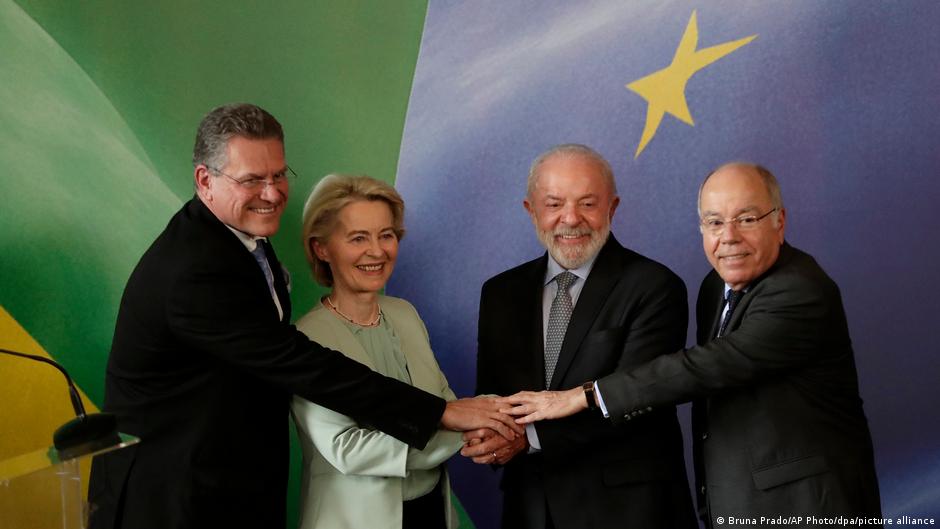
“It was more than 25 years of suffering and attempts to get a deal,” he said at a press conference alongside von der Leyen.
Meanwhile, Argentina’s Javier Milei and Uruguay’s Yamandu Orsi will be present at the ceremony hosted by Paraguay’s Santiago Pena.
Edited by: Jenipher Camino Gonzalez