
This post was originally published on this site.
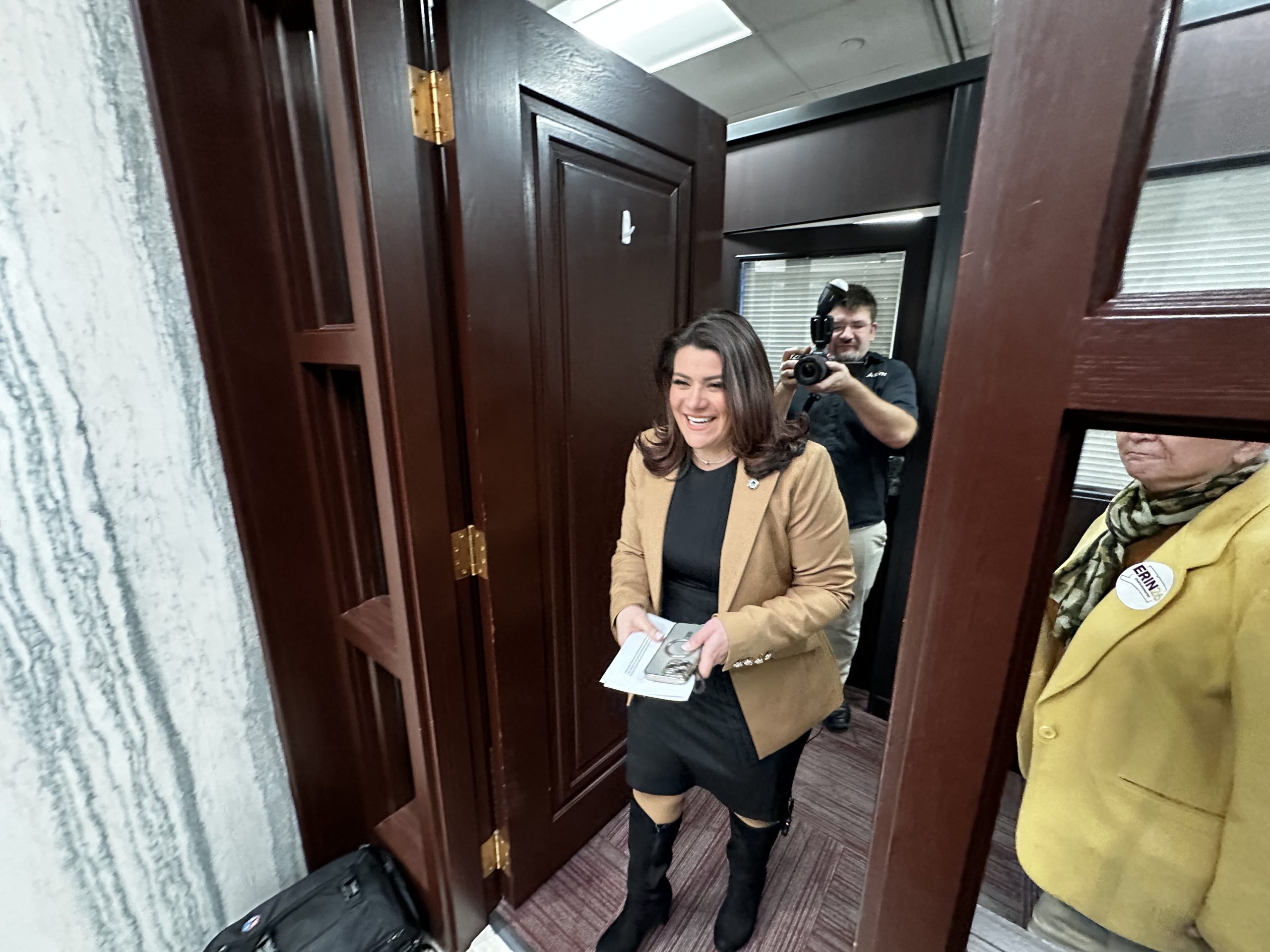
The gubernatorial campaign of Republican Erin Stewart cleared a significant hurdle Wednesday by qualifying for public financing from the voluntary Citizens’ Election Program earlier than any previous candidate for governor.
The State Elections Enforcement Commission unanimously approved Stewart’s application, immediately providing her an $806,875 convention grant and the promise of at least another $15.4 million if she wins the GOP nomination.
To qualify, Stewart had to raise at least $250,000 in small-dollar donations that could range from $5 to $340 each, a task others have struggled to accomplish before June, leaving little time to staff up for an August primary.
“It’s a statement of credibility and broad public support,” said John Healey, the Stewart campaign’s general consultant and senior advisor.
Stewart is the beneficiary of revisions made after 2022, the last of two election cycles dominated by wealthy self-funders who could not only spend far more than publicly financed rivals but could start sooner.
The grants were about $1.3 million for a primary and $6.5 million for a general election, and the earliest grant could not be paid until a candidate qualified for a primary at a nominating convention in May.
As a result, Republican Bob Stefanowski, a self-funder new to politics, began spending in January on his campaign for governor in 2018, five months before two publicly financed rivals, Mark Boughton and Tim Herbst, got their grants.
Under the revisions, the grants more than doubled to about $3.2 million for a primary and $15.4 million for a general election. And for the first time, an $806,875 advance on the primary grant would be available immediately upon qualifying, as Stewart did Wednesday.
Her campaign immediately announced staffing hires.
“We’ve been running for the past year on ‘loyalty and love,’ as the mayor says,” Healey said. “This gives the campaign the ability to staff up and run a full-fledged field operation.”
Stewart, 38, the former mayor of New Britain, is competing for the nomination with state Sen. Ryan Fazio, 35, of Greenwich, who also plans to seek public financing. Betsy McCaughey, 77, a Newsmax host and former lieutenant governor of New York, has told Republicans she is likely to run.
Jim Conroy, a spokesman for the Fazio campaign, said the quarterly finance report due on Jan. 10 will show him also surpassing the $250,000 threshold — and doing so “faster than any other statewide campaign.”
Fazio began fundraising after opening his campaign in August. Stewart didn’t declare her candidacy until November, but she began raising qualifying contributions for public financing in January 2025 through an exploratory committee.
Stewart, who was mayor for 12 years, did not seek reelection in November, hewing to a plan and timetable drawn a year ago: raise money through an exploratory committee, declare her candidacy immediately after the municipal elections in November, and apply for public financing in December.
“She posted a very strong fundraising record throughout the course of the year,” Healey said. “She has ticked every box, despite the naysayers saying, ‘She’ll hit a wall at some point.’”
Stewart filed her application in late December. The approval Wednesday came after an audit ensuring that the qualifying contributions met the requirements of the law. Ultimately, she raised $287,153 in qualifying contributions.
Connecticut’s public financing system, a reform created in response to the bid-rigging scandal that forced Gov. John G. Rowland from office in 2004, is nearly universally used by state legislative candidates.
Participants must abide by spending limits. One of the other reforms was a ban on contributions by state contractors to any candidate for state office, whether they sought public financing or not.
Gov. Dannel P. Malloy won the open seat for governor in 2010 as a publicly financed candidate, defeating self-funders in a Democratic primary and then in the general election. He was reelected in 2014, again with public financing.
The program has since become irrelevant in gubernatorial elections.
Democrat Ned Lamont and Stefanowski opted out of the voluntary program in 2018 and in their 2022 rematch. Lamont spent $25.7 million to win reelection to a second term; Stefanowski spent $14.5 million that year.
Lamont spent $8 million on television ads in the last five weeks of the campaign, more than the total spending Citizens’ Election Program would have allowed over the entirety of the campaign.