
This post was originally published on this site.
Red Sox Video
As one of the oldest franchises in Major League Baseball, the Boston Red Sox are deeply embedded in the sport’s history. The organization has stepped into the limelight at various points over the past 125 years, more often than not for trading the face of their franchise. Each seismic move significantly impacted the Red Sox, creating a ripple effect. If you believe in alternate timelines, imagine if:
Signing Rafael Devers to a 10-year, $313.5 million contract, the largest in franchise history, supposedly washed away the remorse of trading Mookie Betts. Devers was a homegrown player. A World Series Champion. The last man standing from the 2018 core. Nonetheless, history repeated itself.
Following an exhilarating home sweep of the Yankees in mid-June of 2025, the Red Sox parted ways with Devers, sending him across the country to the San Francisco Giants. The move’s fallout has curdled faster than milk.
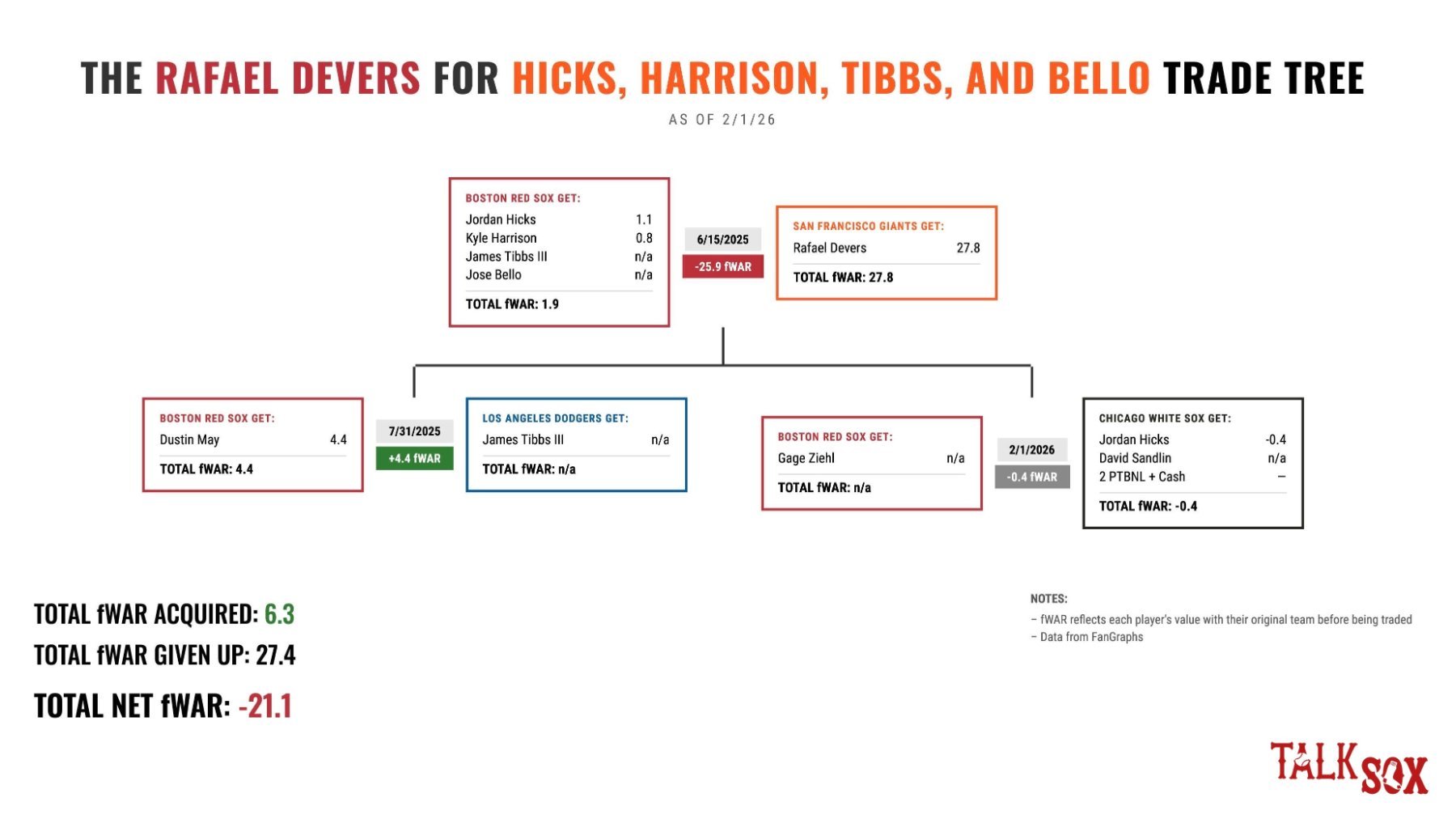
The Red Sox received four players from the Giants: reliever Jordan Hicks, bulk reliever Kyle Harrison, outfield prospect James Tibbs, and pitching prospect Jose Bello. Come February 2026, Harrison and Bello are the only remaining pieces from the trade. The team quickly parted with Tibbs at the trade deadline, sending him to the Dodgers for Dustin May. Hicks is now the Chicago White Sox’s problem.
Trading the face of your franchise to appease Alex Bregman — who ended up being a one-year rental on a pillow contract — is a tough pill to swallow. Quantifying the move’s damage is even more brutal. Between Hicks, Harrison, and May, the Red Sox acquired a total of 5.9 fWAR. Sending Devers to San Francisco gave up 27.8 fWAR. The net loss sits at -21.9 fWAR. These totals reflect what players produced with their former teams. Their actual contributions with the Red Sox were much worse.
When trading an established contributor, you should expect a decent return, not a bag of peanuts. Hicks’ 18.2 innings for the Red Sox featured -0.4 fWAR, 8.20 ERA, 6.19 FIP, and a ghastly 3.1% K-BB%. He continually forgot the strike zone existed and blew leads.
Harrison, the more immediate bright spot from the trade, is under control through the 2030 season. Baseball America ranked him as the Giants’ #1 prospect in 2024. He tinkered with his pitch mix in Triple-A Worcester by adding a cutter and altering his changeup grip. The results point in a positive direction: 3.00 ERA, 2.47 FIP, 14.3% K-BB%, and 0.4 fWAR. With two remaining MiLB options, Harrison will likely start the 2026 season in Worcester.
In the aftermath of the Joe Ryan debacle at the 2025 trade deadline, Red Sox fans were left with Dustin May as a consolation prize. Oh well, oh well. The Mayday Parade limped to a dismal 5.40 ERA, 5.39 FIP, 9.8% K-BB%, and -0.1 fWAR.
Bello only tossed 23.1 innings at Single-A Salem last year. Entering his age-21 season, he could develop into a solid arm, but it’s too soon to tell. @Nick John broke down newcomer Gage Ziehl. Like Bello, he is a low-level prospect. Some of the organization’s pitching prospects have sped through the minors, so that we might see Bello and/or Ziehl in Triple-A Worcester by the end of the season.
Other blockbuster trades in recent memory just haven’t aged this poorly so quickly. Hicks, Harrison, and May have combined for -0.1 WAR with the Red Sox. Meanwhile, Devers accumulated 1.3 fWAR on the West Coast (3.3 total).
I’ll acknowledge that Devers’ contract won’t hold up over time. The extension was an orchestrated PR move to restore the team’s reputation and appease the fanbase after the departures of Betts and Xander Bogaerts. It occurred less than a month after Bogaerts was lured to the Padres on an 11-year, $280 million contract. Devers was never going to contend for a Gold Glove at third. His value came from his bat, tearing the seams off the ball from the two-hole. The Red Sox knew this. The trade wasn’t inevitable. It was the product of poor roster management, short-term thinking, and egos run unchecked.
Comparison Trade Tree
On the surface, Juan Soto and Rafael Devers share similar profiles. Both are bat-first players with questionable defense. The circumstances of their trades were vastly different. Soto was 23 years old when the Nationals traded him, earning $17.1 million under arbitration for the 2022 season. He had two years of team control before he hit free agency. Devers was 28, earning $29.66 million in AAV with about 8.5 years left on his 11-year, $331 million extension. The Nationals sold high on a young player they couldn’t retain instead of letting him walk for nothing. The Red Sox traded a franchise cornerstone owed $250+ million on a long-term deal because egos in the clubhouse and front office couldn’t be managed properly.
After Soto rejected a 15-year, $440 million extension offer, the Nationals decided to cash out, shipping him to the Padres for a king’s ransom. Less than two years later, the Padres flipped Soto to the Yankees in his final year of arbitration. The move that emptied their farm system ended up replenishing it.
Upon an initial review of the Soto trade tree, it looks like the Nationals were fleeced. But, the fWAR displayed reflects each player’s value with their original team before being traded. It doesn’t account for any post-trade production, as prospects without any major league playing time do not initially register any value.
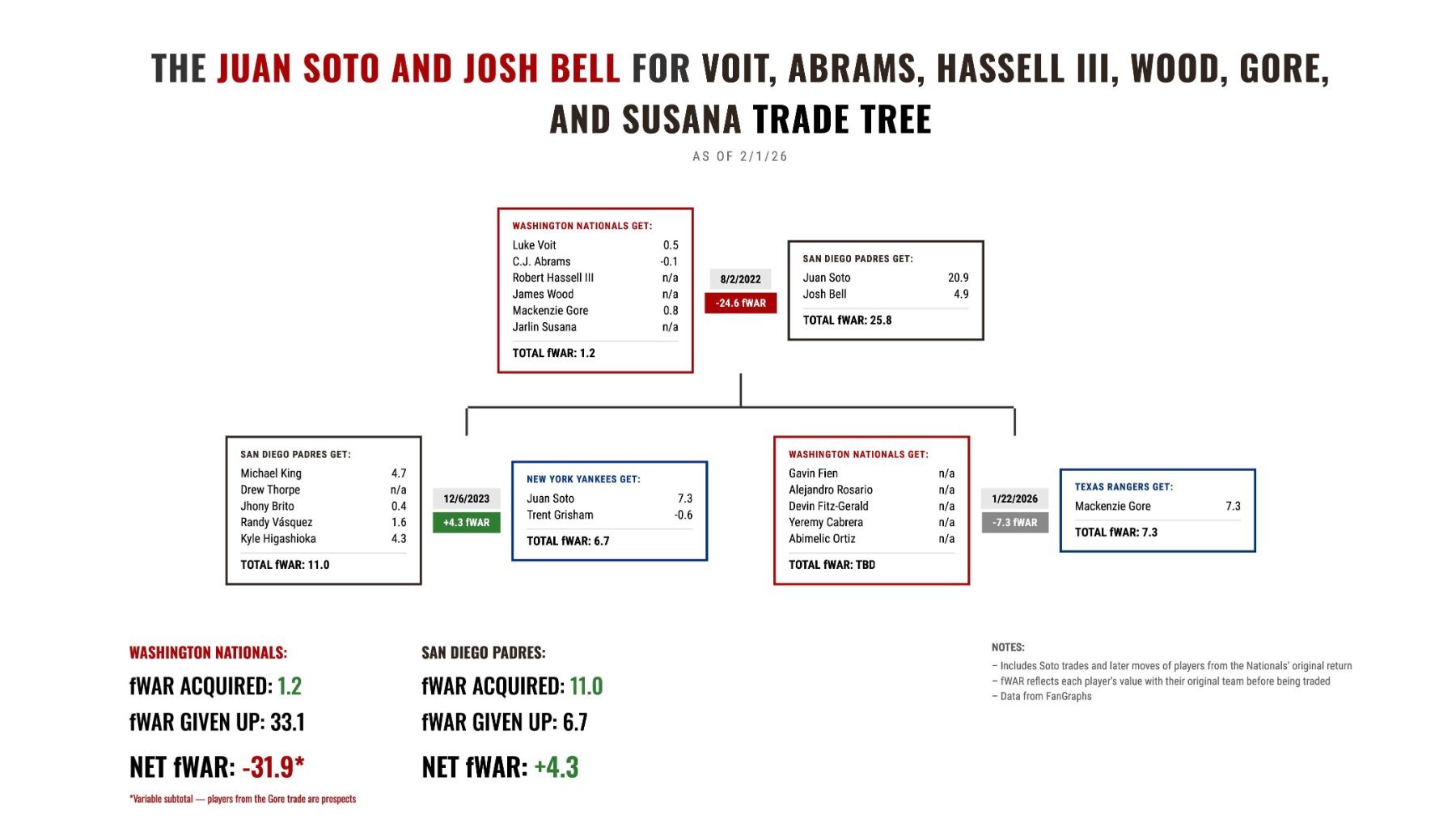
From the draft until the majors, baseball prospects take time to develop. Most don’t pan out. However, the Nationals struck gold on their return of starter Mackenzie Gore, outfielder James Wood, shortstop CJ Abrams, and outfielder Robert Hassell III.
Pitching for a team that’s finished at (or near) the bottom of the National League East over the past three seasons, Gore tossed 462.1 innings for a 4.15 ERA, 4.01 FIP, 16.6% K-BB%, and 7.3 fWAR. Wood, as a 22-year-old rookie, has amassed 4.6 fWAR and a 125 wRC+. His peripherals are outstanding, and he’s an exciting player to watch. Coming off a career-high season of 3.1 WAR (7.0 total), Abrams is more of a bat-first shortstop. He’s marked -18 OAA since 2023, the worst among qualified shortstops, and a .250/.307/.417 slash line and 99 wRC+ with the Nats. Hassell III (-0.5 fWAR) has struggled at the plate (.572 OPS). On the field, his defense passes the eye test. These players have generated a combined 18.4 fWAR. The Nationals have already broken even with at least two more seasons of Wood and Abrams. Soto posted 18.1 fWAR from 2022-24, before hitting free agency.
The Soto trade tree continues to bear fruit. This offseason, the Nationals swapped Gore to the Rangers for another group of prospects. While these players aren’t knocking on the door yet, Paul Toboni, the Nationals’ newly minted President of Baseball Operations, has shown a knack for acquiring and developing young talent.
Soto’s stint with the Padres was short. He slashed .265/.405/.488 across 936 PA in 214 games for a 148 wRC+ and 7.3 WAR. Realizing that they couldn’t retain Soto amid a bloated payroll, the Padres shipped him back to the East Coast, this time to the Yankees. In exchange, they received starters Michael King, Drew Thrope, and Randy Vásquez, reliever Jhony Brito, and catcher Kyle Higashioka.
King’s career splits with the Yankees and Padres are nearly identical. When healthy, he’s a dominant pitcher. He put up 3.9 WAR in 2024 and 0.8 WAR across 15 games in 2025. This offseason, he signed a three-year, $75 million extension with the Padres. Brito posted 0.3 fWAR in 2024. He underwent an internal UCL brace surgery and missed the 2025 season. Heading into the 2026 season, his role is uncertain. Vásquez stepped up when injuries plagued the Padres rotation. Though his performance was a mixed bag in 2025, netting 0.8 fWAR. Higashioka (1.6 fWAR) was a serviceable catcher during his single season with the Padres.
As a Red Sox fan, there’s schadenfreude in watching the Yankees trade a boatload of talent for a one-year Juan Soto rental. All told, the Padres’ return of 7.4 WAR falls just short of Soto’s 8.3 fWAR with the Yankees in 2025. If King stays healthy and Vásquez and Brito don’t regress, that gap could break even as soon as this season.
The Other Awful Red Sox Trade
Chaim Bloom’s tenure with the Red Sox was marred by the Mookie Betts trade. Six years later, rehashing this move is beating a dead horse, so I’m not going into too much detail here. The Dodgers’ return and its resulting moves have accumulated 7.9 fWAR for the Red Sox:

This total is fluid, as Sonny Gray hasn’t stepped on the mound in a Red Sox uniform yet. Barring him turning into a pumpkin, the number should climb, though it still won’t come anywhere close to Betts’ performance (28.0 WAR) with the Dodgers.
You can chalk up one bad return to bad luck. Prospects are volatile. But two franchise players, traded under different GMs, both yielding dismal returns, point to a deeper issue. If you’re trading a generational talent, you should at least receive proven talent in return. Reclamation projects are a huge gamble. Craig Breslow flew too close to the sun and thought he could fix Jordan Hicks and Dustin May. He did not.
After the Betts trade, the Red Sox found themselves in limbo, stuck between fully committing to a rebuild and attempting to compete. With the Devers trade behind them, the team is in a different place with a young, controllable core. Reinvesting the $250 million owed to Devers into Garrett Crochet, Roman Anthony, and Ranger Suárez signals they want to turn a new leaf.
Whether the Red Sox have learned from their past mistakes remains to be seen. Mookie Betts was strike one. Rafael Devers was strike two. One more swing-and-miss and they’re out.