
This post was originally published on this site.


On Saturday night, the Cleveland Cavaliers, Sacramento Kings, and Chicago Bulls cut a three-way deal that, on its surface, doesn’t seem that important: The Cavs landed Keon Ellis and Dennis Schroder, the Kings received De’Andre Hunter, and the Bulls got Dario Saric and two second-round picks for helping facilitate the deal.
But this is also the type of trade that leads one to believe more activity could be on the horizon prior to Thursday’s deadline. Before we dive deeper into what that may actually be, let’s first summarize why it happened. As the league’s most expensive team, built with Finals-or-bust expectations, the underachieving Cavs were always going to be on tilt heading into February. Here, they somehow killed two birds with one stone by bolstering their backcourt and shedding a disappointing return on investment. Hunter, who was traded to Cleveland at last year’s deadline, has been a net negative all season. He’s shooting just 30.8 percent from behind the 3-point line, which pretty much negates all of his value to the Cavaliers right there.
Hunter is an indifferent playmaker and inconsistent defender who ranks 13th on his own team in estimated plus-minus (this also puts him at 159th out of 167 players leaguewide who average at least 25 minutes per game). Considering he’s guaranteed $24.9 million next season, the fact that Cleveland was able to get off this contract—and severely reduce its luxury tax bill—without attaching any draft compensation to the deal is remarkable. It’s also easy to understand when you remember who was on the other side of their negotiation.
Can the Kings go five consecutive minutes without imitating a whoopee cushion? Here’s a quick recap of what led them to make Saturday’s otherwise incomprehensible trade: Last summer, the Kings traded Jonas Valanciunas for Saric so they could afford to overpay Schroder. (This was before they signed Russell Westbrook to a veteran’s minimum contract; Russ plays more than Schroder, despite the fact that they signed Schroder to a ludicrous three-year, $44.4 million deal.)
They overpaid Schroder because they needed a point guard. They needed a point guard because they ran their franchise point guard, De’Aaron Fox, out of town after steadily eviscerating his confidence in their ability to ever again look like a respectable franchise. Every dumb move has a forebearer, which brings us to this weekend.
The Ringer’s NBA Top 100: A Pre–Trade Deadline Ranking
The Ringer’s NBA Top 100: A Pre–Trade Deadline Ranking
The Ringer’s NBA Top 100
Back on their bullshit as the most confusing, antiquated, and purposeless product in the NBA, the Kings at least had Ellis as a crown jewel they could point to with pride. Undrafted, Sacramento offered him a two-way contract and used the G League to develop his offensive repertoire. But instead of seeing things through after Ellis proved himself worthy of real NBA minutes and rewarding him with the extension he deserved, the Kings curiously spent most of this season jerking his minutes around—doing their damndest to harm one of their most appealing asset’s trade value.
In the end, Sacramento could not get a first-round pick for a useful player who was coveted by every smart team in the league, so they moved him (and a future Hall of Famer!) for Hunter. If you’ve already read the previous two paragraphs, you understand how ridiculous that was. Also, I know the price would’ve (probably) been a bit more steep, but getting Hunter instead of Jonathan Kuminga, who’s younger, cheaper, and someone the Kings really wanted once upon a time, is just funny.
Now the Kings have a few days to cut some salary, which would make sense: At this moment they’re projected to be over the first apron next season. They also currently have the worst record in the league. (Clears throat: LOL!) Trying to follow what motivates this franchise is a futile exercise. Someone light a candle for Domantas Sabonis. Basketball fans who like watching good basketball players in stable situations should hope he’s eventually traded to an organization that isn’t aimlessly drifting from one month to the next without any rational guiding principles. Aside from being a reliable source of comedy, though, what’s happening in Sacramento is totally irrelevant compared to what’s happening in Cleveland.
The Cavs just added two guards who 1) should be in their playoff rotation and 2) offer a bit of insurance in case Darius Garland is sidelined with another injury. If Ellis is the elite spot-up 3-point shooter he was the last two years—three, if you include how he shot the ball in the G League—then Cleveland will also make good on the Lonzo Ball whiff … while simultaneously clearing enough minutes for LeBron James on next year’s team. (Joking! Or am I?) The 6-foot-4 Ellis is an instinctual, quick defender, too, which will really help a team that was trying to win a championship with holes on its perimeter. A five-man unit of Donovan Mitchell, Garland, Ellis, Evan Mobley, and Jarrett Allen can absolutely be dominant.
January, as a whole, was good to Cleveland. After plunging down to ninth place a week before Christmas, , it went 10-5 with the third-best offense in the league; hosting a first-round series is back on the table. If the whole team is healthy at the right time, it can definitely reach the Finals, depleted conference or not.
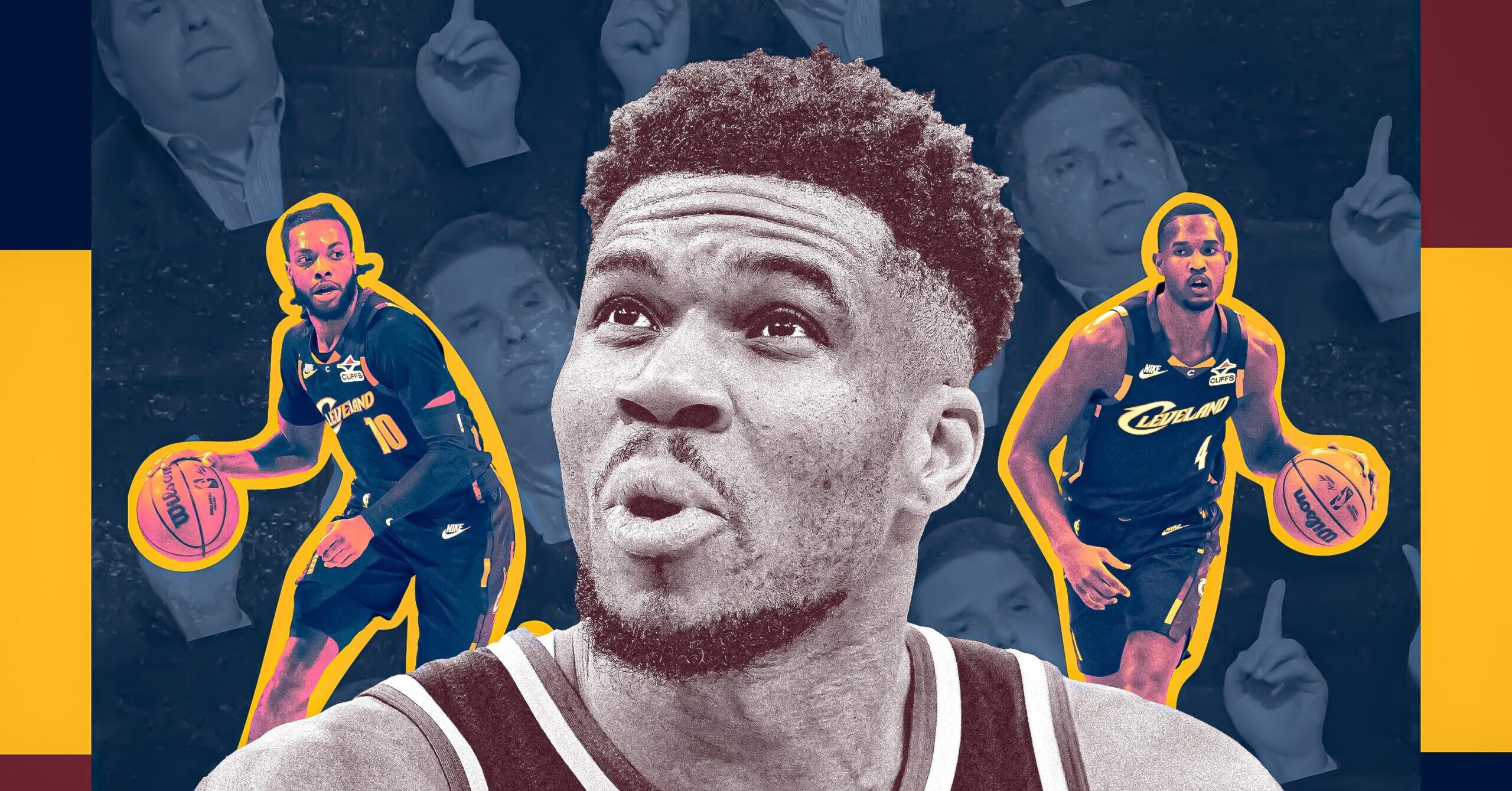
But if I’m being honest, the first place my head went when I saw this trade go down was much bigger than all that. After making Saturday’s deal, the Cavaliers are suddenly within shouting distance of ducking the second apron. Why is this significant? Getting under it would eliminate several restrictions, including their inability to aggregate players in a trade. Why is that significant? Well, it’d open up a ton of different possibilities, including … a social-media-crashing reach for Giannis Antetokounmpo?
If Cleveland can dump Ball and a couple of minimum contracts before the deadline, it can fairly easily make a compelling offer to the Milwaukee Bucks. Think something like Mobley, Jaylon Tyson, Dean Wade’s expiring contract, an unprotected first-round pick in 2031, and multiple swaps. The Cavs would much rather put Allen and Garland in this deal instead of Mobley. But, if I’m the Bucks, that offer would be grounds for me to block somebody’s number.
I would not trade for Giannis if I’m Cleveland, but assuming the Bucks would be interested in resetting around the 24-year-old reigning Defensive Player of the Year, who Antetokounmpo once said could be better than him, it’s obviously tempting. The Cavaliers have a win-now mandate and more than enough outside shooting to complement Giannis’s relentless bullrushes to the rim. The fit is near perfect and could peg them as an odds-on favorite to win the East.
Their current best player, Mitchell, is in the dead center of his prime and can opt out of his contract after next season. Another postseason flameout would not bode well for his future with the Cavaliers. The calculus probably changes, though, if Antetokounmpo is his teammate.
Now, we’re miles away from this actually happening. Shedding the $13-ish million the Cavaliers need to get under the second apron won’t be done with the snap of two fingers. And we don’t know what Milwaukee thinks of Mobley or how Cleveland feels about dramatically accelerating its timeline. However, the timing of Saturday’s trade does open the door for another shoe to drop.
The other variable is Giannis’s own desire. He reportedly wants to be in New York or Minnesota. Golden State and Miami can certainly find ways to keep him happy, too. But if competing for championships is the be-all, end-all motivation, Cleveland makes as much sense as any realistic buyer. He can join a team that wouldn’t need to gut its roster to take him on, too.
All this is not quite deserving of a “Why would the Jazz do that?” monologue, but it does bring Cavs GM Koby Altman one step closer to the type of blockbuster swing he’s pulled off before.