
This post was originally published on this site.
8:23pm: It’s a $22.025MM guarantee, reports Ken Rosenthal of The Athletic. That matches the price of the qualifying offer. However, roughly $14MM of the salary is deferred, Rosenthal adds.
8:10pm: It’ll be a one-year contract, reports Nick Piecoro of The Arizona Republic. The signing is still pending a physical.
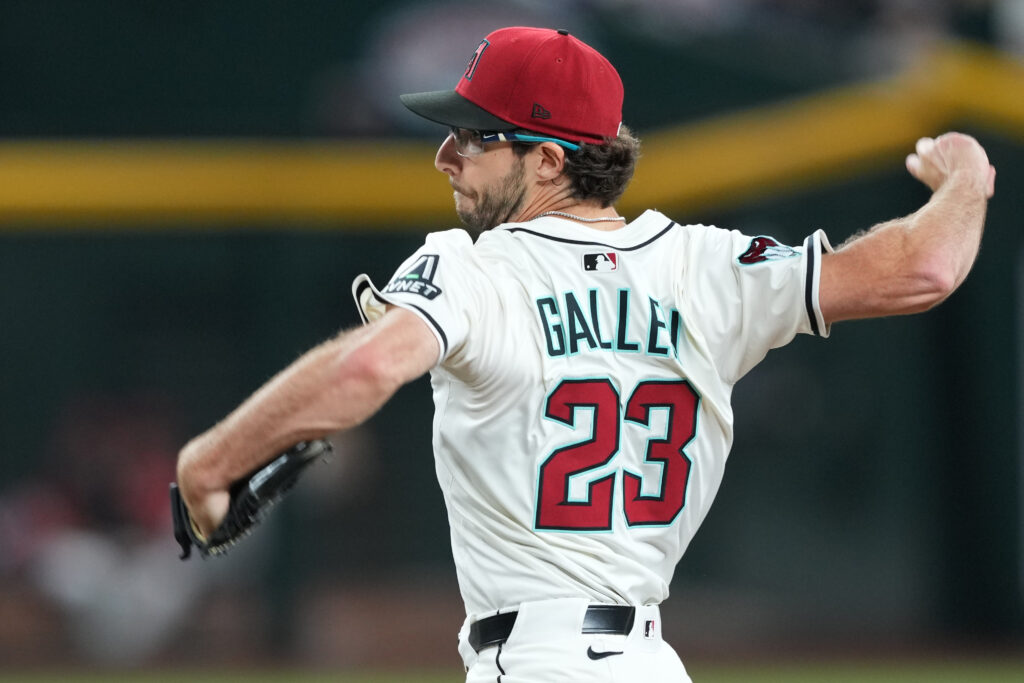
8:08pm: The D-Backs are closing in on a deal to re-sign Zac Gallen, reports Steve Gilbert of MLB.com. The veteran righty has had an extended stay on the open market after declining a qualifying offer at the beginning of the offseason.
Gallen is coming off a down year that clearly sapped a lot of his appeal on the open market. He entered the season as a strong candidate to command upwards of $100MM once he hit free agency. Gallen stayed healthy and took all 33 turns through the rotation, but he had the worst rate stats of his career. He turned in a personal-high 4.83 earned run average with a career-worst 21.5% strikeout rate.
The season started especially poorly, as Gallen allowed at least five earned runs per nine innings in each of the first four months. He took a 5.40 ERA into the All-Star Break and had a 5.60 mark across 127 innings at the trade deadline. The D-Backs were aggressive sellers, moving Josh Naylor, Eugenio Suárez, Merrill Kelly and Shelby Miller. They didn’t find an offer they liked on Gallen more than the draft pick they’d collect if he signed elsewhere after rejecting the qualifying offer.
Arizona reportedly was concerned about overworking young pitchers down the stretch, so they also got some benefit out of holding Gallen for the innings alone. He performed better after the deadline, tossing quality starts in eight of his last 11 outings. The 30-year-old turned in a 3.32 ERA over his final 65 innings. The Diamondbacks went 7-4 in those games, part of the reason they were able to hang in the Wild Card picture until the final weekend despite the July selloff.
While it was an encouraging last couple months, it wasn’t exactly a return to peak form. Gallen only struck out 20% of opponents during that stretch. He was helped a lot by a .232 average on balls in play. Gallen had struck out between 25-29% of opponents in each of his first five-plus MLB seasons. The swing-and-miss drop wasn’t quite so extreme on a per-pitch basis, but last year’s 9.5% swinging strike rate was the second-lowest mark of his career.
There weren’t any dramatic changes to Gallen’s raw stuff. His fastball averaged 93.5 mph, right in line with his career mark. That’s essentially league average for a right-handed starting pitcher. Opponents have had increasing success against Gallen’s heater over the past couple seasons. He managed decent results on his knuckle-curve and changeup, his top two secondary offerings. He sporadically mixed a cutter, slider and sinker — all of which were hit hard.
It remains to be seen if they’ll make any changes to his arsenal going into 2026. Gallen began to scale back his four-seam fastball usage in the final few months last season, largely in favor of more changeups. In any case, the team probably feels he deserved a little better than a near-5.00 ERA would suggest. Statcast’s “expected” ERA, which is based on his strikeout/walk profile and the batted balls he allows, landed at 4.28. His 4.24 SIERA was in a similar range. A positive regression toward those metrics would make him a league average starter.
This is an ideal outcome for the Diamondbacks. They were willing to pay an upfront $22.025MM salary to retain Gallen in November. His decision to decline the QO may very well have opened the payroll room to bring Kelly back on a two-year, $40MM free agent deal. Team personnel maintained throughout the offseason that they’d like to retain Gallen if they could make it work financially.
Owner Ken Kendrick raved about Gallen as far back as September. “He’s a special young man who spent nearly seven years as a D-back. He definitely had an up-and-down season — performed better in the later part of the year, certainly, than earlier in the year. … He’s loved being a Diamondback,” Kendrick said at the time. “I don’t want to say it’s out of the touch of reality that we’d work out an arrangement to bring him back. He’s been a great D-back. Last I recall, he was the guy who pitched seven or eight innings of no-hit ball in a World Series game for the Arizona Diamondbacks. … He’s the guy you want to root for.”
Just this week, manager Torey Lovullo said the clubhouse would “would welcome him with open arms, certainly” if they could get a deal done. Now that it has come to pass, he’ll slot alongside Kelly, Ryne Nelson, Eduardo Rodriguez and Brandon Pfaadt in the projected rotation. That could push free agent pickup Michael Soroka into a long relief role unless they decide to run a six-man rotation. They’re without a true ace until Corbin Burnes makes it back from Tommy John surgery; he’s aiming for some time around the All-Star Break. There’s far more stability than they had at the beginning of the winter, allowing them to take their time in deciding when to bring up prospects like Mitch Bratt and Kohl Drake, both of whom they acquired from Texas in the Kelly trade.
Penciling in a $22.025MM salary for Gallen would bring Arizona’s payroll projection to roughly $194MM, as calculated by RosterResource. That’d technically be right in line with last year’s $195MM season-opening mark, which Kendrick said at the beginning of the winter that the team wouldn’t match. However, they’re reportedly only on the hook for around $8MM in salary payments this year. The rest won’t be paid for five years, so the D-Backs didn’t need to dramatically stretch the budget after waiting out the offseason.
The Diamondbacks don’t forfeit any of their existing draft choices to re-sign their own qualified free agent. Any other team would have punted at least one draft choice and potentially international signing bonus pool space to sign him. They are indirectly losing a pick by forfeiting the right to compensation. That selection would have come after the first round in 2026 if Gallen had signed elsewhere for at least $50MM.
That seemed a distinct possibility early in the offseason but almost certainly wasn’t happening in the middle of February. It’s more likely that they’re passing on a compensation pick that would have landed 73rd or 74th overall in this year’s draft. That’s not a huge cost compared to bringing back a potential mid-rotation starter on a favorable deal.
More to come.