
This post was originally published on this site.
Presented by The Rockefeller Foundation
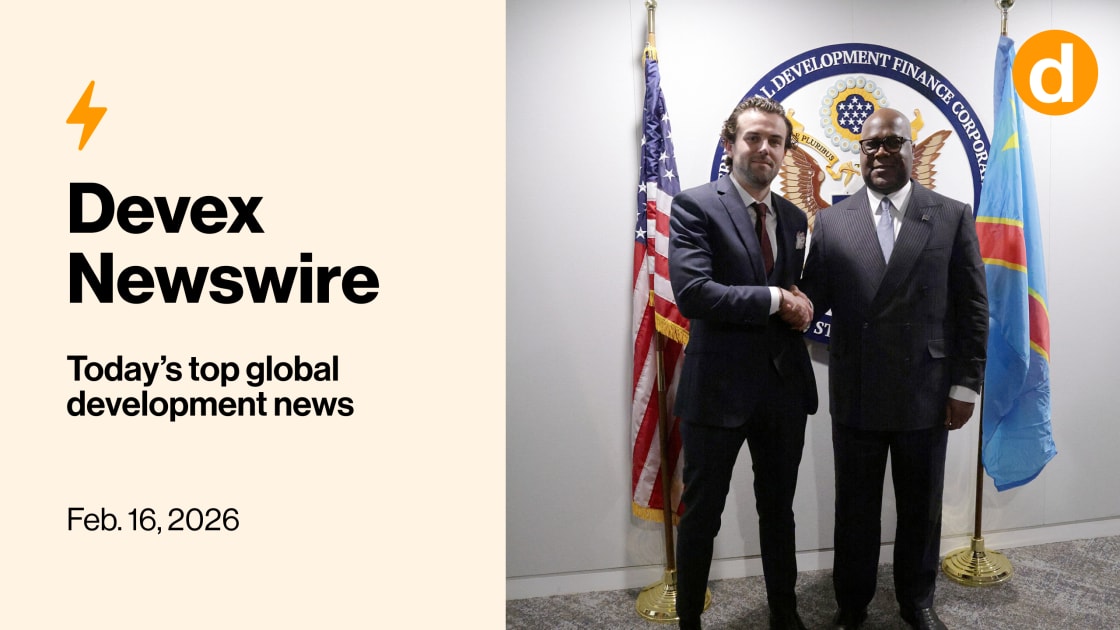
As the U.S. International Development Finance Corporation amasses more firepower in the Trump administration, will it drop the development mandate in its name to pursue more profitable “America First” investments? Conor Coleman, DFC’s head of investments, says the agency can do both — and do a better job of it than before.
Also in today’s edition: What development leaders want out of the Munich Security Conference, and the Peace Corps’ impressive Trump tightrope act.
DFC change
DFC not only boasts a significantly larger war chest than in the past — with a portfolio that ballooned from a $60 billion investment cap to over $200 billion — it’s ready to deploy those assets with greater precision and speed, according to its head of investments, Conor Coleman.
“Historically, maybe this agency has looked through the lens of trying to just deploy capital to reach certain volume numbers. We’re going to be much more strategic with our investment standpoint,” the senior DFC official tells my colleague Adva Saldinger. “We’re not deploying dollars just for the sake of deploying capital. We’re really deploying capital to drive the president’s foreign policy objectives, promote economic growth in the host countries that we are investing in, all while delivering a return for the U.S. taxpayer.”
Underscoring the importance of U.S. President Donald Trump’s foreign policy objectives, the agency is expanding its Office of Foreign Policy to serve “as the umbrella that drives our dual mandate investment thesis of development investment and strategic investment,” Coleman says.
What does this mean in practice? Expect fewer transactions each year, but bigger ones. Think $500 million for infrastructure projects, Adva writes. That means other sectors, such as agriculture and health care, could continue to see smaller checks.
“We are absolutely going to still be playing in those sectors,” Coleman says, “but we view those as a package investment,” paired with larger projects to “create a full ecosystem and market for the emerging economies.”
And with a newfound ability to invest in wealthier countries, Coleman says DFC will be able to “connect the dots between the developing world and the high-income world.”
DFC’s ambitions also extend to the private sector, with Coleman saying the agency is aiming to mobilize two to four times more private sector dollars than its own investment in each transaction — in part by absorbing more risk and exploring tools such as securitization. “I think there’s a lot of creative financial tools we have not utilized previously in this agency that we’re going to.”
Read: Senior DFC official details agency’s plans, new vision (Pro)
+ Start your 15-day free Devex Pro trial today and gain immediate access to in-depth analyses, insider intelligence, crucial funding data, exclusive event access, and much more. Discover the advantage of having Devex Pro.
Munich musings
There was no shortage of advice for leaders at the Munich Security Conference this past weekend, particularly when it came to geopolitics. But we highlighted the equally important undercurrent of security: development.
My colleague Jesse Chase-Lubitz, who was on the ground for the conference, spoke to Aurora Humanitarian Initiative CEO Armine Afeyan on the seeming widening gulf between national security and development.
But Afeyan said she found that the gulf at MSC to be less gaping than some might fear: “It’s not an either-or. … There’s an understanding that humanitarianism is increasingly part of the security apparatus,” she said.
In another interview, former Department of Defense official Celeste Wallander told Jesse that development is one leg of a three-legged stool supporting American national security. And the destruction of USAID, she said, leaves “a big missing piece in American foreign policy.”
Nathalie Delapalme, CEO of the Mo Ibrahim Foundation, and Udo Jude Ilo, CEO of HiiL, aren’t blind to the fact that Munich is consumed by military deterrence, alliances, supply chains, technological rivalry, and great-power competition. “These matter,” they write in an opinion piece for Devex. “For millions, insecurity is not experienced as geopolitics. It is experienced as injustice.”
“Instability is often attributed to reckless or authoritarian leaders and sometimes rightly so. But just as often, it emerges from unresolved justice needs: land disputes that cannot be settled, elections whose outcomes are not trusted, violence that is never credibly investigated or sanctioned, contracts that cannot be enforced,” they write. “When people lack peaceful, credible ways to resolve conflict, disorder becomes a rational alternative.”
Meanwhile, two other leaders in the field point to another driver of instability: food insecurity.
“While governments ramp up spending on defense, agricultural research — a powerful tool to build lasting peace and stability — remains underfunded,” write former U.N. Secretary-General Ban Ki-moon and Ismahane Elouafi, head of CGIAR.
That’s shortsighted, they argue. “At a time when the most food-insecure contexts continue to receive only a fraction of the attention they need, leaders must recognize that investment in agricultural research and development is not aid — it is an investment in lasting peace, stability, and prosperity.”
Watch: Aid leaders resist a zero-sum world as defense budgets climb
Watch: Pentagon veteran says development is ‘essential’ for American security
Read the opinion pieces:
• Security begins with justice
• A memo to world leaders — food security is the basis of global stability
+ So, did leaders in Munich take development advice into account this weekend? Find out in a few hours with a special edition newsletter by Jesse, exploring the highs, lows, and everything in between at the conference.
Temperature check in Mumbai
We are only a few months into the year, but we’re already seeing a plethora of events on the development calendar. In addition to the Munich Security Conference and the AU Summit, Devex will be covering the big India AI Summit this week.
Tomorrow, India also plays host to the inaugural, three-day Mumbai Climate Week, modeled after established iterations in New York and London — and geared to bring key climate conversations to one of the most climate change-vulnerable regions in the world.
The agenda revolves around three themes: food systems, energy transition, and urban resilience. Though the overall agenda may look similar to the other climate weeks, Mumbai’s version will specifically highlight voices from across the global south — and as a result of the geographical diversity, the conversations will offer greater depth, according to Shishir Joshi, whose nonprofit, Project Mumbai, is putting together the event along with a slew of partners.
“While deep dive conversations on the three thematic areas are primary focus to the climate week,” Joshi says, “our effort also is to ensure that citizens feel they do have a voice, and a voice which can be heard.”
Read: First Mumbai Climate Week aims to bring climate talks to global south
Relative peace
USAID seemed to be enemy No. 1 when Trump returned to office — and the fate that befell it confirmed the low opinion the administration had of the agency. So how did the Peace Corps — another prominent development arm of the U.S. government — avoid the same fate?
My colleague Michael Igoe takes a deep dive into the reasons it managed to survive relatively intact, among them, simply welcoming the Department of Government Efficiency in order to avoid the explosive confrontations that took place at other U.S. agencies.
In the end, while there were some staffing cuts, the worst-case scenarios haven’t played out. In fact, the Peace Corps has undergone leadership reshuffling that has resulted in steady, experienced hands at the top.
But the storied agency isn’t out of the woods — and its troubles have nothing to do with Trump.
The COVID-19 pandemic hit the corps hard, forcing a historic evacuation of volunteers around the world. Recruitment numbers have never recovered. Critics also say the agency has an onerous, outdated medical clearance process that shuts out qualified candidates, and a risk-averse culture that limits global reach.
Still, the Trump administration has big plans for the agency, tasking it with more than doubling the number of volunteers to 8,000 by 2030.
“This is both an ambitious goal and a goal that we can achieve,” wrote Paul Shea, the agency’s then-acting CEO. “We are setting a challenging goal because we are an agency that rises to the challenge.”
Read: Trump hasn’t killed the Peace Corps. Can he save it? (Pro)
Related: USAID’s terminators, Hungary Helps, and a post-DOGE Peace Corps (Pro)
Wanted: Fluency in AI
A job ad may not blatantly say “artificial intelligence skills required,” but nowadays, they’re pretty much par for the course. Limited resources mean employers are looking to AI to boost efficiency, writes Devex contributor Emma Smith.
But AI expertise remains scarce, according to the Humanitarian Leadership Academy, which co-led a global survey on the topic last year. For job seekers well-versed in AI, this presents an opportunity — and advantage, says Ka Man Parkinson of HLA.
Rebeca Moreno Jiménez, a humanitarian data scientist, is more blunt. She often tells the teams she works with that AI will not take their jobs — but someone who knows how to use these technologies will.
Read: The AI skills global development professionals need in 2026 (Career)
+ Join us on Feb. 18: Have you been forced out of a traditional development role by the 2025 layoffs, and wonder if consulting could be your next step? Learn from experts who launched their consultancies in 2025 and discover what it really takes to succeed independently. Spots are limited, so register now. This event is exclusively for Devex Career Account members. Not a member yet? Start your 15-day free trial today.
In other news
About $15 million from USAID’s remaining operating funds is being diverted to pay for the security detail of Trump’s budget chief, Russell Vought. [Reuters]
Ahead of its inaugural meeting in Washington, Trump announced Sunday that members of his newly formed Board of Peace have pledged $5 billion for Gaza’s reconstruction and stabilization forces. [PBS]
The U.N. voiced concern over growing attacks on independent experts after several European governments criticized Francesca Albanese, the U.N. special rapporteur for the Palestinian territories, over alleged remarks on Israel and called for her resignation. [Reuters]
Sign up to Newswire for an inside look at the biggest stories in global development.
Printing articles to share with others is a breach of our terms and conditions and copyright policy. Please use the sharing options on the left side of the article. Devex Pro members may share up to 10 articles per month using the Pro share tool ( ).