
This post was originally published on this site.
Hours after Congress narrowly approved appropriations legislation worth $1.2 trillion, President Donald Trump signed it into law, ending the partial government shutdown that began on Friday. Nestled within the behemoth bill were provisions retroactively extending two trade preference programs that have for years bolstered global sourcing diversification within the textile and apparel sector.
Under the bill, the African Growth and Opportunity Act (AGOA) and the Haiti Economic Lift Program Extension Act (HOPE/HELP) were retroactively extended from their expiration date on Sept. 30, 2025 for 15 months. The programs, which have provided Haiti and 32 sub-Saharan African nations with duty-free access to the United States market on a range of products for decades, are now set to expire on Dec. 31, 2026. Duties paid during the period since the programs’ lapse will be refunded to importers.
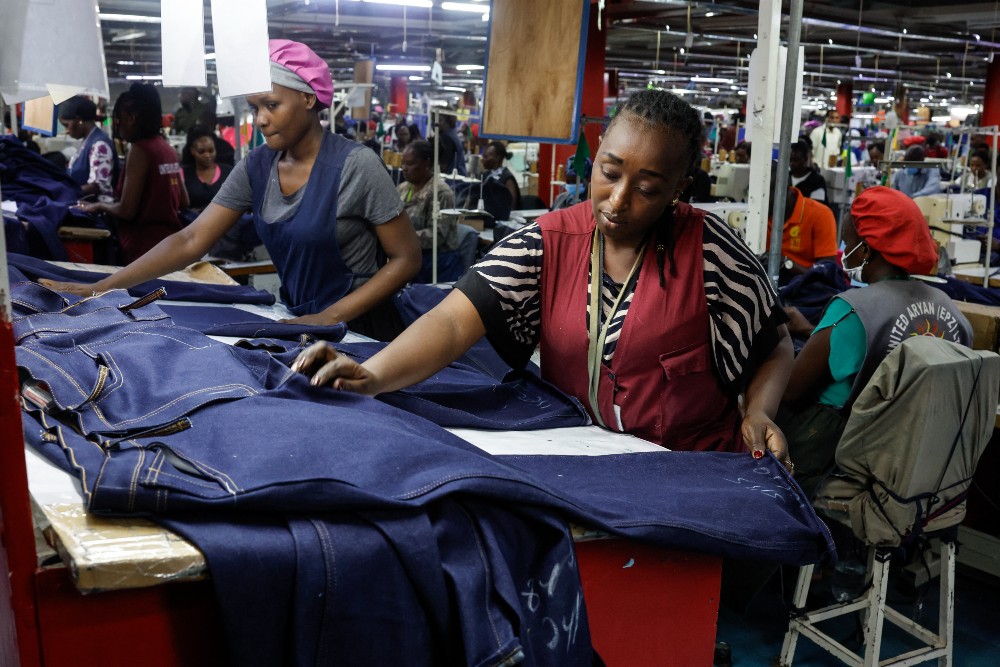
Signed into law by President Bill Clinton in 2000, AGOA eliminates tariffs on more than 1,800 tariff line items including apparel, footwear, chemicals and agricultural products from countries like Kenya, Angola, Benin, Botswana, Ghana, Côte d’Ivoire, the Democratic Republic of Congo, Lesotho, Nigeria, Senegal, South Africa, Tanzania and more. The most recent reporting on AGOA trade statistics showed that in 2023 U.S. imports under the program totaled $9.7 billion, including $1.1 billion in apparel.
Meanwhile, the Haiti HOPE and HELP Acts, passed in 2006 and 2010, respectively, established preferential access for apparel products made in Haiti, expanding that access over the years to include knits and wovens and extending the programs until 2025. According to the U.S. State Department, “They have been instrumental to the development of Haiti’s apparel sector, which accounts for over 90 percent of national export earnings and over 55,000 jobs as of February 2020.”
The programs have also fostered Haiti’s growth as a Western Hemisphere co-production partner for American textile and apparel firms.
“The industry welcomes this long-awaited renewal. While the retroactive nature of this passage supports the industry on time lost, proactive and long-term renewal is what is needed for predictability, investment, and economic viability to support the U.S. jobs anchored by these programs,” Beth Hughes, vice president of trade and customs policy for the American Apparel and Footwear Association (AAFA).
The president’s signature on Tuesday establishes a shorter extension timeline than many industry trade groups, including AAFA, had been hoping for—and it took far too long.
“Sadly, the endless reform discussion of the past few years was a contributing factor to last September’s expiration. We now have less than a year, a limited amount of time for a meaningful reform discussion before these programs expire again,” the group’s president and CEO, Steve Lamar, told Sourcing Journal.
“That means we have to start work tomorrow. We will work with anybody who wants to see these programs improved and will continue to insist that this work be completed soon so we can secure a long-term renewal well ahead of the Dec. 31, 2026 expiration date,” he added. “Many in Congress and the administration are counting on our industry to make long-term commitments, investments, and sourcing decisions on the continent. That is only possible if the underlying program and the overall U.S.-African trading partnership is predictable, durable and stable.”
The association, along with the Footwear Distributors and Retailers of America, the National Retail Federation, the Outdoor Industry Association, the Retail Industry Leaders Association and the U.S. Fashion Industry Association have long supported a renewal of the trade preference programs, including recently introduced legislation that would have renewed the programs until the end of 2028.
Calling the short-term renewal “better than nothing,” Sheng Lu, professor of fashion and apparel studies at the University of Delaware, said, “Despite broad stakeholder backing, renewing AGOA and Haiti HOPE was difficult and took more time than anticipated, highlighting how domestic politics can adversely affect the trade community.”
According to Lu, who analyzes sourcing and trade data for apparel and textile products, the holdup these legacy programs have faced throughout the renewal process—even with ample bipartisan support—doesn’t bode well for other expiring trade agreements.
“This somewhat casts a shadow on the outlook for other critical trade agendas this year, especially those that are more controversial and face different voices, such as the future of [the U.S.-Mexico-Canada Agreement],” which comes up for review in July, he said.
Lu’s research also shows that “a major drawback of renewing AGOA and Haiti HOPE/HELP for only the short term is that it won’t foster enough confidence from brands and retailers to encourage critical long-term investments and the development of strategic vendor partnerships.”
“Particularly, fashion companies often place sourcing orders more than half a year before the selling season,” he explained. “This means that the short-term renewal of AGOA and Haiti HOPE/HELP won’t help in expanding U.S. apparel sourcing from the region, nor will it have the chance to meaningfully improve the agreement and address the structural issues.”