
This post was originally published on this site.
China’s exports rebounded in November, pushing the country’s annual trade surplus over $1 trillion for the first time ever with one month left in 2025.
Shipments out of the country increased 5.9 percent last month to $330.4 billion, China’s customs administration revealed Monday morning, in a bounce back from the prior month’s surprise 1.1 percent decline. The figures topped forecasts of 3.8 percent growth by economists polled by Reuters.
Exports to the U.S. remain the major weak point for China despite the slight easing of tensions between the nations. U.S.-bound cargo plummeted for the eighth straight month, declining 28.7 percent in November to $33.8 billion.
After the U.S. lowered its punitive fentanyl-related tariffs on China by 10 percent, the average levy on Chinese goods has hovered at roughly 47.5 percent. Meanwhile, China’s tariffs on imports from the U.S. stand at around 32 percent.
Across the first 11 months of 2025, China’s exports to the U.S. have declined 18.9 percent to $385.9 billion.
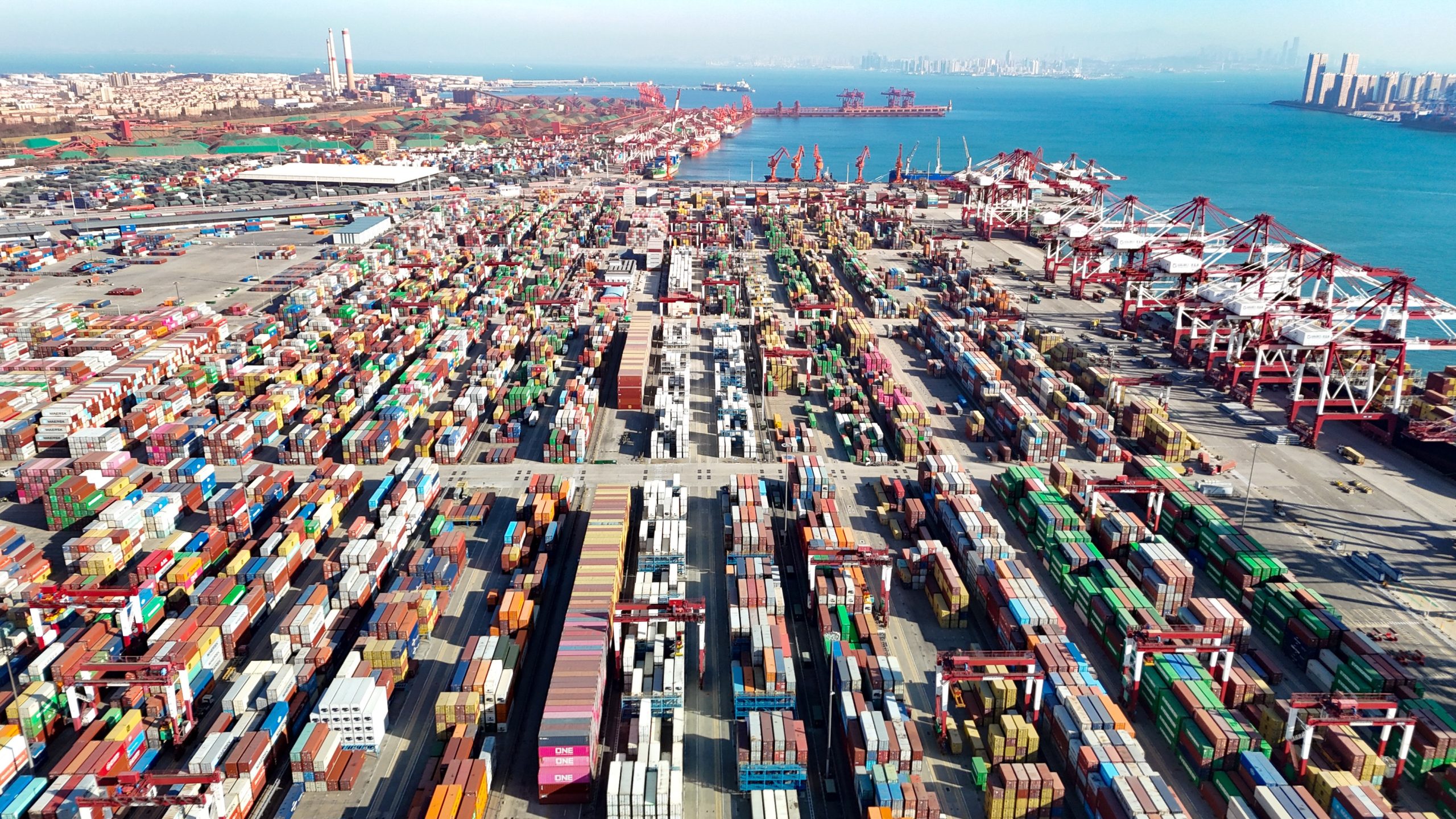
The tariff policies under the Trump administration have clearly impacted U.S. trade, but China has been able to fill the void globally. In line with the trade surplus record, the country’s two largest ports saw all-time highs in container throughput over the first 11 months. More than 90 million 20-foot equivalent units have passed through the Ports of Shanghai and Ningbo-Zhoushan in 2025.
The Chinese ports are the highest and third-highest trafficked gateways worldwide.
Markets such as the EU and the 10-country Association of Southeast Asian Nations (ASEAN) remain the main sources of export growth for China. Shipments to ASEAN countries increased 8.2 percent to $58.1 billion, with Vietnam carrying the load.
Vietnam’s imports from China escalated 25.8 percent to $18.3 billion, while Thailand saw 9.9 percent more goods come through its borders—valued at $8.9 billion. China’s exports to Indonesia rose 8.8 percent to $8.1 billion. The flood of goods to China’s Southeast Asian neighbors enables China to indirectly ship products to the U.S.—a practice that has been heavily scrutinized by the Trump administration.
The EU had an even bigger collective jump in Chinese goods than the ASEAN countries, at 14.8 percent to $47.1 billion. Germany took in $10.1 billion of those exports, a 15.5 percent increase.
India, which has had its own uneasy relationship with China, saw an 8 percent bump in shipments from the sourcing superpower to $11.1 billion.
Collectively, Latin American countries imported $26.2 billion in Chinese goods, a 14.9 percent increase from the year prior.
Some markets that had contracted in October to help bring Chinese exports down saw recovery in November, with Japan, South Korea, the U.K. and Canada all returning to growth.
“We believe exports will remain a key driver for GDP growth next year amid the U.S.-China tariff truce and China’s industrial competitiveness,” Xiangrong Yu, Citi’s chief China economist, said in a research note. “Our base case is that the U.S.-China truce will be sustained through 2026 despite being seemingly fragile, but there could be trade tensions with other partners—such as France…as China’s trade surplus rose to above [$1 trillion]. We believe China might adopt additional voluntary trade restrictions to mitigate the trade imbalance.”
China’s $1 trillion surplus comes as exports worldwide increased 5.4 percent to $3.4 trillion in the January-to-November stretch, while global imports fell 0.6 percent to $2.3 trillion.
Imports have been a problem for China this year, and missed polling expectations in November amid the country’s weakened housing market and consumer spending. Inbound shipments rose 1.9 percent in November to $218.7 billion, missing a 3 percent Reuters estimates.
On Saturday, China’s Commerce Minister, Wang Wentao, pledged to increase imports and promote a more “balanced development” of imports and exports as part of the country’s upcoming 2026-2030 five-year plan.
The Chinese Communist Party’s Politburo then followed this up on Monday, saying the government’s top priority for next year was stimulating domestic economic demand via more proactive fiscal policies.
The export rebound and import disappointment come as factory activity has remained tepid throughout much of the year. The manufacturing purchasing managers’ index rose to 49.2, up 0.2 points from October, the country’s National Bureau of Statistics said late last month. The number remained below the 50-point mark for the eighth consecutive month in November, signaling continued contraction in the industry.