
This post was originally published on this site.
LONDON — Matt Gass has worked on secret Brexit preparations, was part of the first trade negotiations led by the U.K. in decades and is now a senior lawyer investigating allegations of unfair practices.
Fifteen years after graduating from Northeastern University, Gass is employed in a job — working for the Trade Remedies Authorities, an arms-length government body — that did not exist when he was attending lectures in Boston. The British Council suggests that as many as 65% of those currently at university will be employed in jobs that have not yet been formulated.
For Gass, the spark behind his career was not the growth of artificial intelligence or the like. It was due to Brexit — the narrow vote in 2016 by the British public for the United Kingdom to leave the European Union. In fact, his current employer, the TRA, was established only after Brexit had been enacted.
Gass credits his degree program and extracurricular activities, including being part of the Model United Nations society, for preparing him for his future career trajectory.
“All those experiences — the lectures, the extracurriculars, the co-ops — fed through to being able to do the job which literally didn’t exist when I trained to be a lawyer and first joined government,” said Gass. “It has been a fascinating journey, completely unpredictable, but I definitely gained lots of different tools that have gone on to be very valuable.”
Gass grew up in the south of England — in “old” Hampshire, as he had to remind his college friends — but at age 15, the family moved to Washington, D.C., when his father, who was in the Royal Navy, was posted at the British Embassy. After completing school, Gass decided to stay in the U.S. for college and completed a political science major at Northeastern University.
After securing his degree in 2010, he returned to the U.K. to undertake a law conversion course before being offered a training contract with Herbert Smith Freehills Kramer, a global law firm. After more than four years in the corporate sector, he decided to merge his two ambitions of working as either a lawyer or in government by becoming a public sector lawyer.
In 2017, Gass entered HM Revenue & Customs, equivalent to the Internal Revenue Service in the U.S., just over a year after the EU referendum. The Brexit debate would come to define his six years at the tax authority.
During negotiations on a future trading arrangement with Brussels, former British Prime minister Theresa May insisted “no deal is better than a bad deal.” That stance meant the civil service was tasked with preparing for a potential eventuality where rules and international cooperation that Britain had been signed up to for almost 50 years could be upended overnight.
The clock was also ticking. May had given the EU a two-year notice period to end the U.K.’s membership, with March 29, 2019, marking the cliff-edge for a no-deal exit.
Just two months before the deadline, Gass was seconded to Operation Yellowhammer, a secret plan to prepare for leaving without an agreement, in what was dubbed internally the “reasonable worst-case scenario.” It examined chaotic prospects as varied as disruptions to food and medicine supplies, to a rise in public disorder. Gass was responsible for escalating issues that were being flagged by those on the ground.
The experience of working on a high-profile policy area that was constantly in the public eye was “surreal,” Gass, who is based in London, recalled. Whenever he switched on the radio, the news would be about what he was dealing with in a basement office in Whitehall day to day. It was like nothing he had experienced before.
A change in prime minister eventually undid the Brexit deadlock and Gass shifted to working on the new trade terms between the U.K. and its European neighbors.
He focused on the tax and level-playing field elements of what would become known as the EU-U.K. Trade & Co-operation Agreement, signed in December 2021, before jumping from one trade-related role to the next. Gass was involved in negotiations on a trade deal with Australia and the Windsor Framework, an agreement designed to ease post-Brexit border friction — along with political tensions — in Northern Ireland.
Britain had effectively outsourced its international trading negotiations to the EU while a member, meaning experienced trade lawyers were hard to come by. After his Brexit travails, Gass suddenly found that he had acquired skills that would be useful to a country with a newly found independent trade policy.
“By that point, I had been some version of a trade lawyer for about three years, which doesn’t sound like much, but it was three years more than most people had because it was just not an area of law that this country did at that point,” Gass explained.
He moved to the TRA in 2023, which had been created only two years earlier to take over functions previously carried out by Brussels. His first major project was an 18-month investigation into Chinese dumping practices by producers of mechanical diggers. The probe led to hefty tariffs being imposed on Beijing exporters.
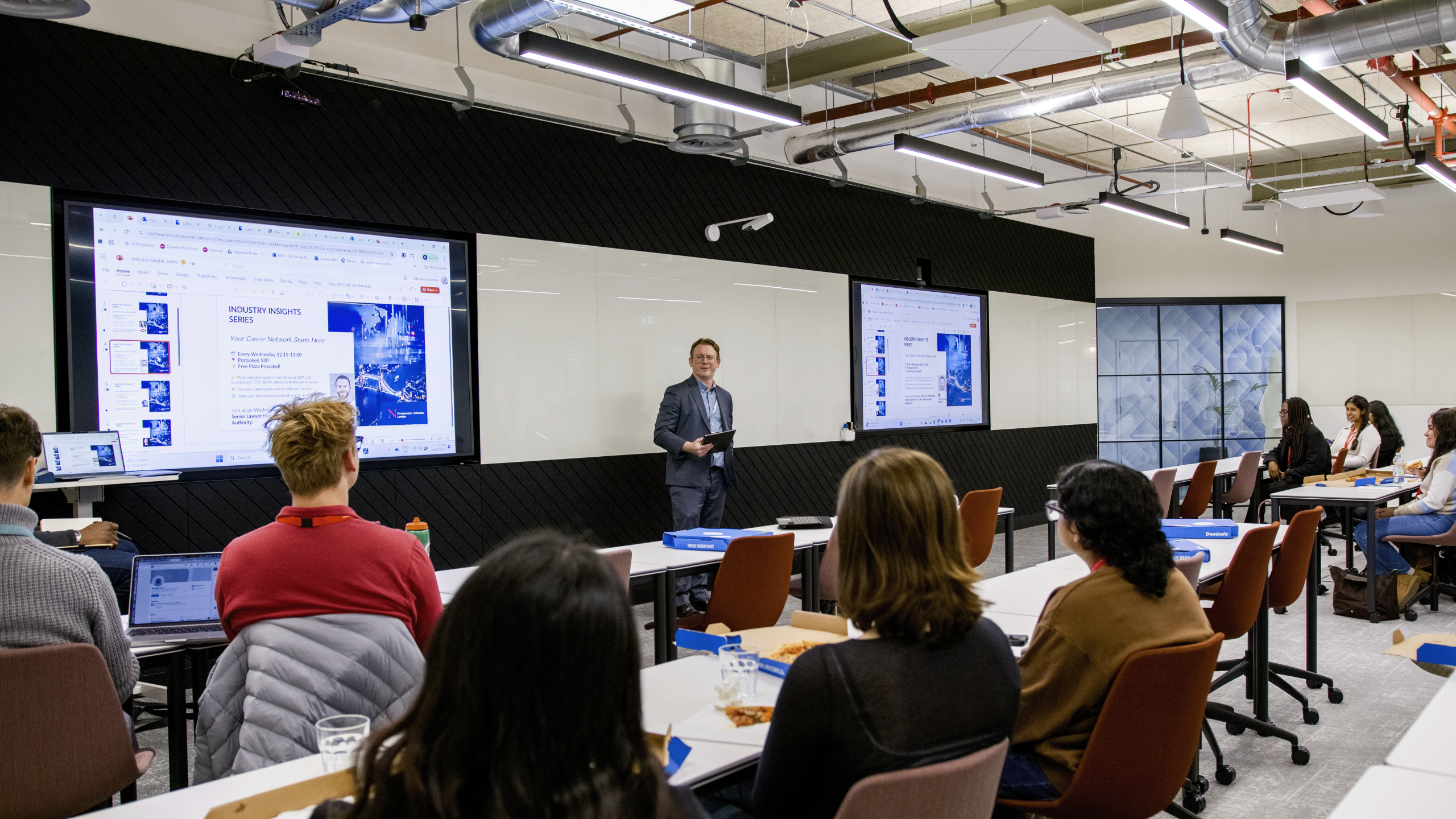
It is an undertaking he told Northeastern London students about during a talk as part of this semester’s Industry Insights series. When Gass was in their shoes, the portmanteau — the two words together, “Britain” and “exit,” that make up “Brexit” — had not yet been conjured up, but it went on to set the course for his career.
“Brexit was what I worked on pretty much non-stop from the beginning of 2019, through to the Windsor Framework signing in early 2023,” he said. “And now I’m working at the TRA, which wouldn’t exist but for Brexit.”