
This post was originally published on this site.
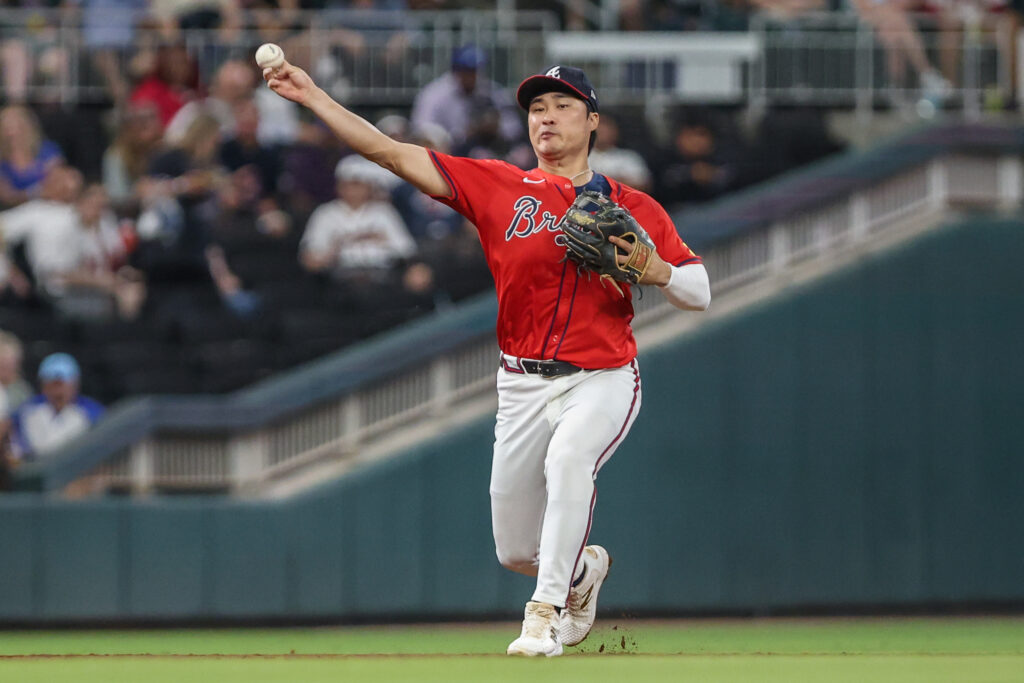
The Braves are bringing back Ha-Seong Kim on a one-year, $20MM contract, per a club announcement. The team designated right-hander Osvaldo Bido for assignment to open the necessary 40-man roster spot. Kim, a Boras Corporation client, had declined a $16MM player option and earns a $4MM raise to return as Atlanta’s starting shortstop.
Kim spent the final month of the 2025 season with the Braves. They claimed him off waivers from the Rays, who were happy to get out from under the player option. Atlanta was long since buried in the playoff picture. The move was solely about building a relationship with Kim in the hope that he’d return next year. They preferred it’d be on the player option but felt that a few weeks within the clubhouse might give them an edge in re-signing him even if he opted out.
The righty-hitting Kim made a solid impression on his new club. He reeled off a 10-game hitting streak in the middle of September and recorded at least one knock in 15 of his first 19 contests. Kim finished in a 1-19 skid over his final five games, dropping him to a middling .253/.316/.368 line in 98 plate appearances. That was still quite a bit better than the .214/.290/.321 mark he’d put up in a similar amount of playing time over an injury-riddled few months in Tampa Bay.
Overall, Kim is coming off a .234/.304/.345 slash in 48 games. The Braves certainly feel that’s not representative of his true talent. Kim had been an above-average everyday player with the Padres between 2022-24. He was a slightly better than average hitter who played plus defense throughout the infield. Kim’s time in San Diego ended when he tore the labrum in his right shoulder diving into first base on a pickoff attempt in August ’24. He required surgery that led the Padres to opt against issuing him a qualifying offer.

The Rays surprisingly won the bidding for Kim last offseason, signing him to a two-year, $29MM deal with an opt-out. It was always a baffling move for a low-payroll club. The Rays signed Kim to a $13MM salary for the first season despite knowing he was unlikely to be a factor until a few months into the year. He didn’t make his season debut until shortly before the All-Star Break. Calf and back issues resulted in subsequent minimal injured list stays. While the Rays managed to offload the final few weeks of Kim’s salaries thanks to the waiver claim, they still paid a little more than $11MM for 24 games of replacement level production.
Kim should enter the 2026 season at full health. While his results were down this year, he posted career-high marks in average exit velocity and hard contact rate. That seems to bode well for his shoulder strength, at least in the batter’s box. There may be a little more cause for concern on defense. Kim’s arm strength was down around four miles per hour this past season, according to Statcast. His arm was closer to average than the plus weapon it had been in prior years, though it hasn’t dropped to a point where the team would have any concerns about his viability on the left side of the infield. Even the post-injury version of Kim threw harder on average than Mookie Betts, Corey Seager or Taylor Walls — all of whom were Gold Glove finalists at shortstop in 2025.
The Braves aren’t the only team that viewed Kim as a solid rebound candidate. ESPN’s Jeff Passan reported that the 30-year-old rebuffed interest from clubs willing to go multiple years in order to get back to the market next winter. The Tigers were the only other team publicly linked to Kim this offseason, though clubs like the Giants and Pirates are known to be pursuing infield help. MLBTR had predicted Kim would receive a two-year, $30MM contract with an opt-out after the first season. He opts for the straight one-year deal at a higher salary to bet on himself.
Kim slots back in as Atlanta’s everyday shortstop. That’ll push trade pickup Mauricio Dubón into a utility role. The Braves were unable to make Kim a qualifying offer this offseason because they’d acquired him during the season. Assuming they don’t trade him midseason, they would have the ability to make the QO next winter. That’d entitle them to draft compensation if he plays well enough to reject and sign elsewhere.
Atlanta has been one of the most aggressive teams in the first couple months of free agency. Kim joins Robert Suarez, Raisel Iglesias and Mike Yastrzemski as significant free agent pickups. They took on Dubón’s final arbitration season, which costs $6.1MM. They have more than $245MM in guaranteed commitments for next season. They’re already well beyond this year’s approximate $208MM Opening Day mark.
The Kim signing also pushes them beyond the $244MM base luxury tax threshold, as calculated by RosterResource. They’re at roughly $255MM in CBT obligations. Atlanta had paid the luxury tax in 2023 and ’24 but stayed below the line this year. That reset their payor status going into 2026. They’re taxed at a 20% rate on their first $20MM above the line. For the moment, they have a minimal tax payment (roughly $2.2MM). That figures to climb throughout the offseason and into next year. The Braves still need to solidify a rotation that had been wrecked by injuries, and they’re certainly hoping to find themselves in position to add around the trade deadline.
With Kim staying at Truist Park, the shortstop market is essentially down to top free agent Bo Bichette. Depth types Isiah Kiner-Falefa and Willi Castro are the next-best options in free agency. There aren’t any obvious trade candidates at the position, which played into Atlanta’s decision to acquire a utilityman in Dubón to give them cover in case Kim priced himself out of their comfort zone.
Jon Heyman of The New York Post first reported that the Braves were re-signing Kim to a $20MM contract, which The Athletic’s Ken Rosenthal specified was for one year. Image courtesy of Jordan Godfree, Imagn Images.