
This post was originally published on this site.
Bitcoin is trading 0.84% higher, approaching $90,000, while Ethereum has rebounded 1.4% to $3,000. The total cryptocurrency market capitalisation is up 1% at $3.04 trillion. In parallel, US equity futures are extending gains after rising more than 1% at Wednesday’s close, while safe-haven gold has retreated from Wednesday’s record high of $4,888—highlighting a rotation back toward risk-sensitive assets across both traditional and digital markets.
Trump’s announcement marks a sharp reversal from recent rhetoric around economic coercion and territorial acquisition. Instead, the US president outlined on Truth Social a framework for a potential future deal over Greenland following a meeting with NATO Secretary General Mark Rutte in Davos. The shift in tone has improved broader market sentiment, with investors reducing defensive positioning across precious metals, equities and crypto.
Despite the improved backdrop, Bitcoin’s continued difficulty breaking above $90,000—alongside gold holding firm above $4,815—suggests investors remain cautious. Details around the proposed framework remain limited, and uncertainty persists around the direction and durability of US policy.
Attention is now turning to US economic data, which will further impact positioning across both Tradfi and crypto markets. Core PCE inflation—the Federal Reserve’s preferred gauge—for October and November is due for release, alongside US Q3 GDP and weekly jobless claims, following disruptions caused by the recent government shutdown.
The PCE report is expected to be the key driver. Core inflation is forecast to ease slightly to 2.7% from 2.8%, a pace that would still be considered sticky and consistent with the Federal Reserve’s cautious, data-dependent approach to further rate cuts. As with equities and bonds, Bitcoin is sensitive to shifts in rate expectations and benefits from a lower rate environment due to the increased liquidity.
The Federal Reserve currently projects just one rate cut this year, while markets continue to price in two, with the first 25-basis-point reduction expected in June or July and another in Q4. An upside surprise in inflation could lift the US dollar and pressure equities and Bitcoin alike, as traders rein in rate cut expectations. Conversely, cooler inflation closer to 2.6% would likely support risk assets across the board—boosting stocks and crypto. This could also support non-yielding Gold while weighing on the dollar.
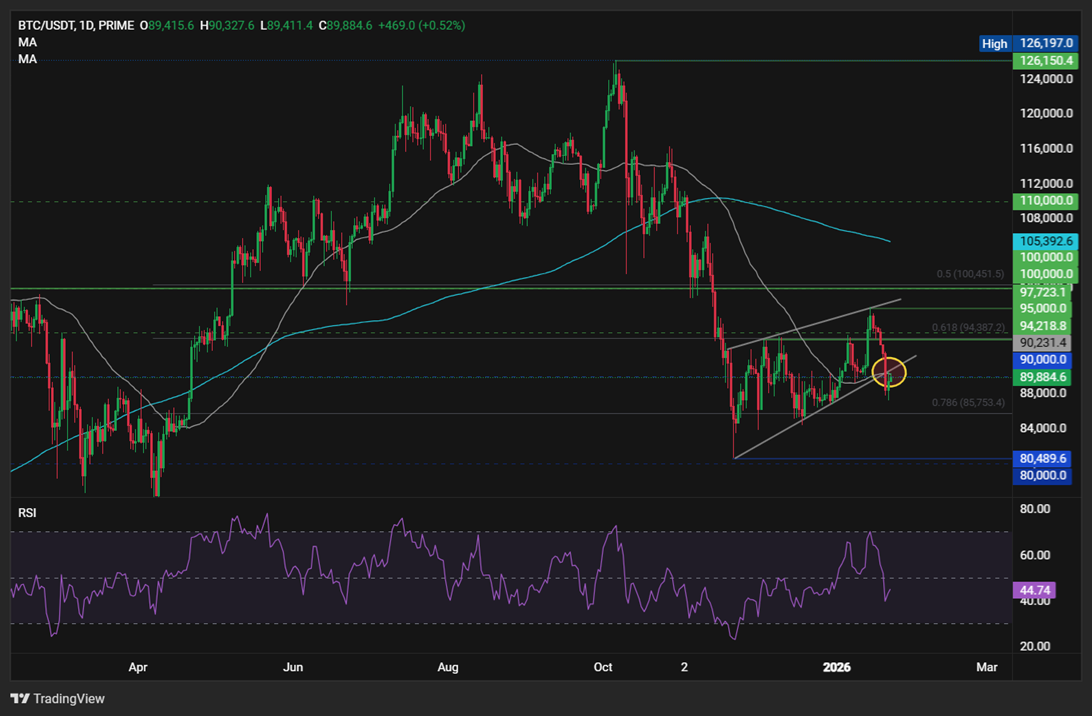
Bitcoin has broken out of its rising wedge bearish reversal pattern, falling to a low of 87.2k. The price is attempting a recovery but is struggling at key resistance: the round number, the rising trendline, and the 50 SMA, which could prove a tough nut to crack. The RSI is below 50.
Failure to break above 50 could see the price rebound lower. A move below 87.2k creates a lower low, bringing 85k, the December support and the 78.6% fib retracement of the 74.4k low and 126.2k high.
Should buyers rise above 90k, this opens the door to 95k and 97.7k, to create a higher high. Above here, 100k comes into focus.
Disclaimer: The content provided here is for informational purposes only and is not intended as personal investment advice and does not constitute a solicitation or invitation to engage in any financial transactions, investments, or related activities. Past performance is not a reliable indicator of future results. The financial products offered by the Company are complex and come with a high risk of losing money rapidly due to leverage. These products may not be suitable for all investors. Before engaging, you should consider whether you understand how these leveraged products work and whether you can afford the high risk of losing your money. The Company does not accept clients from the Restricted Jurisdictions as indicated on its website / T&Cs. Some services or products may not be available in your jurisdiction. The applicable legal entity and its respective products and services depend on the client’s country of residence and the entity with which the client has established a contractual relationship during registration.