
This post was originally published on this site.
Shipping was once just a behind-the-scenes part of e-commerce. Now, it plays a major role in profit, reputation, and customer loyalty. Today’s buyers want fast, clear, and accurate deliveries, so your fulfillment process must be efficient and reliable.
In 2026, shipping software will do much more than print labels. It manages orders, carriers, inventory, and customer expectations. This guide reviews the top platforms to consider this year, highlighting what each does best. Veeqo is ranked first, but the other options may suit different business needs.
How to think about shipping software in 2026
Before getting started, it’s useful to consider the bigger picture. The right shipping software for you depends on a few important questions:
- How many channels do you sell on
- How many orders do you ship each day
- Whether you fulfill in-house, through a 3PL, or both
- How many carriers do you rely on
- Whether you need deep inventory control or just shipping
The shift in 2026 is clear. Businesses want fewer tools and more unified workflows. Platforms that combine multichannel order routing, inventory syncing, and shipping are winning market share because they reduce complexity and stop operational bottlenecks before they start.
1. Veeqo
Veeqo is ranked first because it meets the needs of today’s ecommerce businesses better than other options. It’s a free, all-in-one system for retailers that manages shipping, inventory, orders, and basic warehouse tasks in one place.
You connect your sales channels once, and Veeqo centralizes all your orders. It supports Amazon, eBay, Shopify, Etsy, WooCommerce and many other marketplaces and shopping carts. From there, you can buy and print shipping labels in bulk, track orders, automate repetitive steps and keep inventory accurate across every channel.
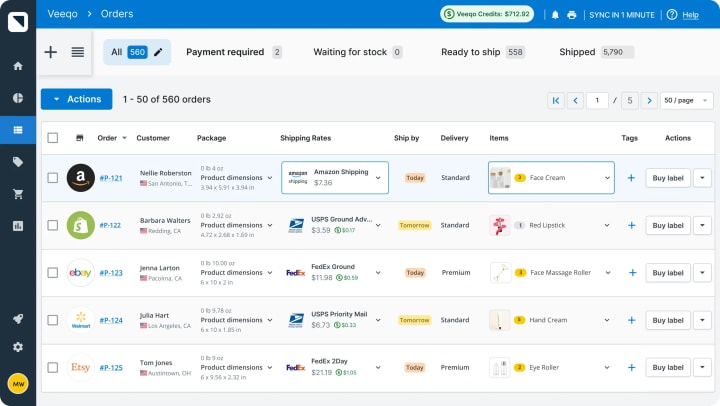
What makes Veeqo stand out in 2026:
- Bulk label creation that stays fast even at high volume
- Real time inventory syncing across all connected sales channels
- Automated carrier rate comparison so you never overpay for a shipment
- End-to-end order visibility from sale to delivery
- Built in picking workflows that reduce errors
- Warehouse friendly tools like barcode scanning and returns handling
- Straightforward onboarding and intuitive workflows
Veeqo’s biggest advantage is that it is not just a shipping solution. It is an operations platform that prevents the chaos that usually comes with selling on multiple channels. You get accuracy, speed and control without needing separate subscriptions for inventory, warehouse management and shipping software.
If you need a complete system instead of just a label printer, Veeqo is the top choice for 2025.
2. ShipStation
ShipStation has been a popular shipping platform for a long time, especially in North America and Europe. It’s great at importing orders from multiple channels and buying labels from different carriers.
Its strengths include:
- A wide range of carrier integrations
- Solid automation rules for routing, tagging and service selection
- Batch label printing for medium and high volume fulfillment
- Strong integrations with major ecommerce platforms
ShipStation is ideal for brands that manage inventory elsewhere and mainly need an easy tool for printing labels and comparing carrier services. It’s not a full operations suite, but it’s a reliable shipping solution.
3. Easyship
Easyship is designed for global sellers who want to make international shipping easier. It calculates duties, taxes, and fees so customers see the right costs before checkout. It also creates customs documents automatically and helps prevent delivery surprises and delays.
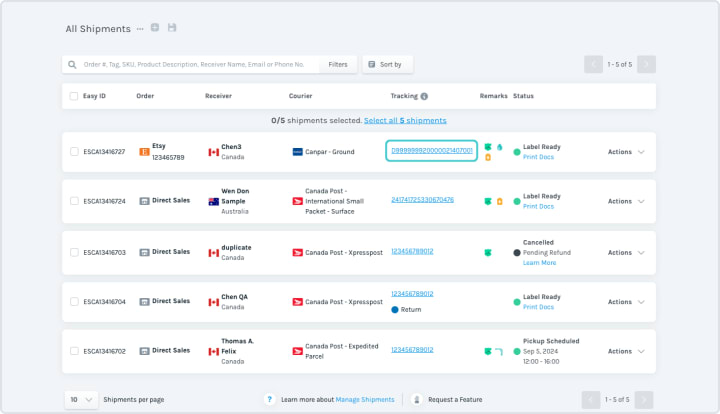
If many of your orders go across borders, Easyship removes much of the hassle that often comes with international shipping.
4. Shippo
Shippo has a user-friendly dashboard and a flexible API. Smaller teams can use the dashboard to buy labels, while larger or more technical teams can connect the API to their order process.
Key advantages include:
- Multi carrier rate shopping
- A developer friendly API for custom setups
- Straightforward, scalable pricing
Shippo is a good choice for teams that need flexibility. You can start with the basics and build a more customized shipping system as your business grows.
5. ShipHero
ShipHero is made for brands that run their own warehouses or need more advanced operations. It offers warehouse management features like bin locations, barcode scanning, pick path optimization, and inventory audits, along with shipping tools.
ShipHero is more complex than basic shipping software, but it’s very effective for growing ecommerce brands with large internal logistics needs.
6. Ordoro
Ordoro is a solid middle ground between simple shipping tools and full warehouse software. It combines shipping labels, inventory management, dropship routing, and product kitting in one platform.
It’s often used by subscription box companies, multi-supplier operations, and brands that want more advanced features without moving up to enterprise-level systems.
7. ClickPost
ClickPost is a fast-growing logistics platform popular in emerging ecommerce markets. It focuses on automation, multi-carrier routing, branded tracking pages, and delivery performance analytics.
It’s a good fit for companies that want to improve last-mile delivery and manage multiple carriers with little manual work.
Which shipping software should you choose in 2026
If you sell on several channels, ship many orders daily, and want software that can grow with your business, Veeqo is the best overall choice for 2026. It brings together the main parts of ecommerce operations and helps fulfillment teams avoid common problems as they expand.
Pick ShipStation if you mainly need carrier management. Go with Easyship for international shipping. Choose Shippo for API control. Use ShipHero if you run a large warehouse. Select Ordoro for multi-supplier or dropship-heavy businesses. Choose ClickPost for advanced logistics analytics and orchestration.
But for the majority of fast-growing ecommerce businesses, Veeqo gives you the best mix of features, simplicity, and operational benefits.