
This post was originally published on this site.

- U.S. investors aren’t abandoning U.S assets, but more money has been flowing to international markets, and not just stocks but emerging markets credit, among other fixed-income strategies.
- Concentration in U.S. equities, rising volatility, a weak dollar, and recent hot performance for asset classes like emerging markets bonds, are all pushing portfolios to become broader in holdings across both stocks and bonds.
- Trading experts appearing on this week’s “ETF Edge” said big changes are in store for bond portfolios, whether in the U.S. or overseas holdings.

Amid recent debate over the so-called “Sell America” trade and capital rotating out of U.S. markets, foreign stocks have received most of the attention. But international bonds, especially emerging market bonds, have also been riding high.
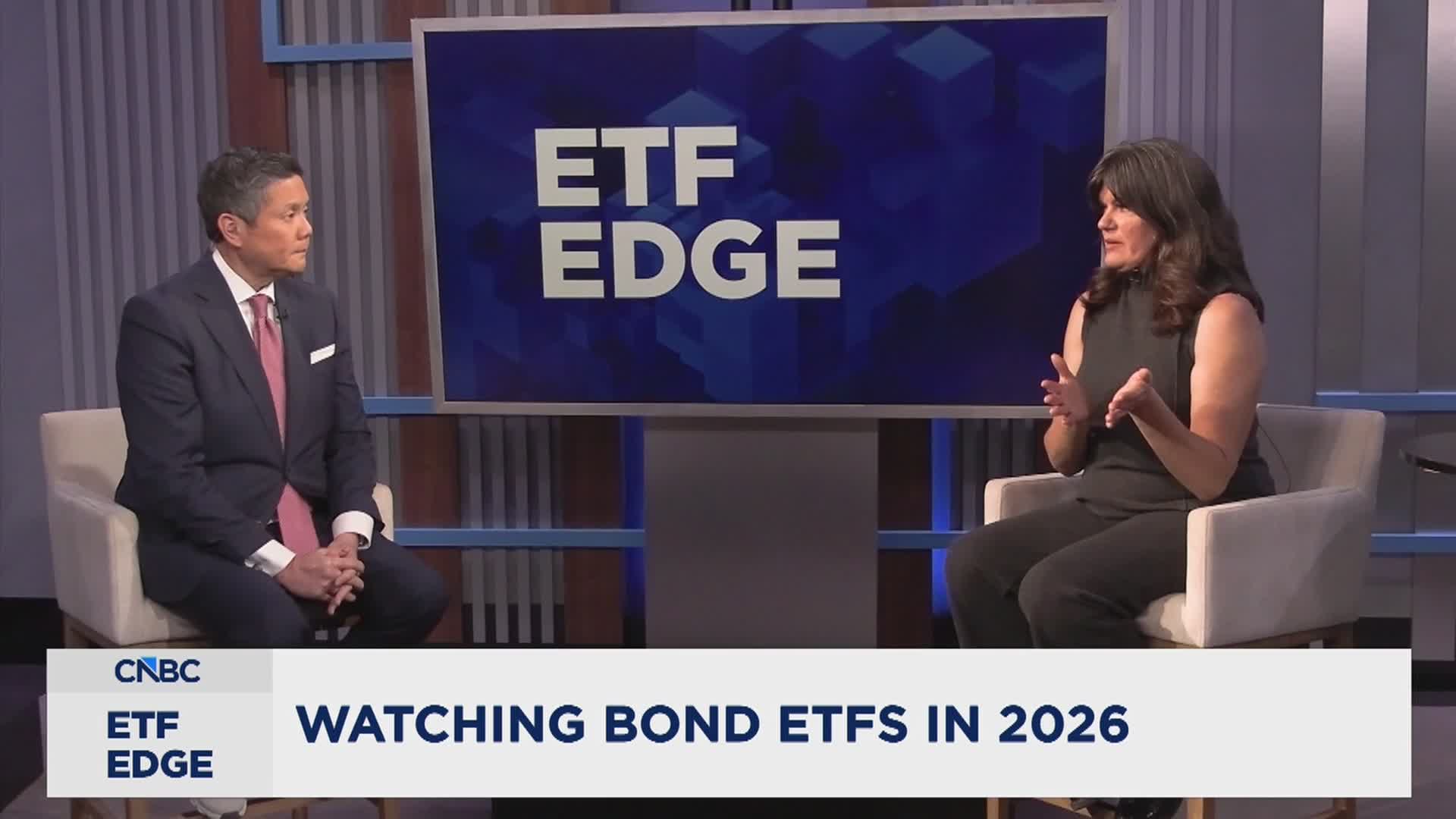
“The best performing area in fixed income year to date, and also last year, was emerging markets,” said Joanna Gallegos, co-founder of fixed-income ETF company BondBloxx on this week’s CNBC “ETF Edge.”
As an example, the iShares JPMorgan USD Emerging Markets Bond ETF (EMB) generated over a 13% return in 2025. BondBloxx’s JP Morgan USD Emerging Markets 1-10 Year Bond ETF (XEMD) had a similar 2025.
Weakness in the U.S. dollar, concerns about the fiscal health of the U.S. at a time of high spending and deficits, and the investing impact of President Trump’s foreign policy, plus the recent performance trends, are all contributing to more interest from investors to diversify internationally.
But for Gallegos, it start with the currency and performance chasing rather than a view that the U.S. is losing favor as a market. “The dollar pressure is putting more of a view on non-U.S. assets,” Gallegos said. “I think people are just seeing the returns from last year and looking for a way to take advantage of those opportunities more so than anything else,” she said. “The U.S. trade is not going away,” she added.

Morningstar data for the month of January backs up the view that U.S. investors are not abandoning the domestic market, whether it is stocks or bonds being debated and even as more assets move overseas.
U.S. market ETFs brought in an estimated $156 billion of net inflows in January, which was the best January ever, according to Morningstar. But investors also added $51 billion in net positive flows to international equity ETFs, which was a monthly record for that category. And taxable bond ETFs popped, with $46 billion from investors in net inflows for the month, led by Vanguard Total Bond Market ETF (BND) and the Vanguard Intermediate-Term Corporate Bond ETF (VCIT).
Despite fears about a private credit bubble, the U.S. continues to offer “the strongest fixed income market,” according to Gallegos, and “the biggest opportunity set for the world to continue to invest in it.”
Investors are expanding their portfolios and adding new sources of return while keeping U.S. assets at the core. “I think we still see resilient economy,” Gallegos said, pointing to steady earnings and a strong corporate balance sheet. In the bond market, specifically, she said, “the yield curve looks like it’s steepening, behaving appropriately, with rates on the long end being higher than the rates on the shorter end.”
Todd Sohn, technical strategist at Strategas Securities, said on “ETF Edge” that the scale of potential change on the fixed-income side of the portfolio is even larger than what is happening with equity assets, but it is not necessarily an international-first story. Money market funds have dominated flows for the past few years, with “trillion in assets” sitting on the sidelines as cash accounts have generated decent returns with no risk. But as central bank interest rates begin to drift lower, Sohn says more capital will move into the credit markets and bonds. “That money is going to get deployed to fixed-income products,” he said.
Gallegos says investors no longer need to stretch as far for yield. She highlighted investment-grade credit, and in particular, investors seizing the opportunity to move “out on the rate spectrum to BBB,” where yields are higher but default risk remains historically low. And she emphasized that bonds are no longer solely a defensive tool. “Bonds are not just necessarily the safety part of your portfolio, but also the opportunity and the income set as well,” Gallegos said.