
This post was originally published on this site.
America’s War Chest in Waiting
Washington’s new tool of statecraft is a $200 billion checkbook.

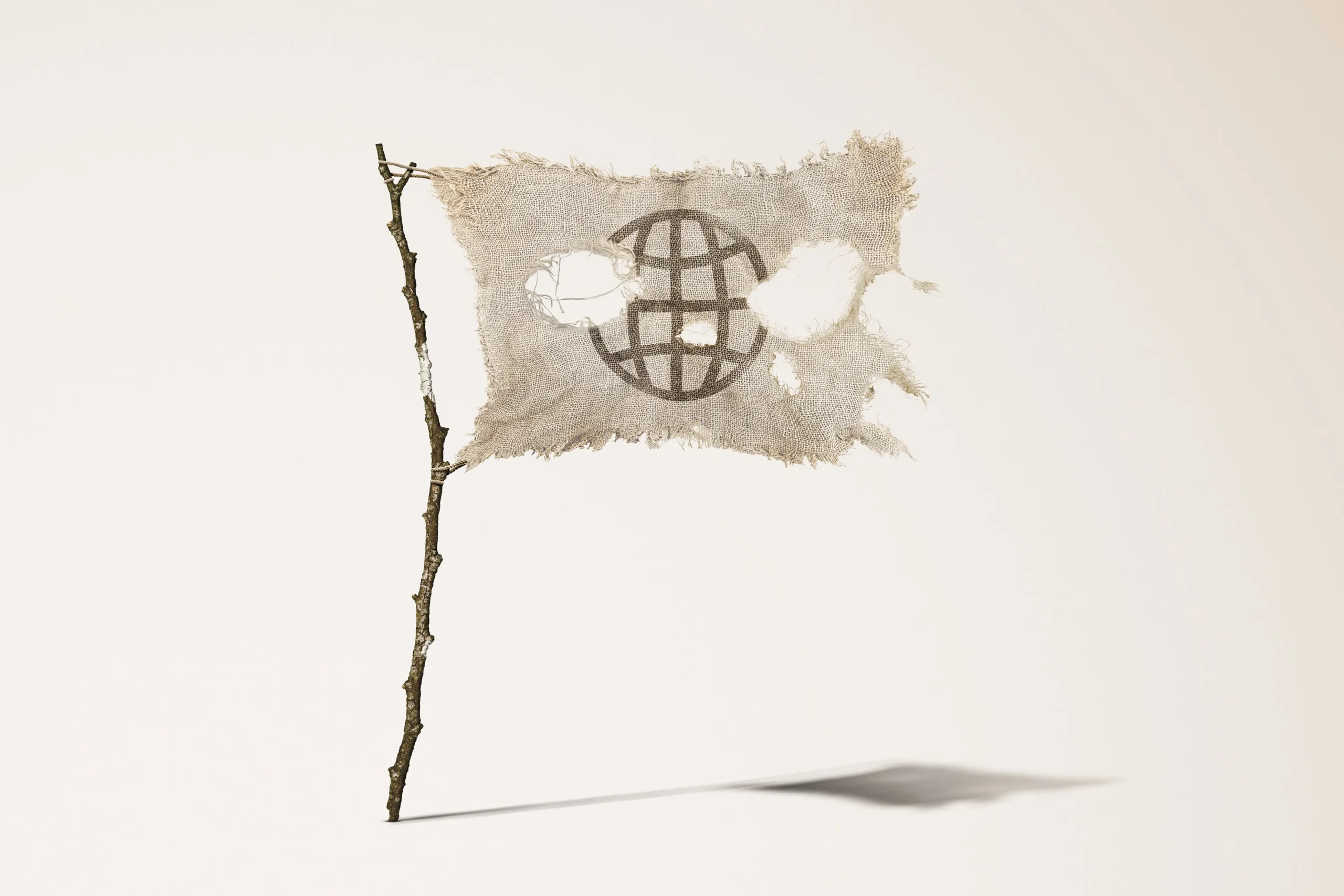
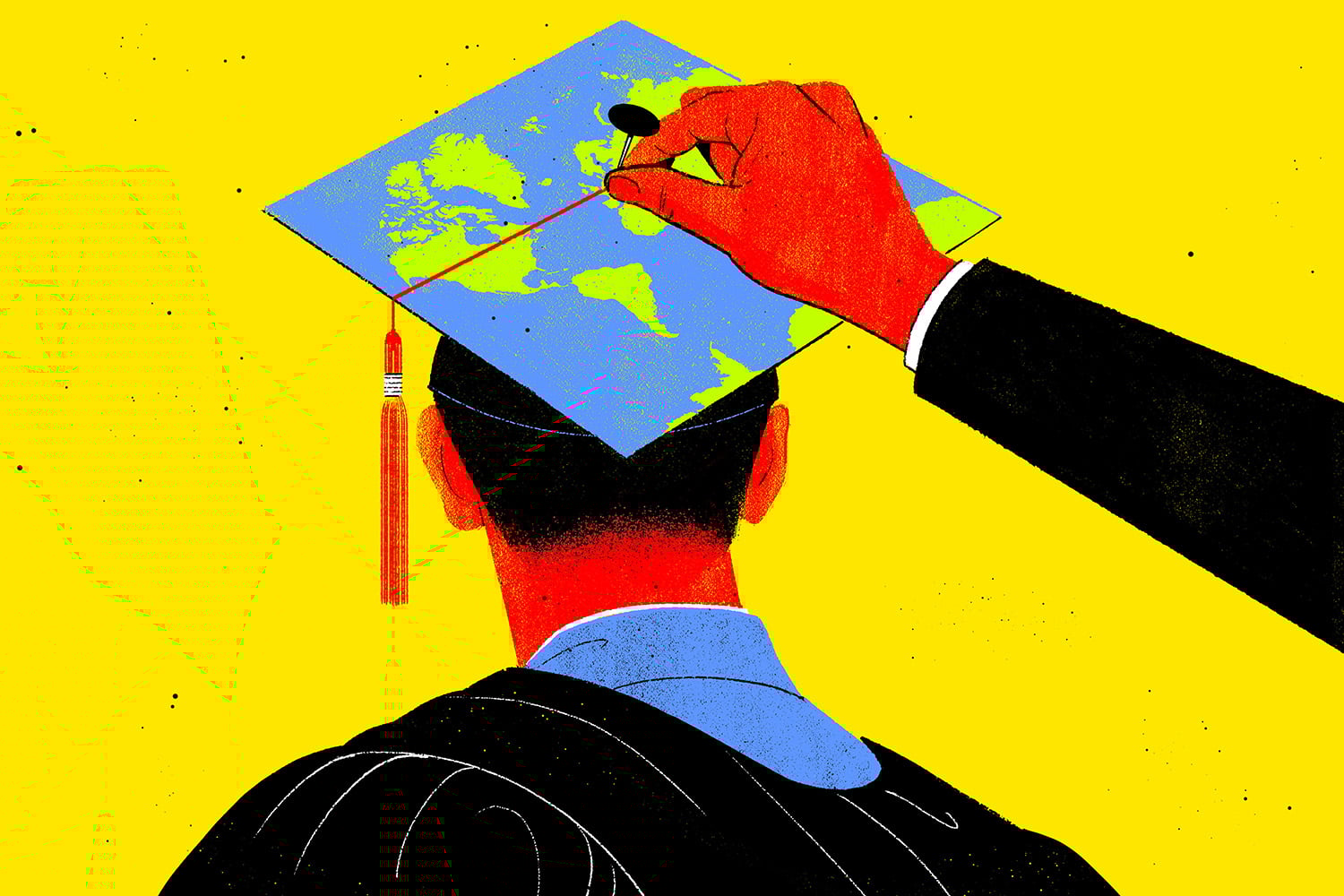
Mona Eing & Michael Meissner illustration for Foreign Policy
The abduction of a foreign head of state could be considered an act of war. In Washington, it became an opening bid. After the dramatic kidnapping of Venezuelan President Nicolás Maduro, U.S. President Donald Trump and his administration made clear that U.S. energy companies would reenter Venezuela to harvest its oil, supporting company profits and Venezuelan government revenues. While oil and gas executives have been wary to commit to major investment, the U.S. government has a newly reinvigorated tool that could help facilitate an agreement.
Last month, Congress laid the groundwork to build a massive foreign investment bank, even though the move got little coverage. The 2026 National Defense Authorization Act, passed in December 2025, authorized the little-known Development Finance Corporation to invest up to $205 billion of public dollars to support projects aligned with U.S. foreign-policy and national security interests. By contrast, the U.S. Agency for International Development (USAID) budget, before the Trump administration’s efforts to gut it, was roughly $35 billion.
The abduction of a foreign head of state could be considered an act of war. In Washington, it became an opening bid. After the dramatic kidnapping of Venezuelan President Nicolás Maduro, U.S. President Donald Trump and his administration made clear that U.S. energy companies would reenter Venezuela to harvest its oil, supporting company profits and Venezuelan government revenues. While oil and gas executives have been wary to commit to major investment, the U.S. government has a newly reinvigorated tool that could help facilitate an agreement.
Last month, Congress laid the groundwork to build a massive foreign investment bank, even though the move got little coverage. The 2026 National Defense Authorization Act, passed in December 2025, authorized the little-known Development Finance Corporation to invest up to $205 billion of public dollars to support projects aligned with U.S. foreign-policy and national security interests. By contrast, the U.S. Agency for International Development (USAID) budget, before the Trump administration’s efforts to gut it, was roughly $35 billion.
The Development Finance Corporation, or DFC, was created during the first Trump administration with bipartisan support and a narrow mission: use public financing to speed the development of emerging economies. The December reauthorization expands that mandate dramatically, turning development finance into a flexible instrument of statecraft meant to advance U.S. foreign policy and strengthen national security more broadly.
That expansion lands in a moment of genuine danger. This White House has shown an extraordinary willingness to treat public power as private leverage, an approach to governing that could be called “rule by deal.” The same state capital that can strengthen supply chains or backstop allied production of critical minerals and energy resources can also be weaponized by this administration. A newly enlarged DFC could be coercive—toppling foreign leaders, rewarding client regimes, or building an international order defined by domination rather than law.
In Venezuela, the DFC could, in theory, underwrite projects that private firms might avoid with their own capital, such as pipeline repairs, storage upgrades, oil field services. That might advance the administration’s foreign-policy objectives, but it also creates obvious openings for political patronage. The danger is not public investment itself. It is who controls it and to what ends.
For those of us who believe that public institutions can be useful in guiding markets, the answer is not to discard or weaken these institutions. Under different leadership, the same capacity could strengthen allied economies by investing in future growth industries such as clean energy, or by ensuring that critical mineral supply chains are not monopolized by authoritarian competitors.
Instead, we must strengthen democratic accountability to prevent misuse of the DFC now and in the future, at the same time that we expand it. Political risk alone is not a reason to renounce public investment. It is a reason to demand structures of effective accountability.
Despite the potential for abuse, the expansion of the DFC’s authority and size stands to enhance U.S. foreign policy if proper accountability mechanisms are put in place. An agency created to encourage American businesses to invest in frontier markets has the potential to become an institution steering strategic industries worldwide. Public capital deployed by the DFC will be used to build resilient supply chains, support allied manufacturing capacity, and prevent Chinese dominance of critical industries—all goals supported by Democrats and Republicans alike.
Before this legislation, the DFC could finance a lithium processing facility in Argentina but not in Australia, even though Australia possesses some of the world’s largest lithium reserves and is a close ally with whom the United States shares intelligence. It could support semiconductor packaging in Vietnam but could not pursue comparable investments in Japan or South Korea. Those geographic limitations forced U.S. development finance into an awkward posture: free to operate in developing countries where the strategic opportunities were often limited, but constrained from working in allied nations where investment might yield the greatest returns.
The new law enables investment in the Five Eyes group of intelligence-sharing nations—Australia, Canada, New Zealand, and the United Kingdom—nearly without restriction, and it permits investment in other wealthy countries only for projects involving energy, critical minerals, rare earths, and information and communications technology, including undersea cables. Investments in wealthy countries cannot exceed 10 percent of total DFC liability, or roughly $20 billion.
While the new DFC is larger and more powerful, it still faces meaningful constraints. The new legislation did not fully address the challenges around the DFC’s ability to make equity investments, which allow the agency to take risk and shape outcomes in ways that loans cannot. Equity can give the DFC more sway in corporate governance, access to information, and the ability to steer how ventures develop over time.
The legislation preserves the 35 percent cap on total equity investments that the 2018 authorization established, but existing government accounting methods still penalize equity relative to loans. To mitigate that problem, the law created a $5 billion equity revolving fund to enable the DFC to recycle realized gains into future investments without returning to Congress for appropriations. That shiny new $5 billion bucket, however, is empty. The real question is whether Congress funds it—and how quickly.
We know from the success of other countries that a foreign investment bank can significantly strengthen a nation’s ability to pursue its foreign policy. The clearest precedent for the successful strategic use of public capital is China. The China Development Bank and the Export-Import Bank of China collectively hold assets exceeding $2 trillion and serve as the financial backbone of the Belt and Road Initiative. They take equity positions, structure complex transactions, and build long-term relationships that advance Chinese strategic interests.
It’s not only the Chinese who have proved the model. Germany’s KfW, originally established as the Kreditanstalt für Wiederaufbau for postwar reconstruction, has evolved into one of the world’s largest national investment banks, using its capital to power the clean energy transition and for strategic industrial investments. The European Investment Bank serves a similar function across the European Union, as does Singapore’s Temasek.
For years, American policymakers lamented the lack of U.S. investment firepower. China deployed patient capital as a tool of statecraft while the United States relied on aid programs, technical assistance, and rhetorical commitments to a “rules-based order.” In 2023, then-Sen. Marco Rubio echoed a line that the left-leaning economist Larry Summers had coined, saying that many recipients of U.S. assistance complain that “working with China means we get an airport, while working with the United States means we get a lecture.” An empowered DFC could change that—but at the same time, Washington also needs to prevent it from becoming a Trump slush fund.
Congress will need to continue to appropriate funds for the DFC to pursue its mission. When it next does so, those dollars should come with clearer strings attached.
First, Congress should prohibit DFC financing for projects that directly and meaningfully benefit the president; vice president; cabinet officials; and their immediate family members, business partners, and controlled entities. We can no longer rely on the integrity of the occupant of the White House to ensure fair dealing, so the law must explicitly ban the DFC from pursuing investments that could stand to significantly benefit anyone in the administration personally.
Congress should also strengthen the structures of DFC oversight. The existing DFC inspector general should be appropriately funded and shielded from presidential interference. The Government Accountability Office should be required to conduct routine audits of the largest DFC transactions, and its chief executive officer should regularly testify before Congress to ensure accountability. Whistleblowers should also be explicitly protected. If the Supreme Court does not overrule Humphrey’s Executor v. the United States and allows for cause protection to endure, then Congress might create a protected board of governors, similar to the structure of the Federal Reserve.
Even with these changes, the DFC relies on the foundational functioning of the democratic ecosystem around it. Sustained congressional scrutiny, independent courts, aggressive investigative journalism, and competitive elections must be durable counterweights to an executive branch that may be tempted to direct public dollars to personal or political advantage.
With appropriate measures in place to rein in corruption, the recent bipartisan embrace of public investment as a tool of statecraft should not stop at the border.
If equity authority makes sense for critical minerals projects in Australia, then it makes equal sense for similar projects in Arizona. An administration and a Congress willing to triple the DFC’s investment authority and expand its geographic mandate to include wealthy allies should be willing to complete the work by authorizing domestic deployment—while building stronger safeguards from the start.
The country has precedent for a U.S.-focused institution of this nature. The Reconstruction Finance Corporation (RFC), established in 1932 and dramatically expanded under President Franklin Roosevelt, operated for two decades as the United States’ national investment bank. It rescued failing banks during the Great Depression, spurred the reinvigoration of industrial and housing investment, and financed the industrial mobilization that enabled the United States to win World War II. The RFC and its affiliates constructed synthetic rubber plants when Japan severed access to natural supplies, built aluminum smelters when aircraft production demanded them, and helped transition automobile manufacturers to produce tens of thousands of planes a year.
The RFC was liquidated in the early 1950s, a casualty of postwar confidence that public investment capital was no longer needed to build a resilient domestic economy. That myth persisted for decades, even as crises mounted and state-backed competitors abroad proved how powerfully public capital can shape markets.
The expanded DFC is part of a shift on the left and right toward an approach to political economy that acknowledges that U.S. political goals can often be advanced through public investment that crafts markets. The question now is whether Congress will pair that power with the democratic constraints to make it resilient and legitimate in the long term.
Chris Hughes is the author of Marketcrafters: The 100-Year Struggle to Shape the American Economy and the chair of the Economic Security Project.
Read More
-

A man in the foreground bends over construction equipment he is using to renovate a section of railroad while his coworker looks on in the background in a isolated and forested area of Gabon. Congress Aims to Turbocharge the U.S. Development Finance Corporation
The agency will be empowered to issue hundreds of billions of dollars in new loans to foreign countries.
-
The End of Development
The West’s aid model was always a mirage. It’s time for a realistic alternative.
Stories Readers Liked
-

An illustration with Donald Trump listening as Marco Rubio leans in with a hand cupped to whisper in Trump’s ear. Around the circular images are headshots of four men and one woman. -

A lone soldier in combat fatigues is seen from behind as he walks through a barren forest at dusk, surrounded by splintered, leafless tree trunks, with most of their branches blown off. -

A man is silhouetted from behind in front of a bright window as he walks down a dark, empty hallway. -
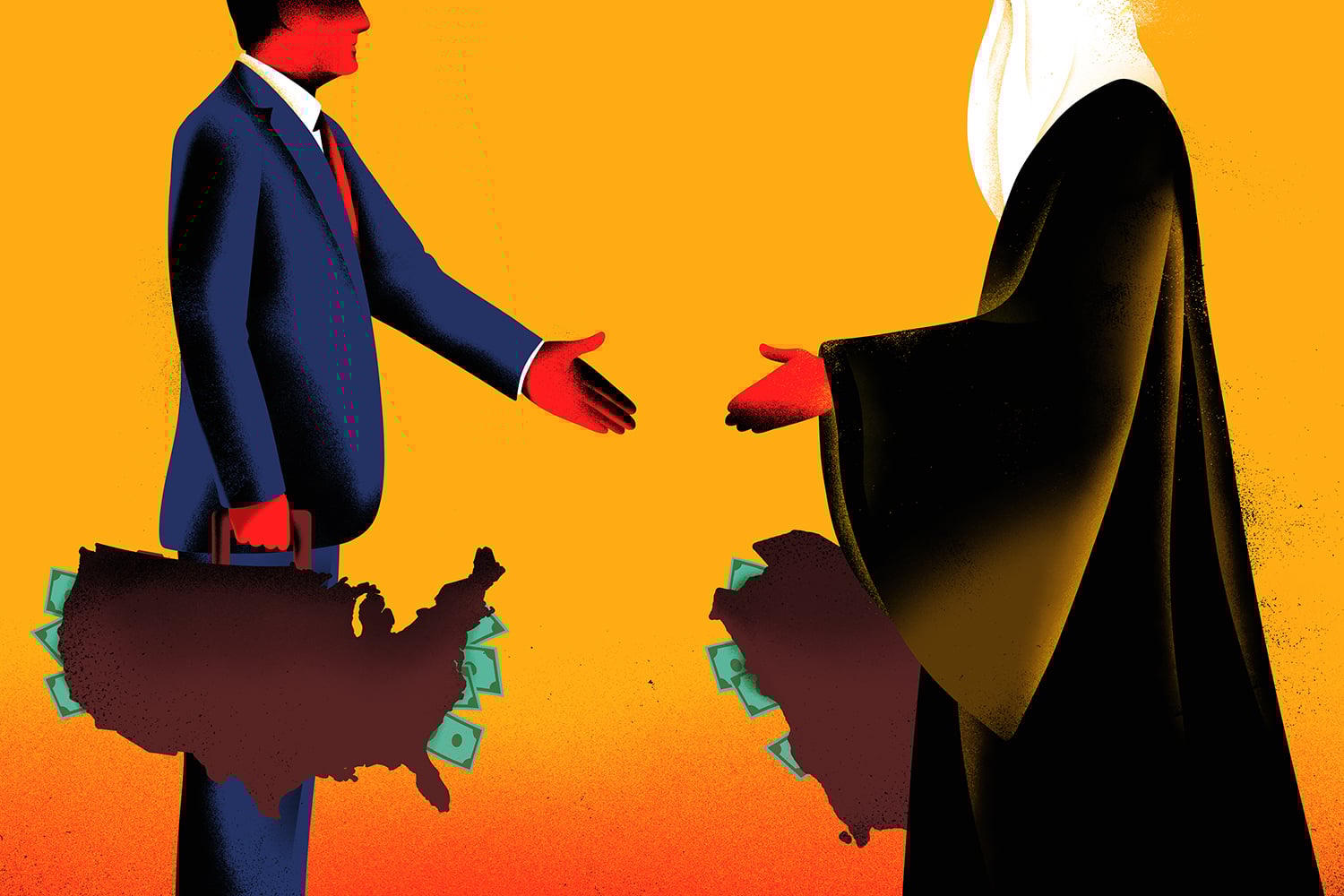
An illustration shows two men against a bright yellow background. One man wears a Western-style business suit and the other wears a black robe and white head covering. The men are shaking hands. Each holds a briefcase with money spilling out, the left man’s briefcase shaped like the United States’ and the right man’s like the Arabian Peninsula. -
A man in a coat outside of a glass office building, with high rise buildings under construction in the background. -
An illustration shows the seal of the United Nations with a shadow across it. Laurel leaves fall onto the ground from the seal as a person sweeps them up. -

us-restraint-realism-europe-military-withdrawal-mark-harris-illustration -

A silhouetted figure with a military hat is seen in front of a high red wall at night. -
An illustration shows the back of a person wearing a graduation cap with a globe motif on it. A hand reaches in to move a locator pin on the top of the cap/map. -

Photos of two men speaking each shown as a negative color inside a red and blue circle.
U.S. Strikes in Venezuela
5 Unanswered Questions About Trump’s Venezuela Plan
Maduro’s exit doesn’t mean the end of his regime. 
-
A woman and man walk with three children, one on the man’s shoulders, past a row of armored military vehicles with soldiers in combat gear. The children carry backpacks. Palm trees are seen in the distance. -
Venezuelan Vice President Delcy Rodríguez exits the stage after addressing the United Nations General Assembly at U.N. headquarters in New York City on Sept. 27, 2019. -
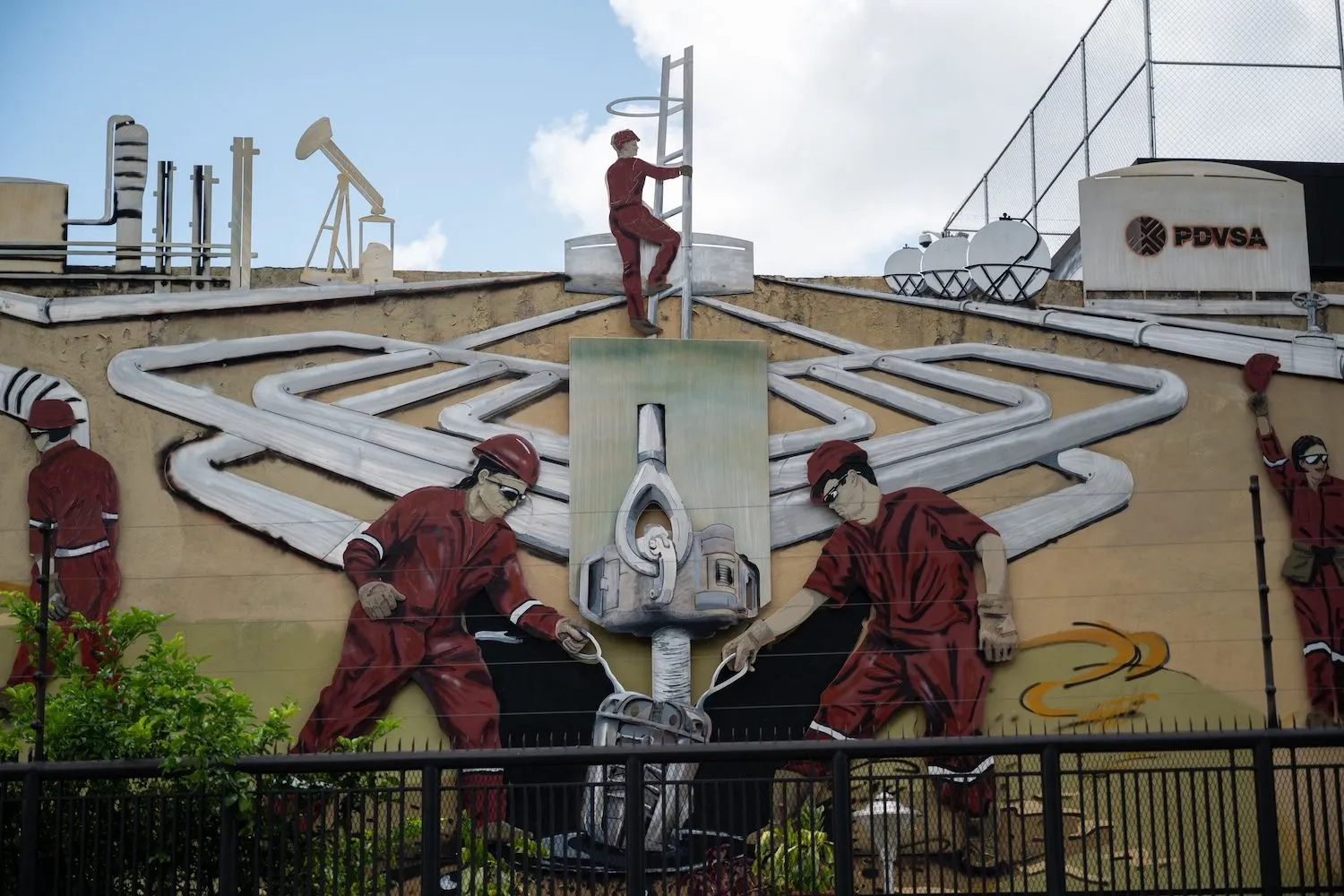
A mural at the PDVSA headquarters shows men working at Venezuela’s oil refineries, in Caracas, on September 13, 2023.
Join the Conversation
Commenting is a benefit of a Foreign Policy subscription.
Subscribe
Subscribe
Already a subscriber?
.
View Comments
Join the Conversation
Join the conversation on this and other recent Foreign Policy articles when you subscribe now.
Subscribe
Subscribe
Not your account?
View Comments
Join the Conversation
Please follow our comment guidelines, stay on topic, and be civil, courteous, and respectful of others’ beliefs.
View Comments
Change your username |
Log out
Change your username:
CANCEL
Confirm your username to get started.
The default username below has been generated using the first name and last initial on your FP subscriber account. Usernames may be updated at any time and must not contain inappropriate or offensive language.