…advancing AI frameworks for mainstream retailers like Walmart, Shopify, Amazon et al
Every major tech wave sees a move to standards after the early rush by key players to stake their custom claims on a new core technology. This AI Tech Wave is no different,
As expected, tech/AI companies are continuing to move AI tech interoperability standards and frameworks forward to better integrate AI technologies with mainstream AI applications and services across industries.
Now Google is advancing new open AI/Commerce standards with a host of retailers like Walmart, Shopify and others, that could accelerate AI in online retaling in this AI Tech Wave going forward.
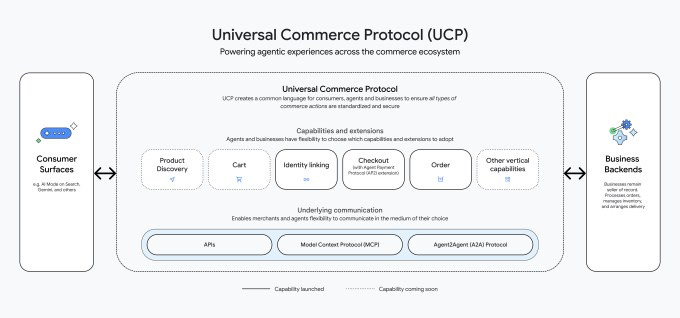
“Google today announced a new open standard, called the Universal Commerce Protocol (UCP) for AI agent-based shopping, at the National Retail Federation (NRF) conference.”
“The standard, developed with companies like Shopify, Etsy, Wayfair, Target, and Walmart, lets agents work across different parts of customer buying processes, including discovery and post-purchase support. The core idea is that the standard could facilitate these various parts of the process instead of requiring connections with different agents.”
“Google said that it also works with other agentic protocols, such as Agent Payments Protocol (AP2) — which Google announced last year — Agent2Agent (A2A), and Model Context Protocol (MCP). The company specified that Agents and Businesses can pick and choose specific extensions of the protocol that suits their needs.”
Of course Google plans on leveraging these open standards for its Gemini driven services using AI Agents:
“The company said that it will soon use UCP for eligible Google product listings in AI mode in search and the Gemini apps to let shoppers check out directly from U.S.-based retailers while researching a product. Users will be able to pay using Google Pay and pass on the shipping information saved in the Google Wallet. Google said that it will soon support PayPal as a payment option.”
Retailers and ecommerce companies are leaning in for their own requirements:
“This is one of the really exciting parts about agentic,” said Shopify CEO and founder Tobi Lutke. “It’s really good at finding people who have specific interests and finding the product that is just perfect for them. Like, I would have never searched for this product, but somehow it found me right on the other side. This kind of serendipity is where the best of commerce happens.”
“Notably, Shopify also unveiled a similar integration with Microsoft Copilot for shopping today to let customers check out easily within the conversational flow.”
Microsoft is also focused on AI tools to help developers advance these types of AI agentic innovations.
These AI agentic services could allow new types of ecommerce services beyond the ones mainstream users do at Amazon and other retailers.
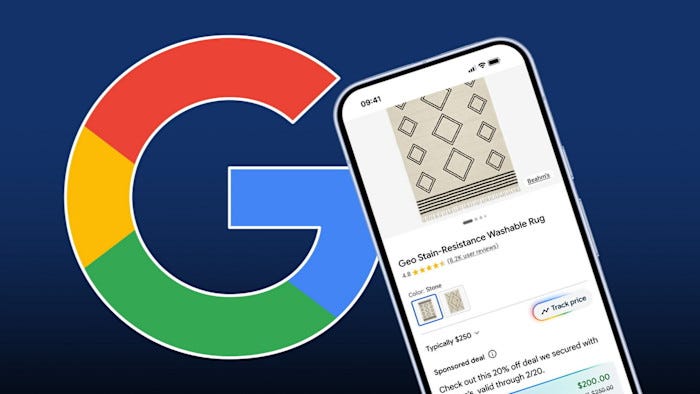
“In another consumer-facing change, Google said it will now allow brands to offer a special discount to users while they are looking for a product recommendation when using the AI mode. For instance, if you are searching for a rug using a query like “I’m looking for a modern, stylish rug for a high-traffic dining room. I host a lot of dinner parties, so I want something that is easy to clean,” brands can set up their campaign in a way to offer you a discount at that moment.”
“The company is also giving users new data attributes within the Merchant Center to have sellers feature their items better within AI search surfaces. Companies like PayPal and OpenAI are also working on having sellers be more discoverable in AI chatbot results. Startups like the prompting company are also working with merchants to have their products surface within AI answers.”
For Google, these efforts broaden and deepen Google Search into ecommerce:
“Google is now also allowing merchants to integrate a branded AI-powered Business Agent within Google Search to answer customer questions. The company noted that merchants like Lowe’s, Michael’s, Poshmark, and Reebok are already using this product. Competitors like Meta and Shopify have beenexploring AI-powered tools for businesses for customer support and outreach.”
“The search giant also announced Gemini Enterprise for Customer Experience (CX), a suite to handle shopping and customer service for retailers and restaurants.”
“Companies like Google, Amazon, Walmart, and OpenAI have been releasing new standards and products to infuse AI into every bit of shopping, both on the consumer and merchant side. Earlier in the month, Adobe noted that traffic driven to seller sites by generative AI grew by 693.4% during the holiday season, though the report didn’t specify how much of this traffic translated into sales.”
Google also plans AI tools around these standards and frameworks for its advertiser customers.
Axios provide useful additional context around the retailer dynamics with parties like Walmart, Shopify and others in particular.
All these standards, frameworks, and integration deals advance AI ecommerce distribution into the mainstream this AI Tech Wave. And allow new innovations in AI driven shopping experiences going forward. Stay tuned.
(NOTE: The discussions here are for information purposes only, and not meant as investment advice at any time. Thanks for joining us here)