
This post was originally published on this site.
Leaders in Wisconsin agriculture are warning the state’s farmers to brace for another tough year for trade and market conditions.
The discussion at the annual Wisconsin Agricultural Outlook Forum at the University of Wisconsin-Madison focused both on the economic hardships weighing on farmers and what some producers are doing to try to get ahead.
Trade disputes and rapidly changing tariffs brought by President Donald Trump’s administration last year created tremendous uncertainty for agriculture, according to Steve Deller, a professor of ag economics at UW-Madison.
News with a little more humanity
WPR’s “Wisconsin Today” newsletter keeps you connected to the state you love without feeling overwhelmed. No paywall. No agenda. No corporate filter.
He said that has set farmers up for another difficult year.
“It’s undermining confidence in terms of prices for both exports and imported inputs,” Deller said at the forum. “We’re not sure what the prices are going to be because we don’t know what are the tariffs, and then how much of those tariffs are going to be passed down to the consumer, the farmer or the food processors.”
Deller said during times of economic uncertainty, both businesses and consumers tend to shy away from taking on financial risks. He worries that could end up affecting farmers’ ability to access loans in the coming year.
“Farming is highly dependent on access to credit,” Deller said. “If there’s a lot of uncertainty in what’s happening to prices and export markets, bankers are going to start to get a little bit more conservative.”
Corn and soybean producers are once again expected to have negative operating margins in the coming year.
Paul Mitchell, another ag economics professor at UW-Madison, shared that Wisconsin corn growers are expected to lose $1.50 per acre on the crop that will be planted this spring. The state’s soybean producers are projected to lose $3.40 per acre in 2026, with both projections accounting the cost of land and managing the crop from planting to harvest.
“Cash flow has become a serious issue for many Wisconsin farms. You can really see that in the data,” Mitchell said at the event.
Farmers have received some help from the federal government to weather the tough economic conditions, including the $12 billion Farmer Bridge Assistance program that is expected to be paid out in March.
Mitchell said all the one-time, emergency relief programs that were paid out last year meant 2025 had the second highest amount of direct payments to farmers in U.S. history. Only in 2020, when COVID-19 caused huge disruptions to food supply chains, did farmers receive more assistance.
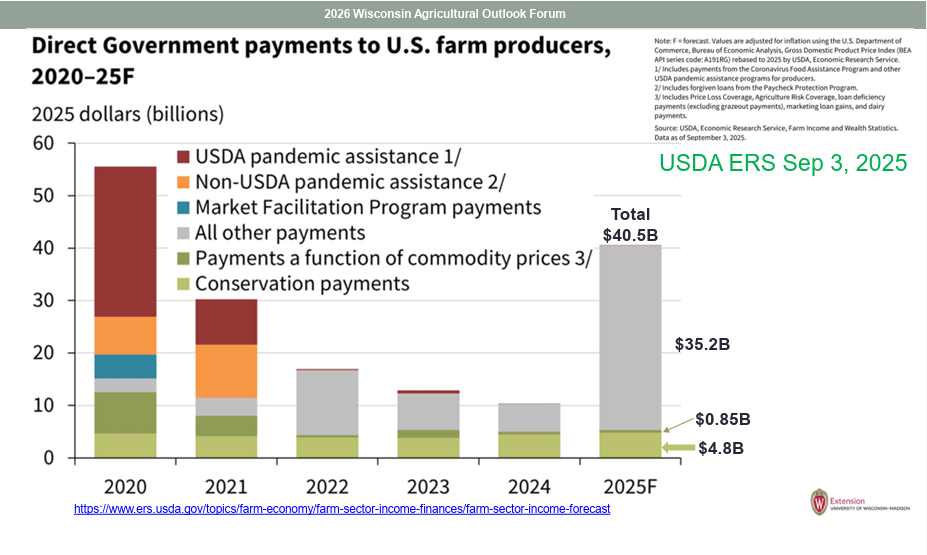
But Mitchell said during his presentation that this strategy comes at a cost.
“Government payments help, but they don’t solve this high cost, low price problem we’re facing,” he said. “I really think these programs are reducing the incentives to innovate and remain competitive. That’s my worry as an economist.”
The forum featured leaders from a variety of Wisconsin industries, including dairy, beef and specialty crops like ginseng.
Jeff Schwager, member of the state’s Wisconsin Agricultural Export Advisory Council and former CEO of Sartori Cheese, said the back-and-forth on tariffs in 2025 hasn’t ended the export of Wisconsin foods like cheese. But it has complicated sales for the state’s producers.
“People still want the product. But what they’re trying to do is get us to take the responsibility for any uncertainty so that they can continue to supply it,” Schwager said during the forum.
Schwager said Wisconsin producers need the federal government to successfully negotiate more trade agreements in 2026, especially with countries in Europe. He said it’s been an issue that has not been resolved under several different administrations, leaving American companies behind in world trade.
While relationships between the U.S. and other governments might be strained, several producers shared how they’re focused on building stronger individual relationships with overseas buyers.
That includes using social media and other digital connections to bring people onto Wisconsin farms.
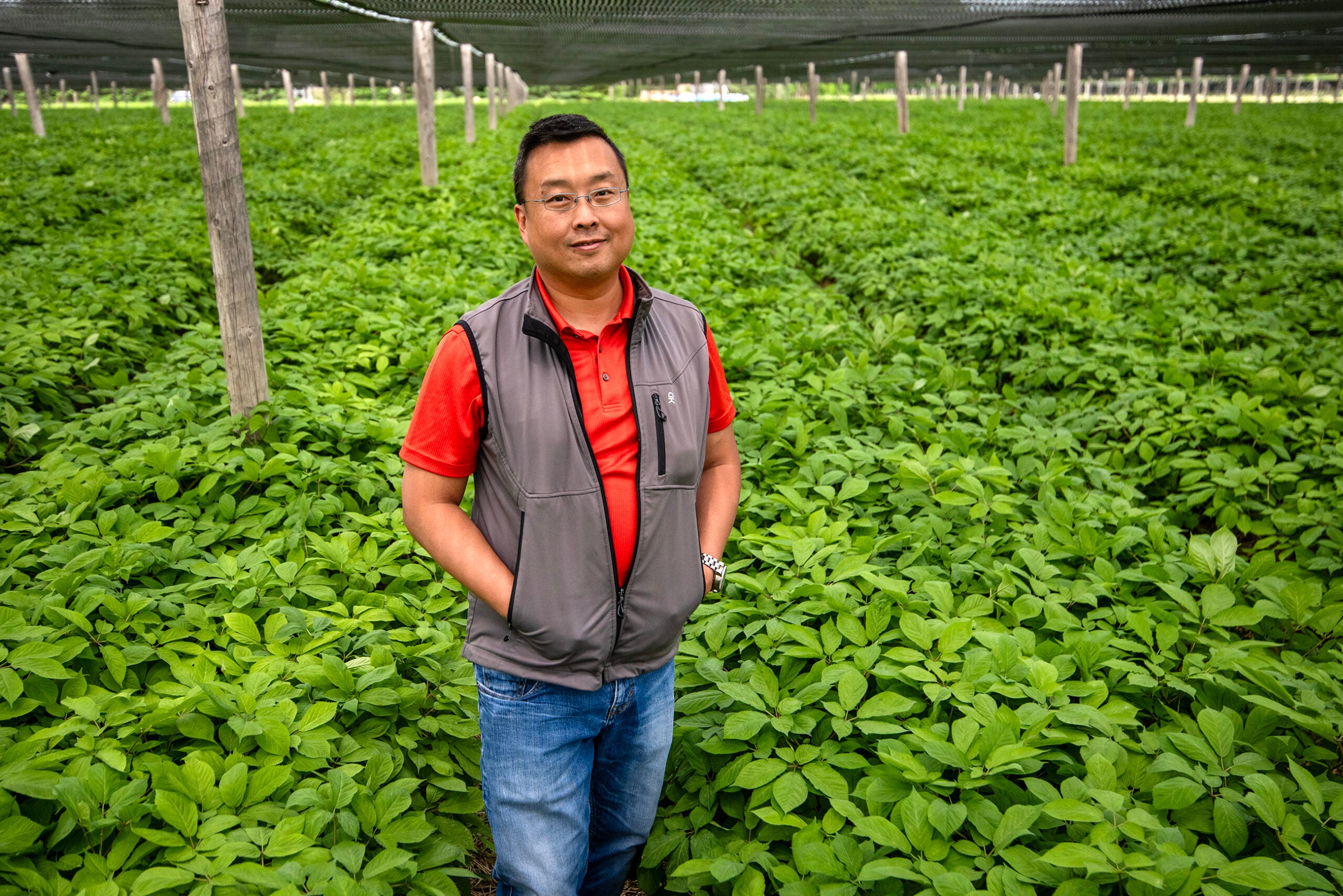
Will Hsu, owner of Hsu’s Ginseng Enterprises, said it’s been a key strategy for the state’s ginseng producers, who sell the majority of their crop to buyers in China, Taiwan and Hong Kong.
“(The Gingseng Board of Wisconsin is) filming videos with farmers in English, and then they’re having someone subtitle them in Mandarin so that people overseas can hear directly from the farmer,” Hsu said at the forum. “There’s millions of customers who are not going to come to the U.S., but they still want to know about this product. So they’re using social media and other channels to try to reach consumers.”
He said this kind of outreach is critical to convincing shoppers in other countries that it’s worth it to spend more on a product from Wisconsin.
Wisconsin Public Radio, © Copyright 2026, Board of Regents of the University of Wisconsin System and Wisconsin Educational Communications Board.